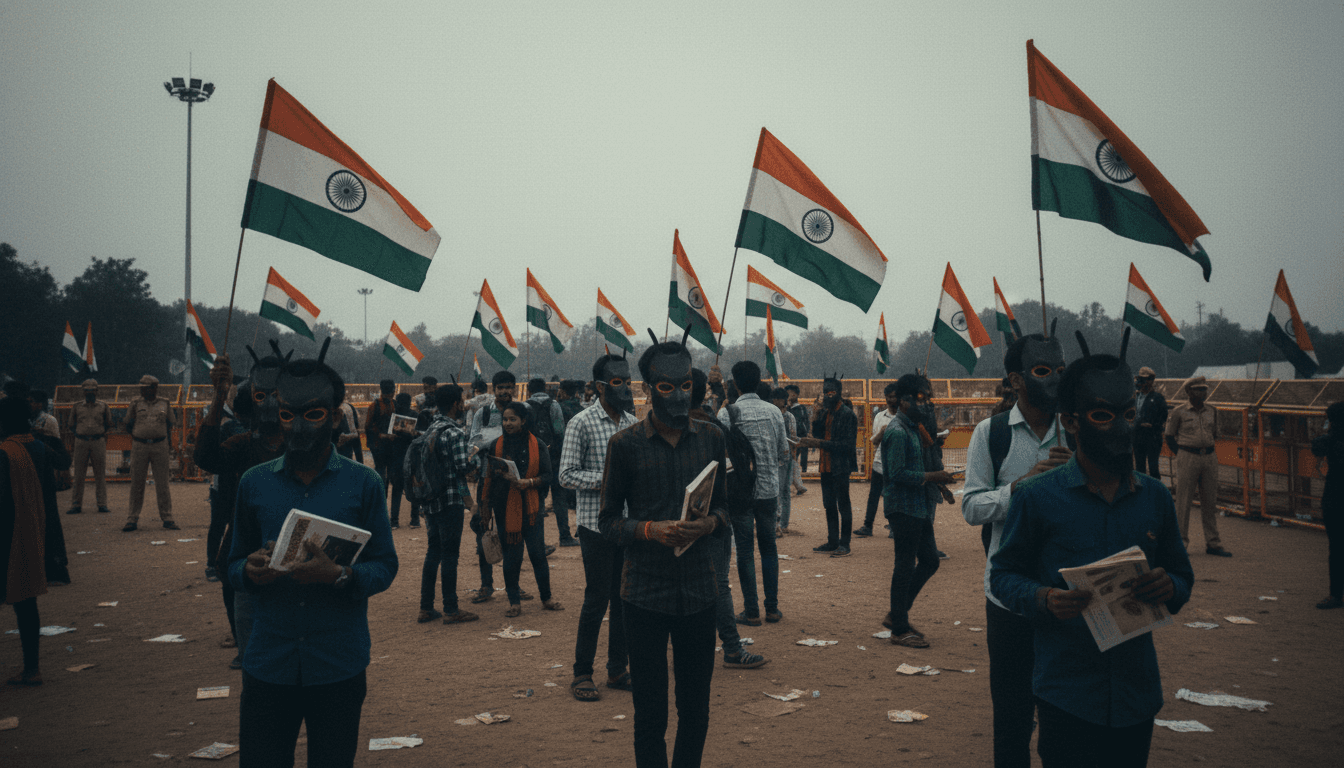
New Delhi witnessed a striking transformation on Saturday, June 6, 2026, as the ‘Cockroach Janta Party’ (CJP), a satirical online movement, successfully mobilized hundreds, and by some accounts, thousands of young supporters for a real-world protest. Many donned distinctive cockroach masks, gathering at Jantar Mantar to demand the resignation of Education Minister Dharmendra Pradhan. The demonstration, led by CJP founder Abhijeet Dipke, marked a significant escalation from digital dissent to tangible political action, shining a harsh spotlight on India’s education system and pressing issues of youth unemployment.
Cockroach Janta Party: From Satire to Street
The genesis of the Cockroach Janta Party is rooted in a controversial remark by Chief Justice of India Surya Kant on May 15, 2026. Justice Kant reportedly likened young critics of the government and those with fraudulent degrees to “cockroaches” and “parasites of society.” Abhijeet Dipke, a 30-year-old political communications strategist and Boston University student, seized upon this insult, founding the CJP on May 16, 2026. The name itself is a satirical play on the ruling Bharatiya Janata Party (BJP), turning a derogatory term into a rallying cry for a disillusioned youth. Rapidly gaining millions of online followers, particularly on Instagram, the CJP adopted the slogan “Voice of the Lazy & Unemployed.” Its website, launched concurrently, initially listed eligibility criteria as being unemployed, lazy, chronically online, and able to rant professionally, encapsulating the cynical humour that fueled its initial growth.
The immediate catalyst for Saturday’s large-scale protest was a confluence of alleged irregularities in the NEET-UG 2026 examination and concerns surrounding the Central Board of Secondary Education’s (CBSE) on-screen marking (OSM) system for Class 12 board examinations. Education Minister Dharmendra Pradhan has acknowledged the NEET-UG paper leak as “extremely unfortunate” and has assured strict action, with the Central Bureau of Investigation (CBI) actively probing the matter. A re-test for NEET-UG is scheduled for June 21, with Pradhan pledging it would be “100 percent error-free.” However, these assurances have not appeased the CJP, which continues to demand Pradhan’s immediate resignation.
Abhijeet Dipke, who previously volunteered with the Aam Aadmi Party’s social media team, arrived in New Delhi from the U.S. on the morning of the protest. He urged supporters to maintain peace, carry India’s national flag, and a book, symbolizing the right to education and equal opportunity. Police had heightened security at the airport and Jantar Mantar, deploying over 1,000 personnel and erecting barricades. While six individuals were preventively detained for attempting to create a disturbance, officials largely characterized the demonstration as peaceful, underscoring the organized nature of the CJP’s mobilization.
Impact on Governance and Youth Engagement
The rise of the Cockroach Janta Party and its successful mobilization for a physical protest marks a significant shift in the landscape of youth activism in India. It highlights the growing frustration among young people regarding education and job opportunities, issues that directly impact their economic future and social mobility. The CJP’s ability to translate online virality into real-world presence demonstrates a potent new model for political engagement, one that governments and established political parties will need to contend with. The visual spectacle of protestors in cockroach masks and the direct challenge to a government minister make this movement highly shareable and newsworthy, amplifying its message far beyond Jantar Mantar.
Beyond Pradhan’s resignation, the CJP’s demands extend to broader systemic changes, including proper training and assessment before the digitalization of education, and the normal functioning of education in Manipur, a state that has experienced unrest for three years. These demands underscore a comprehensive critique of current government policies and their implementation.
The movement has not been without its challenges. The CJP has faced significant pushback, including the temporary takedown of its website and the hacking of its Instagram accounts in late May, which Dipke attributed to government interference. Furthermore, the government has blocked the CJP’s X (formerly Twitter) account in India, a move the organization has challenged in court. Senior cabinet minister Kiren Rijiju has accused the group of seeking followers from Pakistan and the “anti-India gang,” attempting to delegitimize the movement by linking it to external and antagonistic forces.
“The Cockroach Janta Party’s emergence is a powerful indicator of how digital satire can coalesce into meaningful offline political action, challenging traditional power structures and amplifying grievances that resonate deeply with a young, often marginalized demographic.”
What’s Next for the Cockroach Janta Party?
The protest at Jantar Mantar represents a critical juncture for the Cockroach Janta Party. It has successfully tested its ability to translate online popularity into tangible grassroots support and political action. The coming weeks will determine if the CJP can sustain this momentum, maintain its unity in the face of government pressure, and further expand its reach beyond New Delhi. Future developments will likely include continued legal battles over social media blocking, potential further protests, and an intensified debate around education reforms and youth employment policies. Investors and businesses monitoring India’s political stability and consumer sentiment should pay close attention to the CJP’s trajectory, as its ability to mobilize and influence public discourse could have implications for policy direction and social cohesion.
Key Takeaway for Readers and Investors
The rise of the Cockroach Janta Party signifies a new era of youth activism in India, where digital platforms are potent tools for political mobilization. For investors, this movement highlights growing social discontent over education and unemployment, issues that can impact long-term economic stability and consumer confidence. The government’s response to the CJP’s demands and its handling of youth grievances will be crucial in shaping the political landscape and public sentiment in the coming months. The CJP’s journey from satirical online content to a significant real-world protest underscores the evolving nature of dissent and the increasing power of digitally-native movements to challenge established political norms.