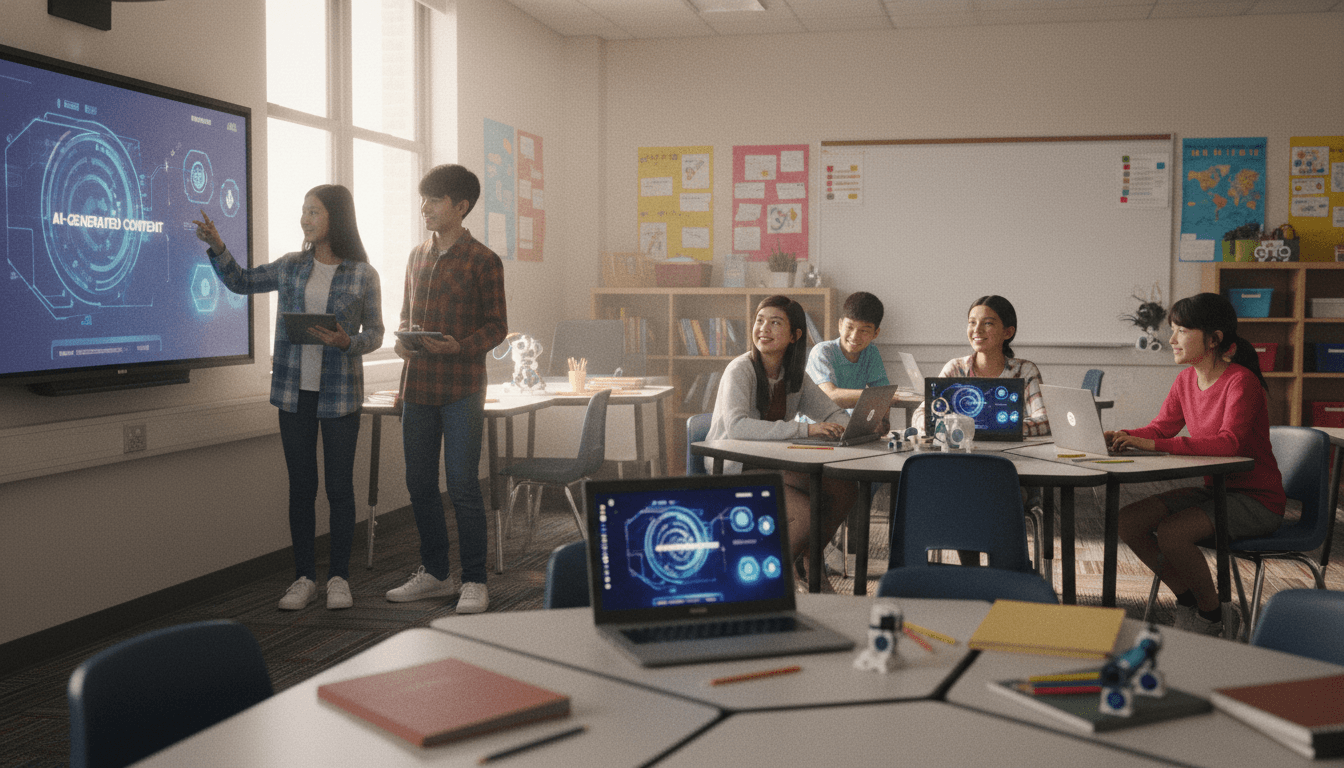
The integration of Artificial Intelligence (AI) into K-12 education is rapidly transforming the learning landscape, with many educators believing its impact will surpass that of the internet or traditional computers. This sentiment signals a significant shift in pedagogical approaches and highlights both the immense potential and emerging challenges of AI in schools. As of Friday, June 5, 2026, the discussion has moved beyond whether AI belongs in classrooms to how it can be responsibly and effectively implemented, marking a pivotal moment in educational history.
A recent NPR/Ipsos poll underscores this profound belief, revealing that nearly three-in-four K-12 teachers anticipate AI will have greater implications for education than previous innovations like the internet or even personal computers. This perspective is not merely theoretical; it’s backed by rapid adoption rates across the educational spectrum. In the 2024-2025 school year, an astounding 85% of teachers and 86% of students utilized AI tools, a significant leap from prior years. Notably, student AI usage in the USA alone surged from 66% in 2024 to 92% in 2025, demonstrating an almost universal embrace of these technologies by the younger generation.
Teachers are not just observing this phenomenon; they are actively integrating AI into their daily practices. A substantial 60% reported using AI in the 2024-2025 school year, with 32% employing it at least weekly. The practical applications are diverse and impactful: 69% of teachers use AI for creating study guides, quizzes, or other classroom materials, while another 69% leverage it for writing or planning lessons and units. This translates into tangible time savings, with teachers who use AI tools weekly reporting an average of 5.9 hours saved per week—a figure equivalent to six full weeks over a standard school year. Such efficiency gains are critical in an often-overburdened profession.
Students, too, are deeply engaged with AI for academic purposes. More than half (54%) are using generative AI for schoolwork or homework. Among teenagers aware of ChatGPT, 19% have utilized it for school assignments, with usage climbing higher among older students, reaching 31% for 11th and 12th graders. Their primary uses include research (54%), solving math problems (29%), and writing essays (18%), indicating a broad spectrum of academic reliance.
The Global Impact of AI in Education
The global impact of AI in education is multifaceted, affecting pedagogical strategies, teacher workload, and student learning outcomes. Experts widely acknowledge AI’s potential to revolutionize education by offering personalized learning experiences tailored to individual student needs. AI tools can adapt to unique learning patterns, predict student performance, and provide real-time feedback, helping to address varying skill levels and learning speeds within a single classroom. This level of individualized attention, once a distant dream, is now becoming a practical reality, potentially democratizing access to high-quality, customized instruction.
However, this rapid integration is not without its challenges. A significant concern among educators is the potential erosion of critical thinking skills. A majority of teachers (54%) worry that AI makes it harder for students to develop these essential competencies. Plagiarism is another pressing issue, with one study revealing that approximately 11% of over 200 million student papers reviewed by Turnitin since 2023 contained at least 20% AI-generated text. This raises serious questions about academic integrity and the very nature of original work. Furthermore, nearly 6-in-10 surveyed educators believe AI contributes to an erosion of trust between students and teachers, a foundational element of effective learning environments.
A major hurdle to effective AI implementation is the lack of institutional guidance. Only 35% of teachers whose schools provide AI software have a formal policy on its use. This vacuum highlights the urgent need for clear frameworks and ethical guidelines. Experts emphasize the importance of intentional, ongoing professional development for teachers, focusing not just on AI-specific applications but also on the ethical considerations and effective classroom integration strategies. Without this, the full potential of AI may remain untapped, or worse, lead to unintended negative consequences. For more trending stories, visit our news section.
The Surging AI in Education Market
The market for AI in education is experiencing explosive growth, reflecting the widespread adoption and perceived value of these technologies. Valued at $2.5 billion globally in 2022, it is projected to reach $6 billion by 2025 and an impressive $88.2 billion by 2032, boasting a compound annual growth rate (CAGR) of over 43.3% between 2023-2032. In the USA alone, the AI in education market is expected to grow from $2.01 billion in 2025 to $32.64 billion by 2034, underscoring its significant economic footprint.
“The conversation has shifted from *whether* AI belongs in schools to *how* it should be used responsibly and effectively, emphasizing equipping students with competencies needed to navigate an evolving world.”
The solution segment, encompassing AI-powered learning management systems and adaptive tutoring platforms, holds the lion’s share of the market, accounting for over 70% in 2024. Cloud deployment is also dominant, representing around 60% of the market in 2024 due to its scalability, accessibility, and cost-effectiveness. Machine learning stands out as the leading technology, powering critical functions like adaptive learning and predictive student analytics, which are at the heart of personalized education. This robust market growth signals strong investor confidence and a clear demand for innovative educational tools.
The transformative impact of AI in education is undeniable, moving rapidly from an abstract concept to a practical daily tool in classrooms worldwide. While AI offers significant benefits in personalizing learning, reducing teacher workload, and expanding access for students, it also presents complex challenges related to privacy, accuracy, equity, and the potential for over-reliance. The current emphasis is on equipping students with the competencies needed to navigate an evolving world, including critical thinking, analysis, and the ability to evaluate AI-generated content critically.
Looking ahead, the next few years will be crucial in shaping the long-term role of AI in education. Schools and districts must prioritize comprehensive professional development for teachers, develop clear and adaptable AI policies, and foster an environment where students learn to collaborate with, rather than merely consume, AI. The success of this educational revolution hinges on a balanced approach that harnesses AI’s power while mitigating its risks, ensuring that technology serves as a tool to enhance human learning and critical thought, not replace it. The educational landscape is undergoing a profound metamorphosis, and the responsible stewardship of AI will determine its ultimate legacy.