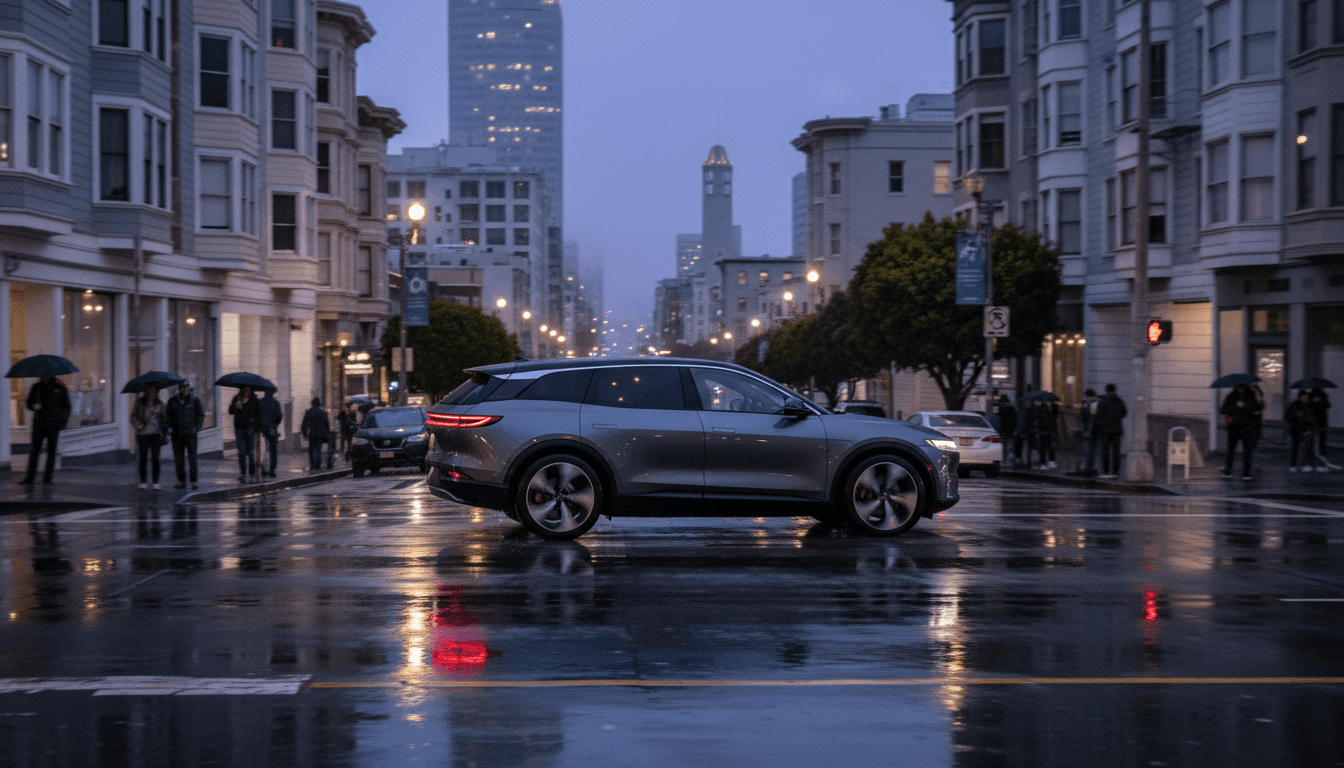
The arrival of new self-driving Lucid Gravity electric cars on San Francisco streets marks a significant milestone for autonomous vehicle technology and premium EV mobility. On Tuesday, April 14, 2026, the city’s iconic thoroughfares welcomed these advanced vehicles, signaling a new phase in the integration of driverless technology into urban environments and high-end automotive offerings.
The Story
The core of this development centers on Lucid Motors’ Gravity electric SUV, now equipped with advanced self-driving capabilities, making its debut in one of the most technologically forward-thinking cities globally. While specific operational details or the scale of the deployment were not immediately available, the presence of these vehicles confirms Lucid’s aggressive push into the autonomous sector, directly challenging established players and traditional automotive giants. San Francisco, with its complex urban topography and diverse traffic conditions, serves as an ideal, albeit challenging, proving ground for such sophisticated systems. The introduction of the self-driving Lucid Gravity is a testament to the rapid advancements in AI, sensor technology, and electric vehicle platforms converging to redefine personal transportation.
Impact Analysis
This development has profound implications for the broader automotive and EV landscape. Firstly, it elevates Lucid Motors’ profile beyond just a luxury EV manufacturer, positioning them as a serious contender in the autonomous vehicle race. The premium segment of the EV market now sees a convergence of luxury, performance, and cutting-edge autonomy, potentially setting new consumer expectations. For the autonomous vehicle industry, the deployment of a high-end, self-driving Lucid Gravity in a major metropolitan area indicates a growing maturity and acceptance of the technology. It suggests that regulatory hurdles, while still present, are becoming more navigable, paving the way for wider commercialization. This move could also intensify competition, pushing other luxury EV brands and tech companies to accelerate their own autonomous development timelines. Read more about the competitive EV landscape.
Context & Background
The journey towards widespread autonomous vehicles has been long and fraught with both technological breakthroughs and public skepticism. From early experiments with DARPA challenges to the current limited deployments by companies like Waymo and Cruise, the industry has steadily progressed. Tesla, a prominent EV competitor, has also been actively developing its ‘Full Self-Driving’ (FSD) beta, albeit with a different philosophical approach. Lucid Motors, known for its groundbreaking Air sedan and now the Gravity SUV, has consistently pushed the boundaries of EV performance and luxury. Their entry into the self-driving arena with the Gravity SUV, a vehicle designed from the ground up as an EV, highlights the strategic advantage of integrating autonomous hardware and software from the initial design phase. This contrasts with many legacy automakers attempting to adapt existing platforms.
“The deployment of self-driving Lucid Gravity vehicles in San Francisco marks a critical juncture, demonstrating that autonomy is no longer solely the domain of pure tech giants but is becoming an integral part of the premium electric vehicle experience.”
What’s Next
The immediate future will likely involve a period of observation and data collection for the self-driving Lucid Gravity fleet in San Francisco. Regulators will be keenly watching performance metrics, safety incidents, and public reception. We can anticipate Lucid providing more details on their autonomous driving system’s capabilities, its operational design domain, and their expansion plans. Other cities might soon follow San Francisco in welcoming these advanced vehicles. Furthermore, this move could spur further investment and partnerships within the autonomous driving ecosystem, as companies seek to either emulate Lucid’s success or collaborate to accelerate their own offerings. The evolution of insurance models and liability frameworks for autonomous vehicles will also be a critical area of focus as these deployments expand. Explore more on EV innovation.
Key Takeaway
The introduction of the self-driving Lucid Gravity in San Francisco is more than just a product launch; it’s a powerful signal about the future direction of the automotive industry. It underscores the accelerating convergence of electric propulsion, luxury design, and autonomous intelligence, creating a new paradigm for personal mobility. This event reinforces the idea that the car of tomorrow will not only be electric and sustainable but also increasingly capable of navigating our world without human intervention, reshaping urban planning, transportation logistics, and the very concept of car ownership.