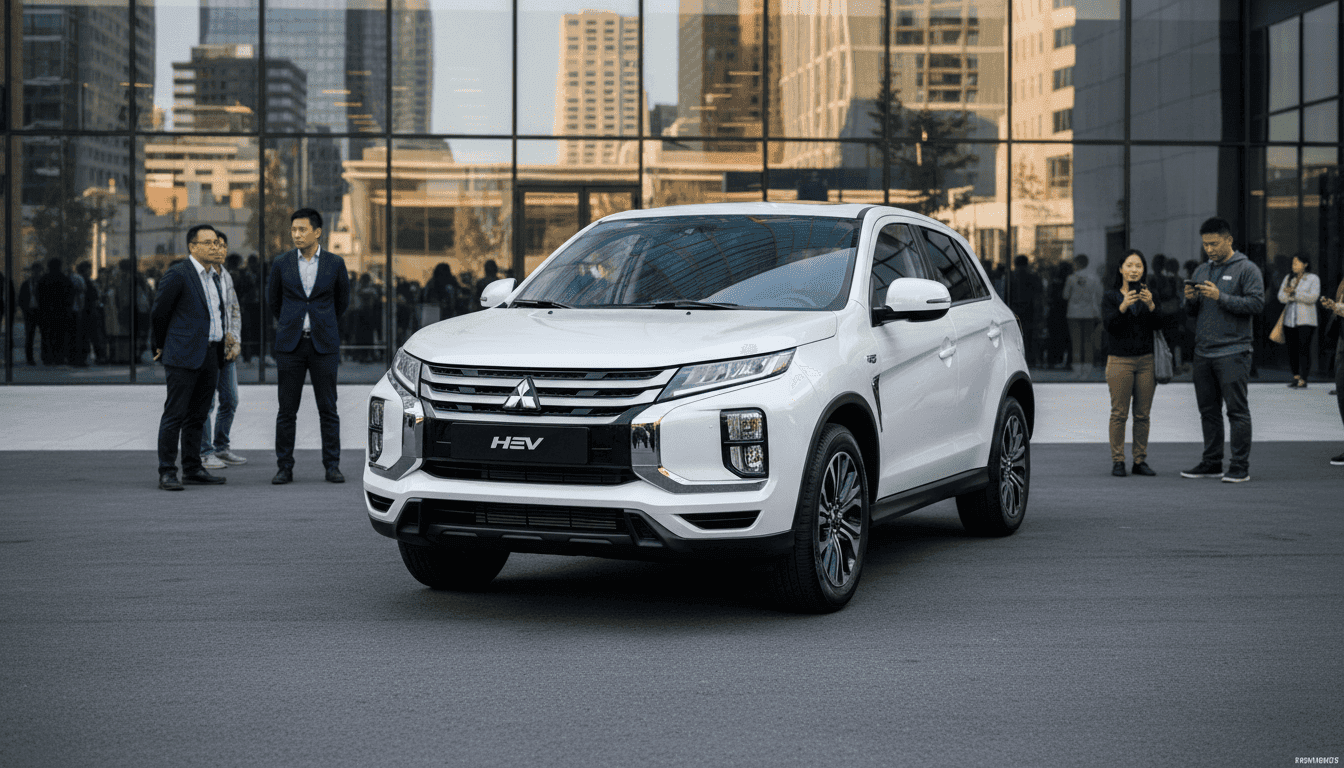
The Mitsubishi Outlander Sport HEV, the brand’s first conventional hybrid vehicle, is set to launch in New Zealand in the third quarter of 2026, marking a significant shift in Mitsubishi’s electrification strategy for the region. However, a notable exclusion from this rollout is Australia, a market that will miss out on the compact SUV due to regulatory hurdles. This strategic divergence highlights Mitsubishi’s nuanced approach to conventional hybrid technology, particularly as it navigates varying market demands and regulatory frameworks across Australasia.
The Outlander Sport HEV, known globally as the Xforce, was unveiled to dealers and staff during Mitsubishi’s Diamond Dealer awards event, ahead of its public debut at Fieldays from June 10-13. This move positions the Outlander Sport HEV as a more accessible electrified option for consumers who may not be ready for a full plug-in hybrid (PHEV) or battery electric vehicle (EV). Mitsubishi has historically been an early adopter of PHEV technology with models like the Outlander PHEV and Eclipse Cross PHEV, making this conventional hybrid introduction a notable expansion of its powertrain offerings.
Regulatory Hurdles Block Outlander Sport HEV for Australia
The decision to exclude Australia from the Outlander Sport HEV launch stems from the vehicle’s inability to meet Australian Design Rules (ADRs). A Mitsubishi Motors Australia spokesperson confirmed,
“The Xforce wasn’t built to meet required ADRs so was unavailable to us.”
This regulatory incompatibility underscores the challenges global automakers face in tailoring vehicles for diverse national standards, even within geographically close markets. While New Zealand embraces the new hybrid, Australian consumers will continue to see Mitsubishi’s electrification efforts focused on other avenues, including an upcoming EV sourced from Taiwanese manufacturer Foxtron and a replacement for the discontinued Pajero Sport.
Globally, the Xforce SUV has already achieved considerable success, with over 77,000 sales since its Indonesian launch in 2023. Its presence spans Asia, Latin America, Africa, and the Middle East, demonstrating its appeal in various international markets. The Outlander Sport HEV is a compact SUV, measuring 4340mm long, placing it in direct competition with popular rivals such as the Toyota Corolla Cross, Kia Niro, Honda HR-V, and Hyundai Kona. Its introduction in New Zealand will expand Mitsubishi’s lineup to five models, with the ASX remaining a key offering alongside the new SUV.
Powering the Mitsubishi Outlander Sport HEV is a 1.6-litre petrol engine combined with Mitsubishi’s latest hybrid system. This system intelligently switches between EV, hybrid, and engine drive modes to optimize efficiency based on driving conditions and battery charge. Overseas, the Xforce HEV utilizes a 1.1kWh battery pack, enabling short-distance, low-speed EV driving. Mitsubishi claims an impressive fuel economy of 5.6L/100km and a driving range of up to 750km from its 42-litre fuel tank, making it an attractive option for fuel-conscious buyers.
Beyond its powertrain, the Outlander Sport HEV boasts practical features, including 212mm of ground clearance and selectable drive modes: Normal, Wet, Gravel, and Mud. The chassis tuning has been optimized for a balance of ride comfort and stability on both urban and rural terrains. Inside, the SUV features a modern cabin with a 12.3-inch infotainment touchscreen, wireless Apple CarPlay and Android Auto, and a digital instrument cluster displaying vital energy flow information. A panoramic glass roof is standard, with higher trims adding a Yamaha-tuned premium audio system and a surround-view camera with moving object detection. Safety is also a priority, with adaptive cruise control, autonomous emergency braking, blind-spot monitoring, rear cross-traffic alert, and leading car departure notification.
Future Implications for Mitsubishi’s Electrification Strategy
Mitsubishi Motors New Zealand’s commitment to the Outlander Sport HEV is part of a broader product offensive for 2026, which will also include a new electric vehicle and another undisclosed model. This aggressive push signifies a renewed focus on electrification and market expansion in the region. Conversely, the Australian market’s exclusion from the Mitsubishi Outlander Sport HEV underscores a fragmented approach to product strategy, driven by specific regulatory environments and market preferences. This divergence could see different paths for Mitsubishi’s market share in the two countries, particularly in the competitive compact SUV segment.
Mitsubishi has historically lagged behind competitors in the conventional hybrid space, focusing primarily on PHEVs. The introduction of the Xforce/Outlander Sport HEV marks a significant step in catching up. While the current Australian ASX is a rebadged Renault Captur, New Zealand retains the first-generation ASX. This further illustrates the disparate product strategies. Reports from Nikkei Asia suggest Mitsubishi is developing new hybrid SUVs based on the Outlander and RVR (the Japanese name for the first-generation ASX), anticipated as early as 2028. This indicates a long-term commitment to expanding its conventional hybrid portfolio globally, potentially addressing the regulatory challenges that have sidelined the Outlander Sport HEV in markets like Australia. The ongoing evolution of Mitsubishi’s product lineup will be crucial in defining its competitive standing in the rapidly electrifying automotive landscape across automotive & ev markets.