A revolutionary new battery-electric cruise ship, developed by German shipbuilder Meyer Werft, promises to slash gas emissions by an astounding 95%. Announced on Tuesday, May 19, 2026, this ‘Project Vision’ vessel represents a monumental leap forward in the decarbonization of the maritime industry, a sector long considered one of the most challenging to electrify due to immense power demands and logistical hurdles.
The Vision: Project Details and Environmental Impact
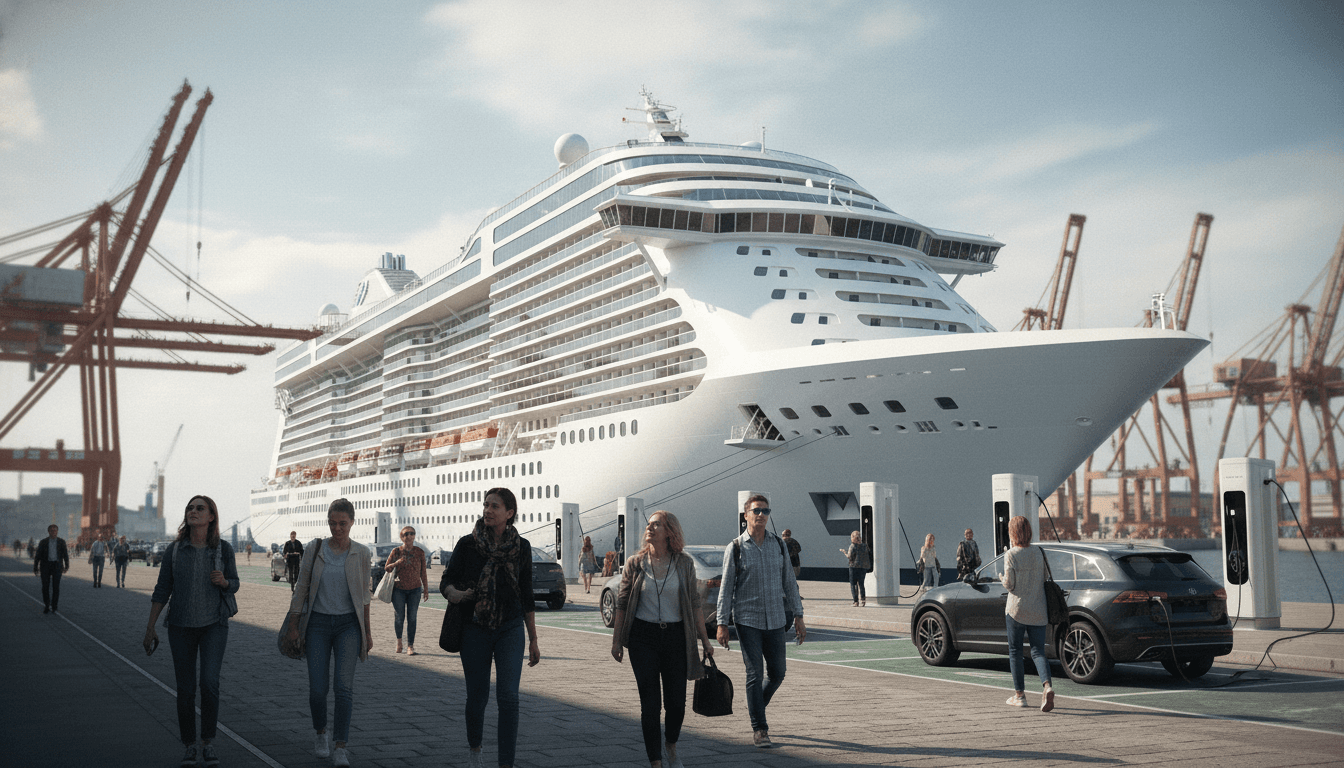
Meyer Werft’s ‘Project Vision’ is set to redefine luxury cruising with its ambitious specifications and environmental credentials. The 275-meter, 82,000-tonne vessel will have the capacity to accommodate up to 1,865 passengers. Crucially, it will be powered entirely by batteries, utilizing the same type of maritime battery technology currently found in smaller boats. This application on such a grand scale is a testament to the advancements made by Meyer Werft, in collaboration with Corvus Energy, in scaling electric propulsion systems.
The core promise of Project Vision lies in its potential to reduce gas emissions by an astonishing 95%. This figure is not merely incremental; it signifies a near-total elimination of traditional fossil fuel exhaust, offering a blueprint for a cleaner future for global shipping. Beyond the environmental benefits, passengers aboard this battery-electric cruise ship can expect a significantly enhanced experience. The absence of heavy diesel engines will dramatically reduce noise and vibration, promising a quieter, smoother, and more serene voyage.
Overcoming the Electrification Challenge Beyond Cars
The electrification of transport has largely focused on automobiles, with significant financial and technical barriers hindering similar progress in aviation and shipping. As Supercar Blondie rightly points out, an electric car’s marginal weight increase and slightly longer charging times pale in comparison to the challenges faced by massive vessels. Traditional maritime fuel, akin to diesel, boasts high energy density – a critical factor for powering enormous ships for week-long voyages. To replicate this with current battery technology would necessitate an impractical volume and weight of batteries, leaving little room for passengers or amenities.
Charging infrastructure also presents a formidable obstacle. Powering an 80,000-tonne ship requires an energy input comparable to that of a small city. However, Meyer Werft’s announcement signals a turning point. If development proceeds as planned, approximately 100 European ports are expected to have the necessary high-capacity charging infrastructure to support this vessel, with the first ship potentially delivered by 2031. This projected infrastructure development underscores the industry’s commitment to enabling large-scale electric maritime transport.
“We need more range, but we can’t make batteries larger and heavier, because they already are, so energy density has to be the next leap forward,” said Italian mechanical engineer Simone Bianconi, emphasizing the critical need for advancements in battery technology for all large-scale electric vehicles.
The challenge of energy density is paramount. Batteries for electric vehicles are inherently heavy; a Tesla Model S battery, for instance, weighs around 540 kg (1,200 lbs) but offers energy equivalent to only about 11 liters (3 gallons) of gasoline. While weight impacts an electric car’s efficiency, for a ship, it can be a hard physical limit. With current battery technology offering 250–300 Wh/kg, this is 5–10 times less energy dense than diesel fuel. This disparity highlights why electric power has historically been confined to smaller watercraft. Meyer Werft’s progress with their battery-electric cruise ship indicates that significant strides are being made to overcome these fundamental limitations, pushing the boundaries of what is technically feasible in marine electrification.
Future Implications for the Automotive & EV Landscape
The unveiling of Meyer Werft’s Project Vision has profound implications not just for the maritime sector, but also for the broader automotive and EV landscape. Success in electrifying such a massive vessel could accelerate research and development into higher energy density batteries and more robust charging solutions, technologies that would inevitably trickle down and benefit electric cars, trucks, and even short-haul aircraft. It demonstrates that the technical hurdles, while significant, are not insurmountable, and that sustained investment in battery innovation and infrastructure can yield transformative results across all transport modalities.
This initiative sets a new benchmark for environmental responsibility in the travel industry, potentially pressuring other cruise lines and shipping companies to explore similar sustainable solutions. The 2031 delivery target, coupled with the projected port infrastructure upgrades, paints a picture of a future where large-scale electric maritime travel is not just a concept, but a tangible reality. This development reinforces the global push towards electrification, proving that even the most challenging sectors are beginning to embrace a cleaner, more sustainable future.