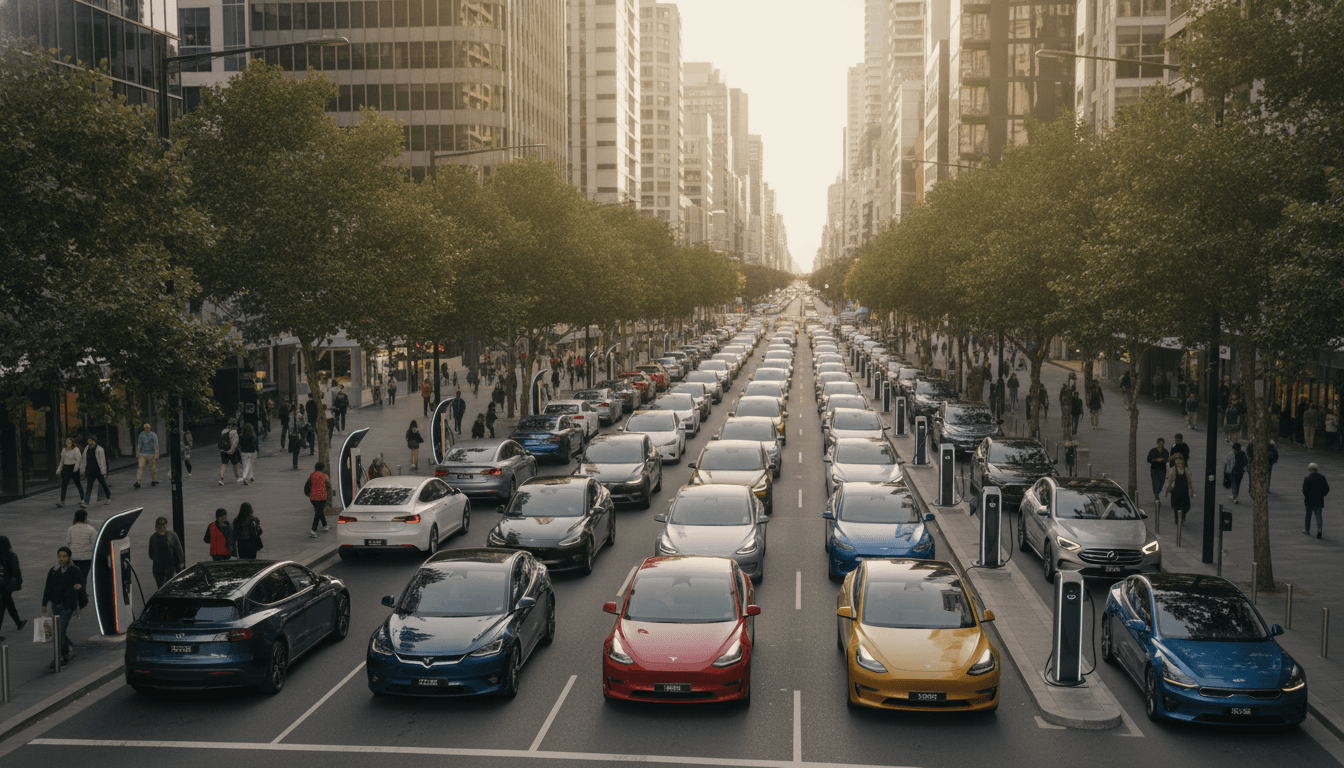
Australia’s automotive & ev landscape saw a significant milestone in May 2026, as the **Australian EV market share** reached an unprecedented 20 per cent of all new vehicle sales. This landmark achievement, detailed in the latest VFACTS sales data released on Wednesday, June 3, 2026, signals a profound and accelerating shift in consumer preferences towards lower-emission powertrains across the nation. While the overall new vehicle market experienced a 4.8 per cent decline compared to May 2025, with 100,206 total deliveries, the surge in electric vehicle adoption underscores a resilient and expanding segment.
The Federal Chamber of Automotive Industries (FCAI) highlighted these figures as indicative of a substantial change in buying habits. When considering all electrified vehicles – Battery Electric Vehicles (BEVs), Hybrid Electric Vehicles (HEVs), and Plug-in Hybrid Vehicles (PHEVs) – their collective market share soared to 46 per cent of all new vehicle sales. This broad embrace of electrification is particularly pronounced within Australia’s dominant SUV segment, where the transformation is most striking.
Impact Analysis on the Automotive & EV Landscape
The record **Australian EV market share** in May 2026 carries significant implications for manufacturers, policymakers, and consumers alike. The data reveals a dramatic divergence in sales trends: electric SUV sales surged by 167 per cent compared to May 2025, and plug-in hybrid SUV sales exploded by 377 per cent. In stark contrast, petrol-powered SUV sales plummeted by 31 per cent, and diesel SUV sales fell by 41 per cent over the same period. This undeniable shift will necessitate rapid strategic adjustments from traditional automakers heavily reliant on internal combustion engine (ICE) models.
FCAI chief executive Tony Weber articulated the rapid evolution of consumer choice, stating,
“The shift is particularly evident in the SUV segment, where consumer preferences are changing rapidly. Today’s SUV buyer is increasingly choosing hybrid, plug-in hybrid and electric options.”
This statement encapsulates the profound reorientation occurring within the industry. Toyota, despite its historical dominance, maintained its position as Australia’s best-selling brand with 16,342 sales. However, the meteoric rise of Chinese manufacturers like BYD, securing second place overall with 8,211 sales (a 155 per cent year-on-year increase), along with Omoda Jaecoo (up 729 per cent) and Geely (up 416 per cent), signals a new competitive dynamic. These newer entrants are clearly capitalizing on the growing demand for electrified options, particularly in the value and accessible EV segments.
Context & Background: A Shifting Tide
The current surge in **Australian EV market share** is not an isolated event but the culmination of several converging factors. Policy initiatives, such as the New Vehicle Efficiency Standard (NVES), are playing a crucial role. The FCAI itself acknowledges that NVES is encouraging manufacturers to introduce a wider array of low-emissions vehicles into the Australian market, expanding choice and accelerating adoption. This regulatory push, combined with increasing consumer awareness of environmental benefits, running cost savings, and improving EV technology, has created a fertile ground for growth.
Previous VFACTS reports have hinted at this trajectory. January 2026 saw hybrids and plug-in vehicles gaining ground as petrol sales continued to slide, while March 2026 recorded EV sales surging to a then-record 14.6 per cent market share. May’s results demonstrate an acceleration of this trend, indicating that even as the broader new-car market experiences a slight downturn, the electrified segment remains robust and ascendant.
What’s Next: Infrastructure and Innovation
As the **Australian EV market share** continues its upward trajectory, the focus inevitably shifts to supporting infrastructure. The FCAI has explicitly called for increased investment in public charging networks, recognizing that the rapid growth in EV adoption will place considerable pressure on existing facilities. Addressing range anxiety and charging accessibility will be paramount to sustaining this momentum. Manufacturers will also continue to innovate, with brands like BYD already prioritizing advanced battery technologies and fast-charging capabilities, as evidenced by their preference for Blade battery technology over solid-state solutions for now.
The competitive landscape is also set for further evolution. The strong performance of emerging brands like BYD, Omoda Jaecoo, and Geely suggests that traditional stalwarts will need to aggressively expand their EV offerings and pricing strategies to maintain market relevance. The SUV segment, being the largest, will remain a key battleground for electrification, driving further innovation in electric and plug-in hybrid SUV models.
May 2026 will be remembered as a pivotal month for Australia’s automotive sector, solidifying the irreversible shift towards electrification. The record 20 per cent EV market share, alongside the overall 46 per cent for all electrified vehicles, underscores a consumer base increasingly prioritizing sustainable and efficient transportation. This trend, bolstered by supportive policies and fierce competition, demands continued investment in infrastructure and agile adaptation from all industry players, setting the stage for a fundamentally transformed automotive future.