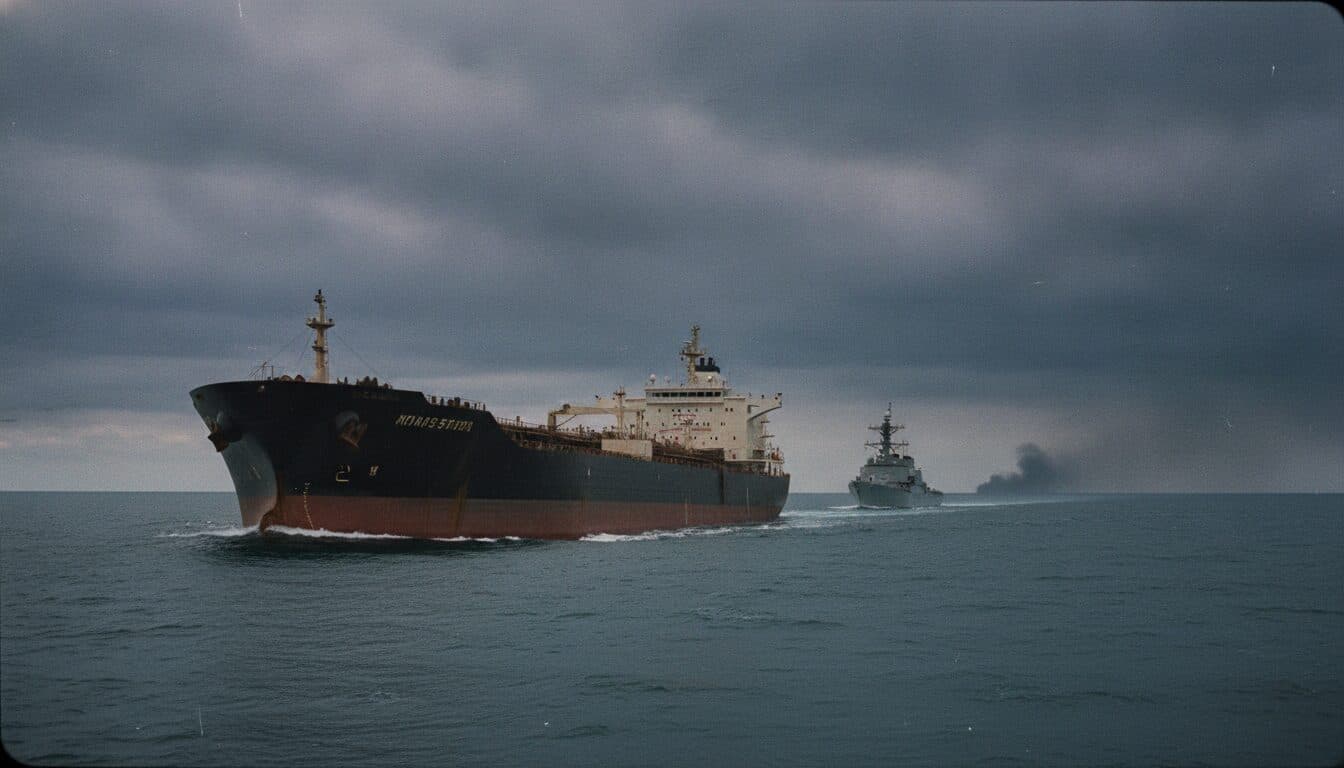
The fragile, month-old ceasefire between the United States and Iran has been severely tested, if not shattered, following a direct exchange of fire in the critical Strait of Hormuz on May 7, 2026. This dangerous escalation, marked by conflicting accounts from Washington and Tehran, has immediately sent global oil prices surging and cast a dark shadow over the prospects for a lasting diplomatic resolution to the ongoing 2026 Iran war.
According to the US Central Command (CENTCOM), three American Navy guided-missile destroyers – the USS Truxtun (DDG 103), USS Rafael Peralta (DDG 115), and USS Mason (DDG 87) – were transiting the Strait of Hormuz into the Gulf of Oman when they came under “unprovoked Iranian attacks.” CENTCOM reported that Iranian forces launched “multiple missiles, drones and small boats” at the destroyers. US forces responded with “self-defense strikes,” targeting Iranian missile and drone launch sites, command-and-control locations, and intelligence, surveillance, and reconnaissance nodes. Crucially, CENTCOM stated that “no U.S. assets were struck.” A senior US official, speaking to Fox News, specified that these strikes hit Bahman Port on Qeshm Island, an unspecified target in Bandar Abbas, Hormozgan Province, and the Bandar Kargan naval checkpoint, also in Hormozgan Province. Despite the robust response, CENTCOM maintained that it “does not seek escalation but remains positioned and ready to protect American forces.”
Iran, however, presented a starkly different narrative. IRIB News, the country’s state broadcasting network, cited an unnamed military official claiming that US military units “came under Iranian missile fire in the Strait of Hormuz and, after sustaining damage, were forced to flee” following an American strike on an Iranian tanker. Iran’s central military command, the Khatam Al-Anbiya headquarters, further alleged that the US had targeted an Iranian oil tanker and another vessel near the strait, prompting Iranian forces to return fire on US warships. Iranian state media reported that the country’s armed forces exchanged fire with “the enemy” on Qeshm Island and that explosions were heard near Bandar Abbas. Iranian officials were unequivocal in their accusation that the US had violated the ceasefire agreement.
The immediate impact on global markets was pronounced. Oil prices, which had seen a brief dip earlier in the week amid hopes of diplomatic progress, climbed sharply. West Texas Intermediate (WTI) crude futures, which had momentarily fallen below $90 a barrel, surged, with analysts now projecting a potential rise to $150 a barrel should the conflict persist. The Strait of Hormuz, a narrow choke point, is responsible for the transit of approximately one-fifth of the world’s crude oil and liquefied natural gas supplies. Iran’s effective closure of the strait earlier in the 2026 Iran war had already triggered the largest supply disruption in oil market history, pushing prices as high as $112 a barrel in early April. This latest escalation exacerbates those supply concerns significantly.
“The Strait of Hormuz is the world’s most sensitive economic artery. Any direct military confrontation here sends an immediate, unmistakable signal of extreme risk to global energy markets and supply chains.”
This exchange of fire critically strains the month-old ceasefire brokered by Pakistan and agreed upon on April 8, 2026. That agreement was intended to create a window for discussions on a lasting peace, addressing contentious issues such as freedom of navigation through the Strait of Hormuz, Iran’s nuclear and ballistic missile program, post-war reconstruction, and the lifting of sanctions. While President Donald Trump acknowledged the hostilities, he insisted the ceasefire remained in effect, controversially describing the US strikes as “just a love tap.” Iranian officials, however, declared that the US had “crossed the point of no return” after the strikes on ports in the Strait of Hormuz.
The 2026 Iran war commenced with US-Israeli airstrikes on Iran on February 28, 2026, which included the assassination of Iran’s Supreme Leader Ali Khamenei. Iran retaliated with missile and drone strikes and by closing the Strait of Hormuz. Adding another layer of complexity, Iran has been attempting to formalize its control over the Strait of Hormuz by establishing a new body, the Persian Gulf Strait Authority (PGSA). This authority would require vessels to submit extensive information before transit, a move that has already raised significant concerns for international shipping, with hundreds of commercial vessels reportedly trapped in the Persian Gulf.
The immediate future hinges on the diplomatic and military responses of both nations. The prospect of further direct military engagement in the Strait of Hormuz remains high, threatening to unravel any remaining semblance of the ceasefire. Investors and global consumers alike will be watching closely for any statements from Washington or Tehran that could signal either de-escalation or a more direct path towards a full-blown conflict. The ramifications for oil prices, global trade, and regional stability are immense, making this a pivotal moment in the ongoing crisis.
The key takeaway for investors and policymakers is the extreme volatility and uncertainty this event injects into the global economy. The direct engagement in the Strait of Hormuz underscores the immediate and severe risks to energy supplies and international shipping, demanding urgent attention and strategic planning for potential prolonged disruption.