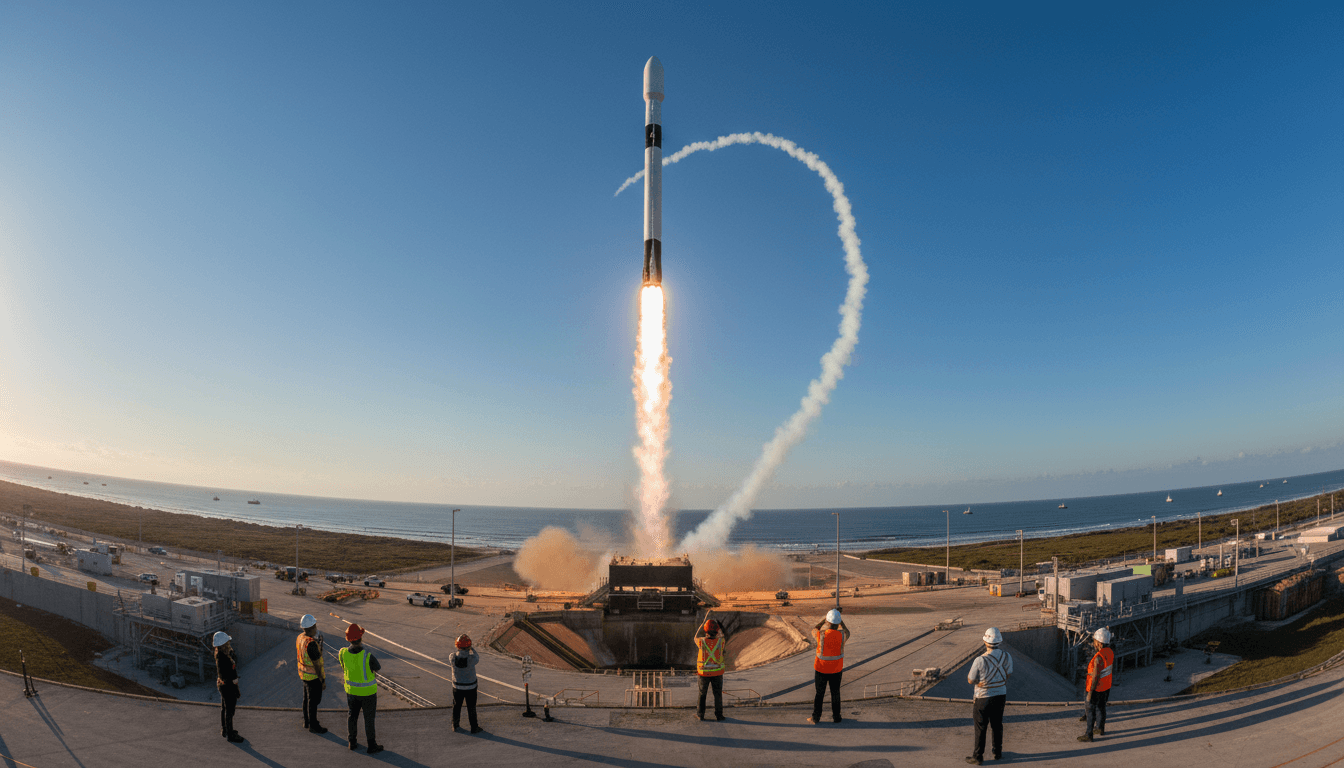
A surging SpaceX IPO valuation targeting a staggering $2 trillion is poised to fundamentally reshape the global financial landscape and the burgeoning private space industry. The company, founded by visionary Elon Musk, confidentially filed for its Initial Public Offering with the U.S. Securities and Exchange Commission (SEC) on April 1, 2026, with market observers anticipating a potential listing as early as June 2026. This audacious target would not only make it one of the largest market debuts in history, potentially dwarfing Saudi Aramco’s $29 billion debut from 2019, but also underscore a profound shift in how public markets perceive the value of extraterrestrial enterprise.
SpaceX aims to raise an unprecedented $75 billion through this public offering, a testament to the immense investor appetite for its diverse and rapidly expanding portfolio. The company’s valuation trajectory has been nothing short of meteoric: from $137 billion in January 2023, it rocketed to $210 billion by June 2024, hitting $350 billion in December 2024, and approximately $400 billion by July 2025. By December 2025, it had reached an estimated $800 billion, culminating in a colossal $1.25 trillion after its strategic acquisition of Elon Musk’s xAI in February 2026. This latest valuation surge to over $2 trillion reflects a confluence of factors, from its dominant launch services to its ubiquitous Starlink internet constellation and ambitious plans for orbital AI data centers.
The Multi-Trillion Dollar Enterprise: Beyond Rockets
SpaceX’s financial strength is underpinned by robust revenue generation across its key divisions. Sacra estimates the company generated $15.5 billion in revenue in 2025, an impressive 18% year-over-year increase from $13.1 billion in 2024. A substantial portion of this, roughly $10 billion, came from its Starlink satellite internet service, which, as of early 2026, served over 9 million users globally with nearly 9,500 active satellites in low Earth orbit. The recurring revenue model of Starlink is a particularly attractive proposition for investors, providing a stable, predictable income stream that complements the more project-based nature of launch services.
Launch services, the bedrock of SpaceX’s operations, also continue to be a significant revenue driver. In 2023, this segment generated $3.5 billion, propelled by 28 Falcon 9 and 5 Falcon Heavy launches. The company’s strategic importance was further solidified in April 2025 when it secured a massive $5.9 billion Pentagon contract for 28 national security launch missions through 2029, cementing its role as a critical partner for national defense and exploration.
A ‘Space + AI’ Infrastructure Juggernaut
The narrative surrounding SpaceX has evolved dramatically. It is no longer merely an aerospace firm but is increasingly perceived as a ‘next-generation infrastructure platform,’ a transformation significantly accelerated by its acquisition of xAI. This merger broadened SpaceX’s strategic scope, intertwining its space infrastructure with the burgeoning field of artificial intelligence. Experts highlight the company’s plans for orbital AI data center infrastructure as a pivotal factor in its soaring valuation, aligning perfectly with the projected demand for AI data centers, which is expected to exceed $2 trillion in 2026. This synergy positions SpaceX uniquely at the intersection of two of the most transformative technologies of our era.
“SpaceX’s pivot to becoming a ‘Space + AI’ infrastructure platform fundamentally changes its investment thesis. It’s no longer just about rockets; it’s about owning the high ground of future data and connectivity,”
remarked a senior analyst at a leading investment bank. This comprehensive vision, coupled with its technological prowess in reusable rockets like the Falcon 9 and the developing Starship, drives the market’s enthusiasm for a more trending stories.
Global Market Repercussions and Investor Frenzy
The anticipated SpaceX IPO is set to send seismic waves through both the space industry and broader capital markets. It is expected to attract unprecedented institutional investment and redefine how public markets assess the value of space transportation and related technologies. This monumental listing will undoubtedly act as a powerful catalyst for the entire space sector, elevating valuation frameworks and directly benefiting other space-focused companies such as Rocket Lab, Planet Labs, and Intuitive Machines, potentially ushering in a new era of space-related public offerings.
Fund managers are bracing for intense pressure to participate in the SpaceX IPO valuation, even at its lofty target. Recent Nasdaq 100 rule changes and the inherent risk of underperforming if shares rapidly appreciate mean that institutional investors can ill-afford to miss out on what is widely considered a generational investment opportunity. Major financial powerhouses including Bank of America, Goldman Sachs, JPMorgan Chase, Morgan Stanley, and Citigroup have reportedly secured senior roles in preparing the offering, underscoring the significance of this market event.
The Road Ahead: Scaling Ambition
SpaceX, founded in 2002, has consistently pushed the boundaries of space exploration, from the Falcon 9, the world’s first reusable rocket, to its ambitious Starship program designed for lunar and Martian missions. The company’s robust business model, fueled by lucrative government contracts (including NASA’s Artemis program), commercial satellite launches, and its ubiquitous Starlink internet services, provides a solid foundation for its future endeavors. The IPO is a critical opportunity to raise substantial capital needed to scale Starship development, expand the Starlink constellation even further, and build out its groundbreaking orbital AI data centers.
As the potential June 2026 listing approaches, all eyes will be on how this colossal SpaceX IPO valuation redefines not just the space sector, but the very metrics by which technology and infrastructure companies are assessed. Its success could herald a new era of private capital flowing into ambitious, long-term space ventures, transforming science fiction into economic reality.