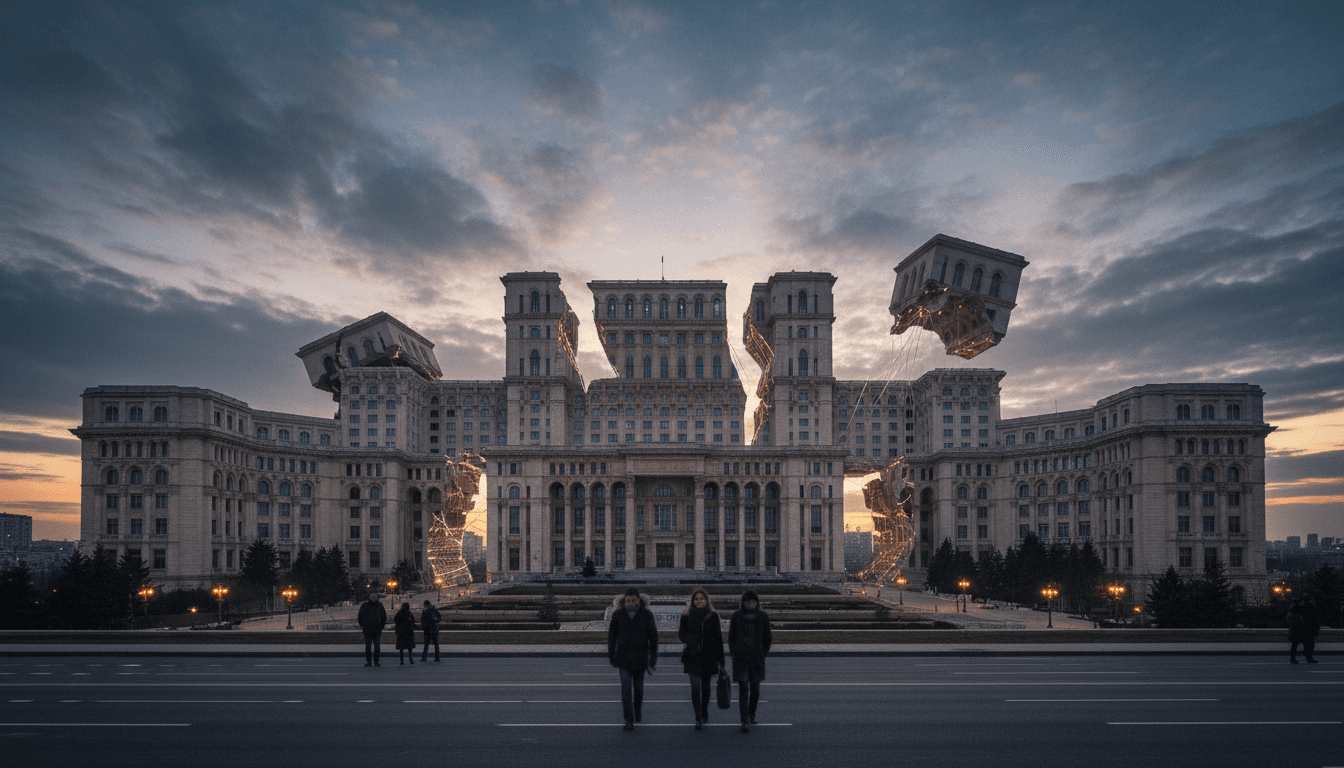
The Romanian government collapses today, plunging the EU member state into renewed political turmoil less than a year after its pro-European coalition was sworn in. Prime Minister Ilie Bolojan’s administration fell after losing a no-confidence vote, signaling a significant period of instability for a nation grappling with a substantial budget deficit and rising far-right populism.
The motion, initiated by the Social Democrats (PSD) and the far-right Alliance for the Union of Romanians (AUR), passed with 281 votes in the 464-seat parliament, comfortably exceeding the 233 votes required. Bolojan’s National Liberal Party (PNL) and its USR allies abstained from the vote, effectively sealing the fate of the four-party coalition. This dramatic turn of events follows the PSD’s withdrawal of its ministers in late April, which stripped the government of its parliamentary majority and set the stage for this week’s collapse.
Austerity Measures and Economic Fallout
At the heart of the crisis were the Bolojan government’s stringent austerity measures, designed to rein in Romania’s budget deficit, one of the highest in the European Union. Prime Minister Bolojan defended these cuts, stating they were “urgent and necessary for our country” and had “regained the trust of the markets in the Romanian government.” Indeed, the coalition had made reducing the deficit a top priority since taking office last June, successfully bringing it down from 9.3% to 7.9%.
However, the political turbulence ignited by these measures has already had tangible economic repercussions. Concerns are mounting over Romania’s sovereign debt ratings and its ability to secure approximately €10 billion in crucial EU recovery and resilience funds before an August cutoff. Borrowing costs have risen, and the leu currency hit a record low against the euro, reaching 5.21 Romanian lei on Tuesday, underscoring the immediate market reaction to the political uncertainty.
The Ascent of the Far-Right and Political Realignment
A striking development in this political upheaval is the surging popularity of the far-right Alliance for the Union of Romanians (AUR). Polling data now indicates the AUR enjoys about 37% support, remarkably surpassing even the PSD as the most popular party. The PSD’s decision to collaborate with the AUR on the no-confidence motion has drawn sharp criticism, with many observers expressing concern that it has legitimized the far-right and brought it further into the political mainstream.
“The PSD’s collaboration with AUR transformed the far-right party into a significant political player, from a party that was isolated, ostracised and kept on the margins of the political system,” noted political scientist Costin Ciobanu.
AUR leader George Simion wasted no time in calling for early elections, declaring that the “voice of the people” had been heard. This sentiment highlights the growing influence of nationalist and anti-establishment voices within Romanian politics, mirroring trends seen across parts of Europe.
What’s Next for Romania’s Political Landscape?
With the Romanian government collapses, the immediate future remains uncertain. President Nicușor Dan has ruled out early elections, which are not constitutionally due until 2028. Instead, he is expected to initiate negotiations with parties to attempt to rebuild the four-party coalition, potentially under a different PNL premier or a technocrat. President Dan has also firmly reiterated Romania’s commitment to its pro-Western direction and explicitly ruled out any far-right government.
However, the path to a new government is fraught with challenges. Both the PNL and USR have expressed an unwillingness to rejoin a government that includes the Social Democrats, making a direct re-establishment of the previous coalition highly unlikely. The historical context of Romania’s political instability, including the annulment of a presidential election in December 2024, underscores the deep-seated divisions that continue to plague the nation.
Broader Implications for the EU and Regional Stability
The implications of this political crisis extend beyond Romania’s borders. As a frontline state bordering Ukraine and a key logistical partner for Kyiv, Romania’s stability is crucial for regional defense planning and the ongoing logistical support for Ukraine on the Black Sea frontier. Any prolonged period of political paralysis could affect these critical functions.
Furthermore, the potential for the AUR to gain further influence or even enter government raises significant questions about Romania’s future approach within the European Union. Experts are drawing parallels to Hungary’s more sovereignty-focused stance, suggesting that a stronger far-right presence could shift Romania’s alignment within the bloc, potentially impacting EU cohesion and policy-making. The continued political uncertainty and the ascent of the far-right demonstrate the complex challenges facing this vital EU member state.