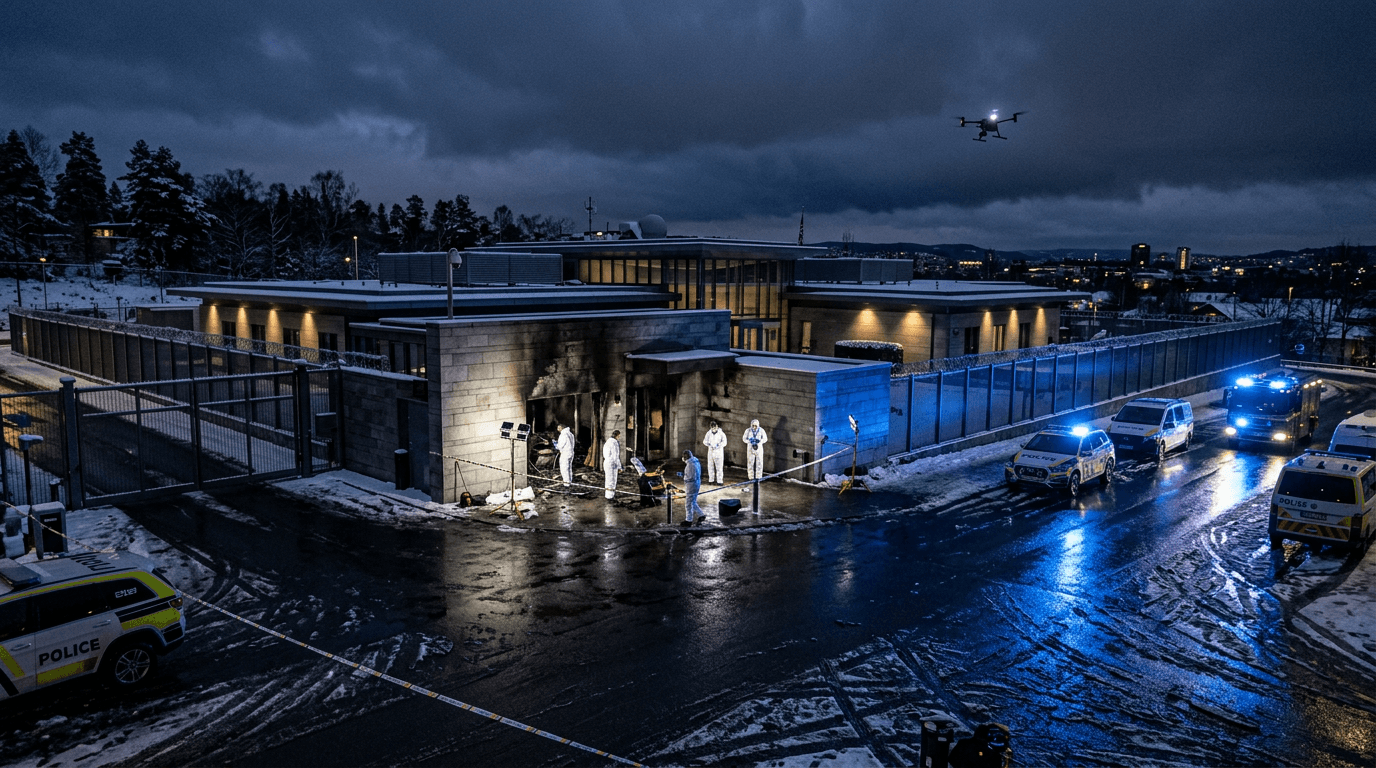
The Oslo embassy explosion that occurred in the early hours of Sunday, March 8, 2026, has immediately become the focal point of international security concerns as investigators scramble to identify the perpetrators behind the targeted attack. At approximately 1:00 AM local time (0000 GMT), a blast rocked the western district of the Norwegian capital, specifically targeting the entrance to the consular section of the United States Embassy. While the incident caused significant alarm across the city and generated a heavy plume of smoke, Norwegian authorities have confirmed that there were no casualties or injuries. The U.S. mission, a high-security compound located in the Huseby area since 2017, appeared to withstand the primary force of the blast, reporting only minor structural damage to the building’s exterior.
The timing of the event, occurring on a quiet Sunday morning, likely prevented a much larger tragedy. Oslo police representative Frode Larsen identified the cause of the blast as an “incendiary device,” though the specific chemical composition and delivery method remain under forensic analysis. In the immediate aftermath, the area surrounding the embassy was transformed into a high-intensity crime scene. Deployment included specialized bomb disposal units, police canine teams, drones, and a surveillance helicopter circling the Huseby district. The rapid response reflects the gravity with which the Norwegian government is treating what they describe as a direct strike against a foreign diplomatic mission on their soil.
Analyzing the Oslo Embassy Explosion
As the sun rose over Oslo on March 8, the investigation transitioned from immediate crisis management to a deep forensic and intelligence-gathering operation. Michael Dellemyr, the police incident commander, confirmed to public broadcaster NRK that the blast was no accident. “It appears to us that this is an act carried out by someone,” Dellemyr stated, noting that investigators are currently sifting through a vast array of surveillance footage and witness testimonies from the surrounding residential areas. While the consular section entrance sustained material damage, the embassy’s reinforced construction—designed specifically to resist kinetic force—prevented any breach of the secure perimeter.
The geopolitical ramifications of the Oslo embassy explosion are already being felt across the Atlantic and throughout Europe. Astri Aas-Hansen, Norway’s Minister of Justice and Public Security, was quick to condemn the event, labeling it an “unacceptable incident.” She assured the public and the international community that the government is allocating “significant resources” to the case. Despite the targeted nature of the attack, Martin Bernsen, a communication adviser for the Norwegian Police Security Service (PST), indicated that the national terror threat level remains unchanged for the time being. However, he confirmed that additional personnel have been mobilized to support the investigation and monitor for potential follow-up threats.
“It appears to us that this is an act carried out by someone rather than an accidental occurrence, and we are treating this with the utmost seriousness.”
The incident has also raised questions about the safety of international personnel in Scandinavia. You can find more trending stories regarding global security shifts on our dedicated news portal. While the immediate market impact within Norway has remained negligible—with the Oslo Børs and major trade indices showing no signs of distress—the long-term economic consequences could manifest in the insurance and security sectors. Experts suggest that continued volatility could lead to increased insurance premiums for high-profile diplomatic and international corporate sites across Northern Europe, particularly as the region’s reputation for stability is tested.
Global Impact and Diplomatic Fallout
The broader context of the Oslo embassy explosion cannot be ignored. The attack comes during a period of extreme global friction, characterized by escalating tensions in the Middle East involving the United States, Israel, and Iran. Recent U.S. military operations in that region have triggered a series of retaliatory threats against American interests worldwide. While Norwegian police have been careful not to prematurely link the Oslo blast to any specific foreign conflict, the parallels to recent security breaches at Israeli embassies in Copenhagen and Stockholm are striking. This pattern suggests a potential coordinated effort to target Western diplomatic infrastructure in traditionally low-risk Nordic countries.
Security analysts are particularly concerned about the vulnerability of consular access points. The U.S. Embassy in Oslo is a formidable fortress, yet the fact that an incendiary device reached the consular entrance suggests that the perpetrator identified a specific window of opportunity or a localized weakness in the perimeter patrol. This has prompted an immediate review of security protocols for all diplomatic missions across Scandinavia. U.S. embassies in Sweden, Denmark, and Finland were already on heightened alert, and this latest incident is expected to push those security postures to their maximum levels.
For the Norwegian public, the blast serves as a jarring reminder of the country’s entanglement in global power struggles. Norway, a key NATO ally, has often sought to balance its role as a global mediator with its strategic partnership with the United States. An attack of this nature on Norwegian soil challenges the perceived safety of the capital and places immense pressure on the PST to deliver a swift arrest. As of midday on March 8, no group has officially claimed responsibility for the act, leaving a vacuum of information that is currently being filled by intense speculation in both domestic and international media circles.
What to Watch For in the Coming Days
In the wake of the Oslo embassy explosion, the U.S. State Department has remained relatively quiet, referring most inquiries to local Norwegian investigators. This suggests a collaborative approach where Washington is allowing Oslo to take the lead on the ground while providing intelligence support in the background. Observers should watch for a formal statement from the White House or the Secretary of State, which may provide clues as to whether U.S. intelligence has already linked the device to a specific state actor or extremist group.
Furthermore, the forensic details of the “incendiary device” will be critical. If the device shows signs of sophisticated construction, it would point toward a state-sponsored or highly organized cell. Conversely, a more rudimentary device might suggest a “lone wolf” actor inspired by global events. The results of the CCTV analysis from the Huseby area will also be pivotal; the embassy is surrounded by one of the most comprehensive camera networks in the country, and it is highly likely that the perpetrator’s movements were captured in the minutes leading up to the 1:00 AM blast.
The coming week will be a litmus test for Nordic security cooperation. We expect to see increased visible police presence at diplomatic sites and potentially more restrictive access to the areas surrounding the U.S. and Israeli embassies in the region. As the investigation continues, the focus will remain on whether this was an isolated incident or the opening salvo of a broader campaign targeting American interests in Europe.
The Oslo embassy explosion stands as a stark indicator that the relative calm of Northern Europe is no longer a shield against the spillover of global conflict. While the lack of casualties is a cause for relief, the symbolic breach of a major U.S. diplomatic site remains a significant escalation. The world now waits to see if Norwegian authorities can successfully close the net on those responsible before the narrative of regional instability takes firm root.