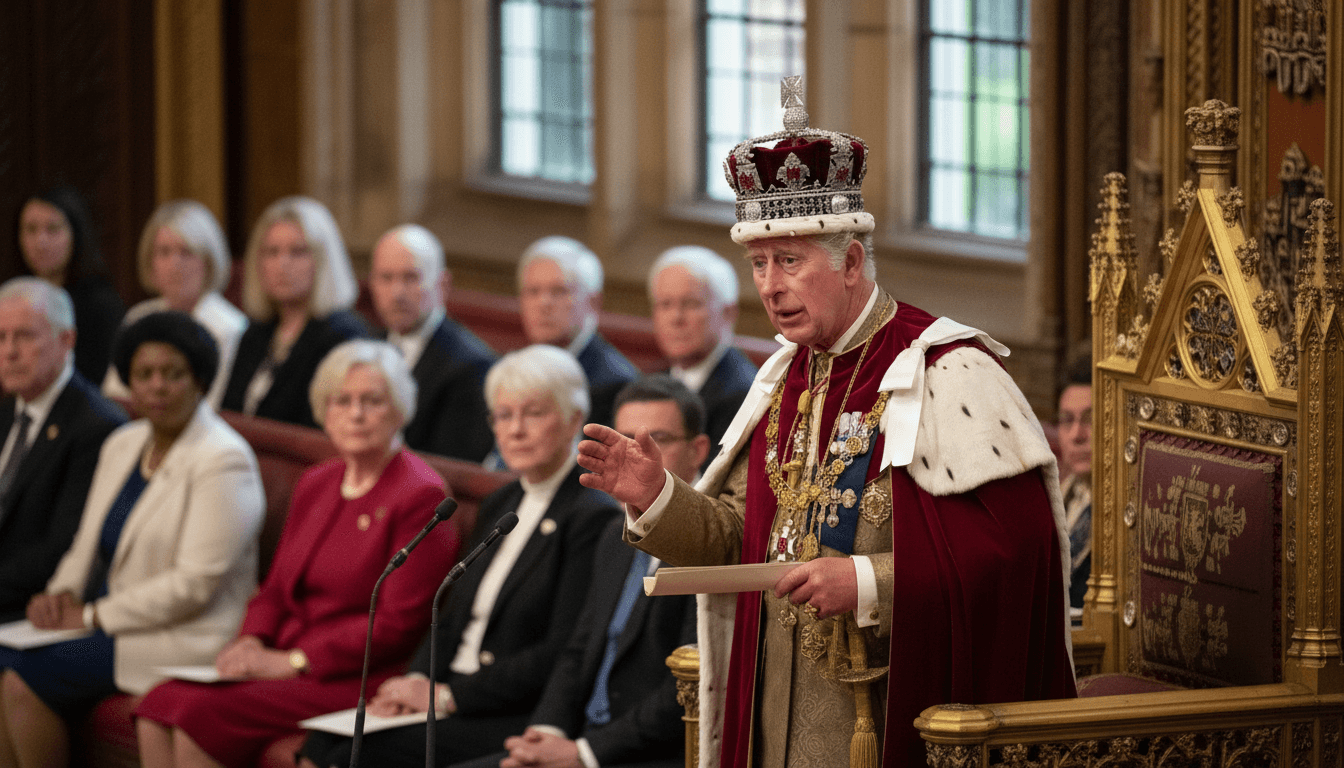
King Charles unveils UK government agenda today, marking a pivotal moment for Prime Minister Keir Starmer’s embattled administration and setting the legislative course for the nation amidst significant economic and political uncertainty. The centuries-old tradition of the King’s Speech, delivered this Wednesday, May 13, 2026, from the gilded throne in the House of Lords, outlined an ambitious legislative programme designed to tackle everything from economic stability to national security and environmental concerns. With over 35 bills and draft bills anticipated, some reports suggesting as many as 37 to 40 new pieces of legislation, the breadth of the government’s ambition is undeniable, even as its political footing remains precarious.
The speech comes at a particularly challenging juncture for Prime Minister Starmer, who is grappling with intense calls for his resignation following recent setbacks in local and regional elections. The political drama unfolding in Westminster casts a long shadow over the ceremonial pomp, turning what is typically a statement of intent into a high-stakes declaration for a government fighting for its political life. Financial markets, ever sensitive to political stability, have been closely watching developments, with gilt yields climbing in the lead-up to the speech, reflecting investor apprehension.
The Blueprint for a Nation: Key Policy Pillars
At the heart of the King’s Speech are four overarching policy areas: economic stability, national security, public services, and environmental concerns. Each pillar contains a raft of legislative proposals designed to address pressing issues facing the UK.
Economic Rebalancing and Growth
Economically, the government’s agenda signals a desire for greater national control and investment. A significant proposal includes legislation for the potential nationalization of Chinese-owned British Steel, contingent on a public-interest test. This move, if enacted, would represent a major shift in industrial policy. Further bolstering the economy, a new “National Wealth Fund Bill” aims to stimulate private investment in crucial public infrastructure projects, seeking to unlock capital for long-term growth. Measures to tackle late payments to suppliers, a persistent issue estimated to cost the UK economy a staggering £11 billion annually, are also on the table, aiming to improve cash flow for businesses. The government also signalled a strategic pivot towards closer alignment with the European Union to boost trade and reduce the cost of living, acknowledging the economic realities post-Brexit. Fiscal discipline is underscored by a proposed Budget Responsibility Bill, designed to ensure independent scrutiny of significant spending and tax changes by the Office of Budget Responsibility (OBR). Locally, legislation to allow mayors and councils to introduce a tourist tax for overnight stays could provide new revenue streams for regional authorities.
Fortifying National Security and Justice
In the realm of national security and justice, the agenda reflects a heightened awareness of evolving threats. A “Tackling State Threats Bill” is designed to impose severe penalties, up to 14 years imprisonment, for attacks on Jewish buildings on behalf of foreign states, and importantly, grant the Home Secretary powers to ban Iran’s Islamic Revolutionary Guards Corps (IRGC). This robust stance against hostile state actors is complemented by a broader “National Security Bill” to address evolving threats from terrorism and foreign interference. Reforms to the criminal justice system are also anticipated, including potential limitations on jury trials for some cases, a move likely to spark debate. An Armed Forces Bill aims to improve the service justice system and enshrine the armed forces covenant in statute, reinforcing support for service personnel.
Revitalising Public Services and Infrastructure
Public services and infrastructure are set for significant overhauls. The “Energy Independence Bill” is a cornerstone of the environmental agenda, aiming to scale up homegrown renewable energy, protect living standards, and achieve greater energy independence. Addressing the persistent issue of water pollution, legislation is planned to replace Ofwat with a new water regulator, tasked with combating pollution and protecting consumers from bill hikes. Housing reforms are also prominent, with changes to the leasehold system, including capping ground rents and banning new flats being sold as leasehold properties, offering potential relief to homeowners. A “Building Safety Remediation Bill” seeks to strengthen building safety standards in the wake of past tragedies. In healthcare, proposals include legislation to abolish NHS England and overhaul special educational needs teaching, signalling a major restructuring of key public services. Critical infrastructure improvements are also on the agenda, with measures to improve airport expansion, road construction (such as the Lower Thames Crossing), and the ambitious Northern Powerhouse Rail project. A “Public Procurement (British Goods and Services) Bill” aims to increase the use of UK suppliers, boosting domestic industries.
The King Charles Unveils UK Government Agenda: Market and Political Repercussions
The political instability surrounding Prime Minister Starmer and the King’s Speech itself have sent ripples through financial markets. Gilt yields, particularly 10-Year and 30-Year, climbed in the run-up to the speech, reflecting investor unease, with 10-Year yields above 5.1% and 30-Year yields nearing 5.8%. The value of sterling also saw a decline against the dollar. However, as Prime Minister Starmer’s position appeared to stabilise slightly, yields experienced a cautious fall, indicating a tentative return of optimism. The housing market, in particular, is keenly awaiting clarity on leasehold and commonhold reforms, as the current uncertainty has been noted as a hindrance to sales.
“While the King delivers the speech, its content is entirely written by the government of the day. The tone of the speech is considered crucial for market confidence, especially given the current political climate,” noted Sir Peter Westmacott, former UK Ambassador to the US, highlighting the delicate balance between government ambition and market sentiment.
Beyond the immediate legislative proposals, the speech also touched on wider societal issues. A “Representation of the People Bill” proposes lowering the voting age to 16 for general elections, a significant democratic reform. Other legislation includes measures to remove disgraced peers, introduce a full trans-inclusive ban on conversion practices, and the introduction of a voluntary digital ID system. The burgeoning field of artificial intelligence is also addressed with planned legislation for its regulation. Public health initiatives include a “Tobacco and Vapes Bill” to gradually increase the age for tobacco purchases and restrict e-cigarette sales and marketing to children, alongside a “Mental Health Bill” to ensure mental health receives equal focus to physical health.
What’s Next: A Legislative Marathon and Political Battle
The unveiling of this extensive legislative agenda marks the beginning of a parliamentary session that promises to be both busy and contentious. Each of these bills will face scrutiny, debate, and potential amendment in both Houses of Parliament. For Prime Minister Starmer, the success or failure of these legislative efforts will be intrinsically linked to his political survival. The government’s ability to navigate these complex proposals through Parliament, secure cross-party support where necessary, and demonstrate tangible progress on key issues will be paramount. The coming months will reveal whether this ambitious programme can restore public confidence and stabilise the government’s position, or if the political turbulence will continue to overshadow its legislative ambitions.
The King’s Speech, therefore, is not merely a ceremonial opening of Parliament; it is a declaration of intent for a government under pressure, a blueprint for the nation’s future, and a critical barometer for the UK’s economic and political trajectory. The world will be watching closely as these proposals move from rhetoric to reality, shaping the lives of millions and influencing global perceptions of the UK’s stability and direction.