Major German philosopher Jürgen Habermas, a towering intellectual figure known globally for his foundational work on communicative action and the public sphere, passed away on March 14, 2026, at the age of 96 in Starnberg, Germany. His death marks the end of an era for modern intellectual history, as confirmed by his publisher, Suhrkamp Verlag, and reverberates across academic, political, and social spheres worldwide.
Born on June 18, 1929, in Düsseldorf, Habermas’s formative years were deeply scarred by the Nazi regime and World War II. These experiences profoundly shaped his lifelong intellectual quest to understand and prevent the resurgence of totalitarian politics. A congenital cleft palate, which necessitated corrective surgeries in his childhood, also influenced his unique perspective on communication and human interdependence, laying an early foundation for his later theories.
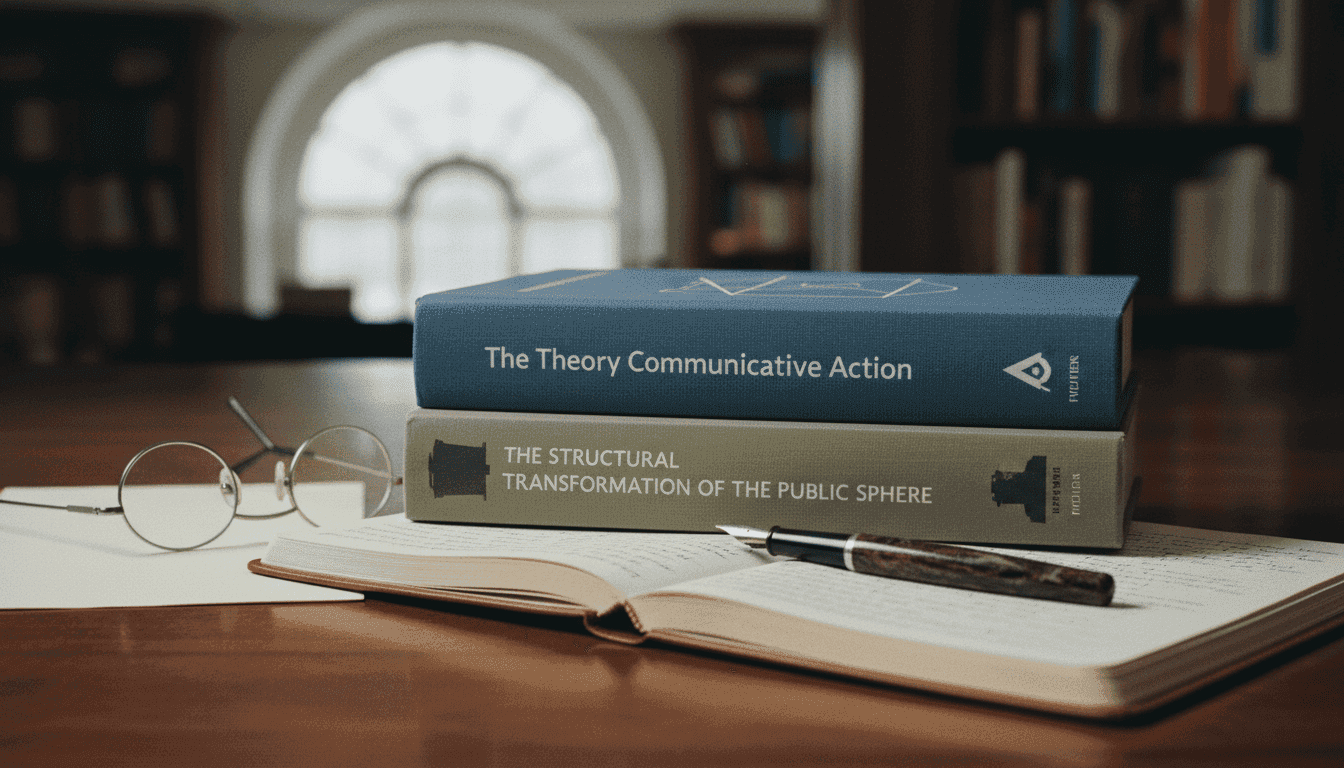
Habermas is perhaps best recognized for his groundbreaking ‘Theory of Communicative Action,’ a two-volume magnum opus published in 1981. This seminal work posits that rational discourse, rather than strategic maneuvering, is the path to mutual understanding and coordinated social action. Central to this theory is the ‘ideal speech situation,’ a hypothetical construct where participants engage freely and equally, allowing the most compelling argument to prevail uncoerced. Its impact has been immense, permeating political philosophy, sociology, and communication studies.
The Structural Transformation of the Public Sphere
Another of his defining contributions, ‘The Structural Transformation of the Public Sphere,’ published in 1962, meticulously traced the historical evolution of the public sphere in Europe. He argued for its indispensability in democratic societies, where open and rational debate among private individuals could effectively challenge entrenched power structures and foster genuine democratic participation. This concept remains a cornerstone of contemporary discussions on media, democracy, and civil society.
Associated with the second generation of the influential Frankfurt School, Habermas continued the legacy of critical theory. He served as an assistant to Theodor W. Adorno at the Institute for Social Research in Frankfurt during the late 1950s, absorbing and later expanding upon the critical insights of his predecessors while forging his distinct intellectual path.
“His analytical rigor shaped democratic discourse far beyond the borders of our country, acting like a beacon in a raging sea.”
German Chancellor Friedrich Merz eloquently lauded Habermas as “one of the most important thinkers of our time,” underscoring the profound global impact of the German philosopher. His influence spans an extraordinary range of disciplines, including communication studies, cultural studies, moral theory, law, linguistics, political science, and sociology. Habermas was not merely an academic; he was a quintessential public intellectual, frequently engaging in crucial political and social debates both within Germany and internationally.
Notably, he played a pivotal role in the ‘Historians’ Dispute’ of the 1980s, fiercely opposing attempts to relativize the atrocities of Nazism and steadfastly emphasizing the unique and unparalleled magnitude of the Holocaust. His unwavering advocacy for European unity and trenchant critiques of nationalism were also hallmarks of his public engagement, reflecting a consistent commitment to rational discourse and democratic ideals.
A Lasting Intellectual Legacy
The market impact of Habermas’s work is undeniable. His extensive bibliography includes numerous influential books, with ‘The Structural Transformation of the Public Sphere’ and ‘The Theory of Communicative Action’ standing as his most significant. The sheer volume of scholarship dedicated to his ideas is staggering, with over 14,000 books and articles focusing on his theories. In 1998, the International Sociological Association recognized ‘The Theory of Communicative Action’ as the eighth most important sociological book of the 20th century, cementing its place in the intellectual canon.
Habermas’s enduring legacy lies in his comprehensive vision of modern society, his robust defense of modernity and civil society, and his persistent exploration of the possibilities for reason, emancipation, and rational-critical communication within complex modern institutions. Even in his final years, the German philosopher continued to contribute vital insights to public discourse. His most recent work, ‘Things Needed to Get Better,’ published as recently as December 2025, demonstrated his unwavering optimism, expressing a refusal to “let defeatism have the last word” in confronting contemporary global crises. For more trending stories, visit our archives.
The passing of Jürgen Habermas at 96 signifies not only the loss of a brilliant mind but also a poignant moment for global intellectual discourse. His theories will continue to shape how we understand communication, democracy, and the pursuit of a more rational and just society. Scholars, policymakers, and citizens alike will undoubtedly continue to grapple with and draw inspiration from his profound contributions for generations to come, as his beacon of analytical rigor continues to shine.