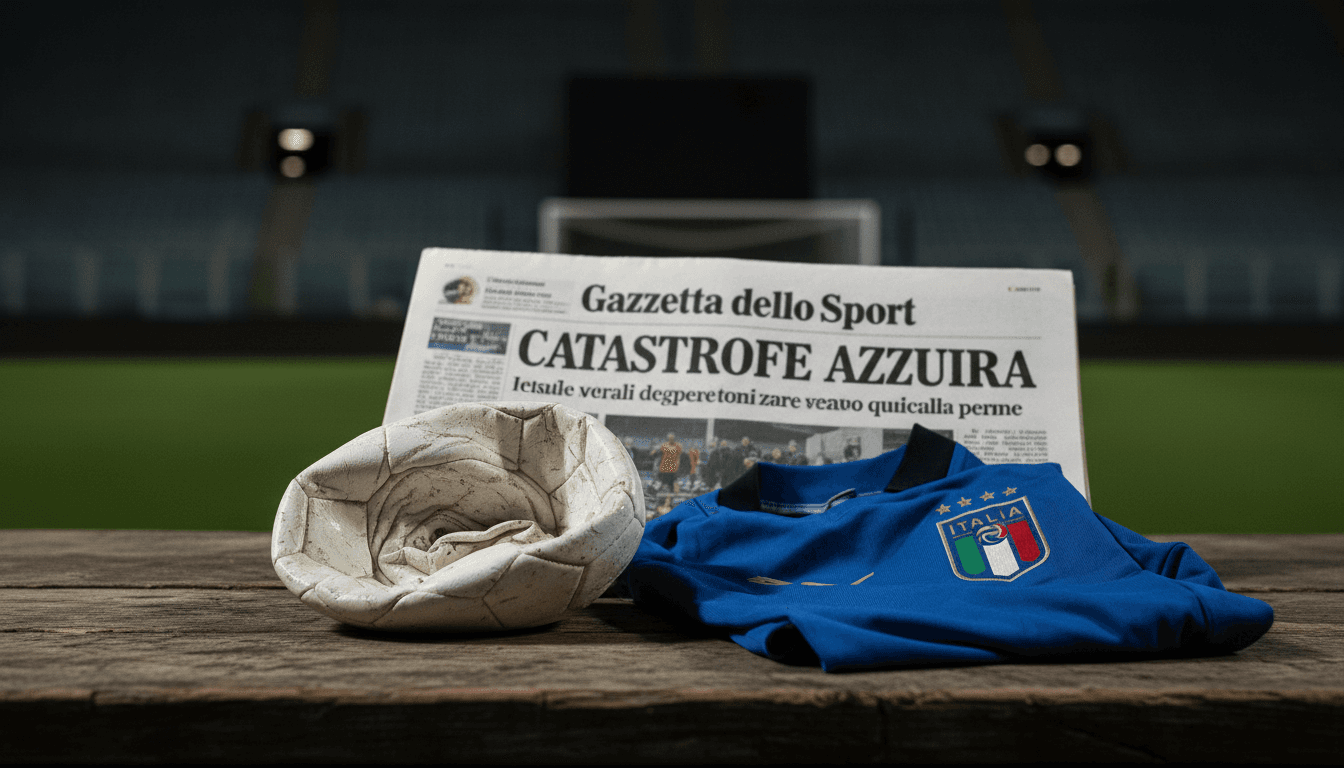
The Italy World Cup qualification failure has plunged the nation into what is being widely termed its ‘third apocalypse’ in football, sparking widespread national devastation and a profound questioning of the sport’s structural integrity. For the third consecutive time, the Azzurri, four-time World Cup champions, will be absent from football’s premier global tournament, a streak unprecedented for any former champion.
The latest hammer blow arrived on March 31, 2026, as Italy succumbed to Bosnia and Herzegovina in a penalty shootout, losing 4-1 after a 1-1 draw following extra time in their qualifying playoff. This defeat follows similar heartbreak in 2018 against Sweden and a stunning upset by North Macedonia in 2022. The repetitive nature of these exits has transformed national shock into a deep-seated despair, signaling a systemic malaise rather than mere misfortune.
Adding a poignant layer of irony to this crisis is the memory of Italy’s triumph at Euro 2020 (played in 2021). That victory, achieved just months before the 2022 World Cup qualification failure, had offered a fleeting sense of renewed glory, only to amplify the subsequent fall. Roberto Mancini, the architect of that European success, initially stayed on after the 2022 debacle but was later replaced. Gennaro Gattuso, the coach for the 2026 campaign, now faces intense scrutiny, though Italian Football Federation (FIGC) president Gabriele Gravina has publicly asked him to remain.
The Economic Fallout of Non-Qualification
Beyond the emotional toll, the Italy World Cup qualification failure carries substantial economic ramifications. The Italian Football Federation (FIGC) is bracing for significant financial losses, estimated at approximately 30 million euros due to non-qualification for the 2026 World Cup. This figure includes an estimated 9.5 million euros from sponsorship deals that contained clauses for reduction in the event of the team’s absence from the tournament.
Furthermore, Italy misses out on FIFA’s prize money, which includes a $9 million participation fee and an additional $1.5 million for preparation costs – roughly 9 million euros in total. This direct financial hit to the FIGC is just the tip of the iceberg.
“Soccer isn’t just entertainment in our country; it’s part of our culture and national identity.”
The broader economic ecosystem also suffers. Sponsors scale back planned investments, significant advertising campaigns tied to the World Cup are shelved, and existing commercial agreements lose considerable value. Television interest inevitably wanes, leading to reduced audiences and a weakening of broadcasting rights values. Sectors like television sales, restaurants, and the burgeoning betting industry experience a downturn as the national buzz and associated consumer spending dissipate. Some reports, such as those from Coldiretti, an association of agricultural producers, have previously linked major tournament victories to a potential 0.7% to 1% increase in GDP over subsequent periods; these potential economic boosts are now unequivocally lost.
Systemic Cracks and Calls for Overhaul
The sentiment across Italy, echoed by leading sports newspaper The Gazzetta dello Sport, which labeled the latest ouster “The third apocalypse,” is that this is no longer a shock but a disturbing new norm. This widespread disillusionment has fueled calls for a radical overhaul of Italian football, starting at the very top. Sports Minister Andrea Abodi and former Italian Premier Matteo Renzi are among those advocating for new leadership at the FIGC, viewing the current crisis as a deep-seated structural failure.
Concerns are mounting over the declining pipeline of young talent, with many lamenting the decreasing number of children engaging in street football – once the fertile ground for future stars. There’s a pervasive perception that the national team is neglected between major tournaments, with coaches’ pleas for more training camps outside of FIFA international breaks often falling on deaf ears. The problems extend to club football as well, with Italian clubs struggling to make a mark in European competitions. The last Italian club to win the Champions League was Inter Milan in 2010, and in the current season, all four Italian clubs exited before the quarterfinals, highlighting a broader decline in the domestic game.
What’s Next for Italian Football?
The immediate future for Italian football is clouded by uncertainty. The calls for Gennaro Gattuso’s resignation are likely to intensify, despite the FIGC president’s support. More critically, the spotlight will remain firmly on the leadership of the FIGC and its ability to instigate meaningful, long-term reforms. Any proposed changes will need to address the fundamental issues of youth development, the relationship between clubs and the national team, and the overall strategic vision for Italian football.
The financial implications will continue to ripple through the sport, potentially impacting grassroots programs and infrastructure development. The repeated Italy World Cup qualification failure demands more than just a change of coach; it necessitates a comprehensive re-evaluation of how football is governed, nurtured, and developed in a nation where it is intrinsically linked to national pride and identity. The path to recovery will be long and arduous, requiring unprecedented unity and a clear, actionable strategy to avoid a fourth apocalypse.