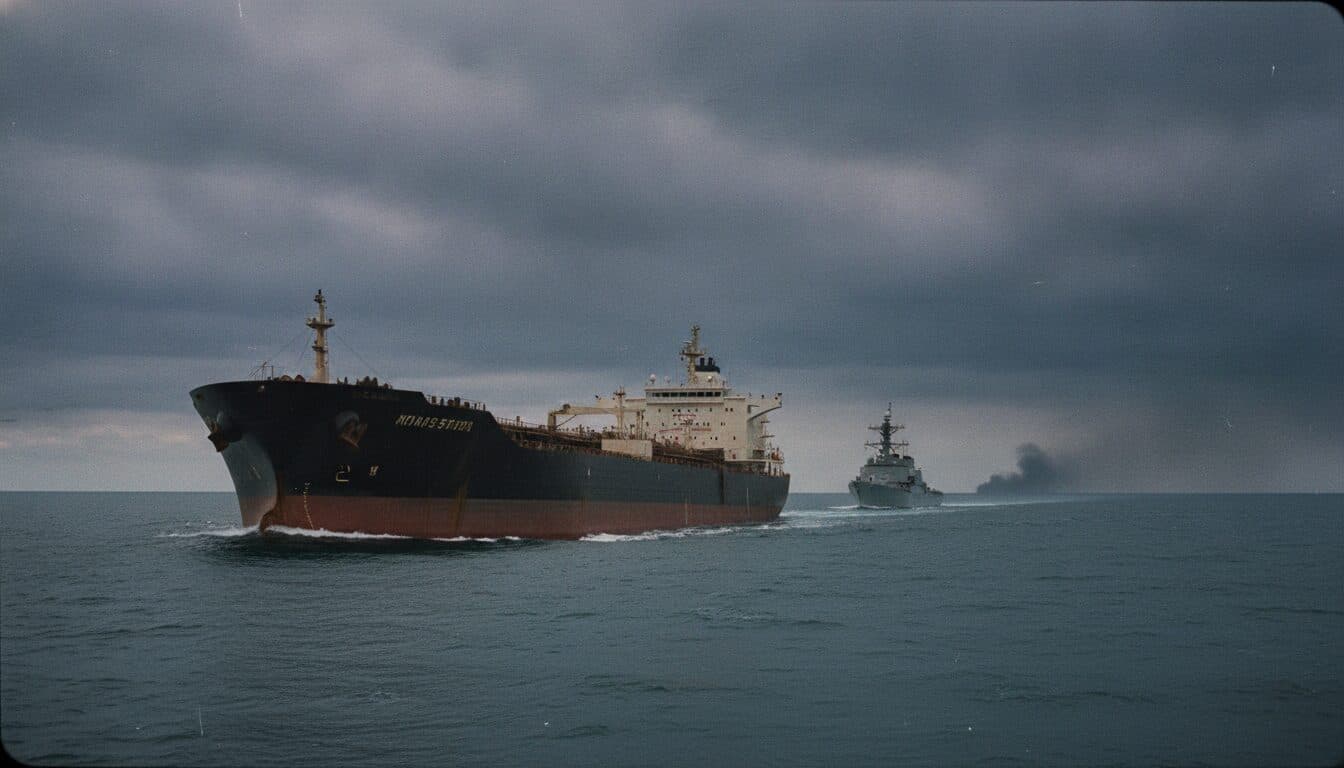
The fragile de-escalation efforts in the Middle East sustained a direct hit this week, as Iran attacked a Singaporean-flagged cargo vessel, the *Ever Lovely*, in the Strait of Hormuz. The incident, occurring on Thursday, June 25, 2026, near the Omani coast, immediately ratcheted up geopolitical tensions and sent ripples of concern through global shipping and oil markets. The Strait of Hormuz, a critical chokepoint for a significant portion of the world’s oil transit, has once again become a flashpoint, underscoring the precarious balance of stability in the region.
U.S. officials swiftly confirmed that Iran’s Islamic Revolutionary Guard Corps (IRGC) was responsible for the drone strike on the *Ever Lovely*’s bridge. The attack, which took place at 5:40 p.m. local time (10:10 a.m. ET) approximately 7.5 nautical miles southeast of Dahit, Oman, targeted a 101,063 gross tonnage container ship built in 2015 and owned by Evergreen Marine (Asia), a subsidiary of Taiwan’s Evergreen Marine. Fortunately, the damage was minor, limited to the bridge eaves and two windows, and all 21 crew members were reported safe with no injuries or environmental impact. The vessel has since completed its transit and is continuing its voyage, a testament to its resilience but not to the region’s newfound peace.
This strike holds particular significance given its timing and target. It marks the first reported Iranian attack on a cargo vessel since a ceasefire agreement was reached between the U.S. and Iran just last week, which included a 60-day extension. Furthermore, the *Ever Lovely* was navigating a route promoted by the United Nations’ International Maritime Organization (IMO). Earlier in the week, the IMO had launched an evacuation plan to assist over 11,000 stranded seafarers and hundreds of ships that had been largely blockaded in the Strait of Hormuz since the start of the war in late February. Although the *Ever Lovely* was not operating under this specific evacuation framework, the attack prompted IMO Secretary-General Arsenio Dominguez to temporarily pause the entire plan to reconfirm safety guarantees for all vessels in the region. Dominguez stated that the IMO is working “vigilantly” with Oman, the United States, and Iran to find these guarantees and resume the critical evacuation process.
Hours before the drone strike, Iran’s Revolutionary Guard Corps Navy issued a stark warning, asserting that safe passage through the Strait of Hormuz was limited to routes designated by Tehran, deeming all other pathways “unacceptable and completely dangerous.” This was echoed by Iran’s newly established Persian Gulf Strait Authority, a government agency tasked with managing shipping in the strait, which declared that vessels outside its set routes would not be guaranteed safe passage and that “consequences arising from passage through unauthorized routes shall be the responsibility of the owner, operator and vessel commander.” This unilateral assertion of control directly challenges international maritime law and longstanding principles of free navigation.
“The attack on the Ever Lovely in the Strait of Hormuz represents a significant setback for regional de-escalation and highlights the persistent volatility of this crucial global waterway.”
The United States and the Gulf Cooperation Council (GCC) countries have strongly condemned these attempts to assert control over the Strait of Hormuz. In a joint statement issued after a ministerial meeting in Manama, Bahrain, co-chaired by U.S. Secretary of State Marco Rubio and Bahraini Minister of Foreign Affairs Dr. Abdullatif bin Rashid Al Zayani, they emphasized the need for “free, unconditional, and unrestricted navigation,” including the fundamental right of transit passage under international law. They explicitly rejected “any tolls, fees, or attempts to assert control” over the Strait of Hormuz. The ministers also acknowledged the June 17 memorandum of understanding between the US and Iran and recognized the mediation roles played by Pakistan and Qatar, stressing the need to maintain “momentum and unity” as negotiations proceed toward a more permanent end to hostilities and the shared objective of preventing Iran from “ever developing or otherwise acquiring a nuclear weapon.”
The immediate impact of this incident is a renewed spike in risk premiums for shipping in the Persian Gulf. Insurers are likely to re-evaluate their coverage, potentially leading to higher costs for vessels transiting the area. For the global energy markets, any sustained disruption or perceived threat to the Strait of Hormuz translates directly into higher oil prices, as approximately one-fifth of the world’s total petroleum liquids consumption, or about 21 million barrels per day, passes through this narrow channel. Businesses relying on timely delivery of goods through this route will face increased uncertainty and potentially higher supply chain costs. The attack on the *Ever Lovely* serves as a stark reminder of the geopolitical risks inherent in global trade and the interconnectedness of seemingly distant conflicts.
Looking ahead, the immediate priority for international bodies and regional powers will be to re-establish safety guarantees for shipping and resume humanitarian efforts like the IMO’s evacuation plan. The attack directly undermines the fragile ceasefire and puts pressure on the ongoing negotiations between the U.S. and Iran. The international community will be watching closely to see if this incident is an isolated act of defiance or a precursor to a more aggressive posture from Tehran. The challenge for diplomats and policymakers will be to de-escalate without capitulating to Iran’s demands for control over international waters. The future of shipping in the Strait of Hormuz, and indeed the broader stability of the Middle East, hangs in a delicate balance, with the *Ever Lovely* incident serving as a potent symbol of the enduring volatility.