Hungary’s new prime minister sworn in on Saturday, Péter Magyar, marks a seismic shift in European politics, bringing to an end Viktor Orbán’s formidable 16-year grip on power and ushering in an era promising democratic renewal and a recalibration of Hungary’s place within the European Union. The 45-year-old lawyer, once an insider in Orbán’s Fidesz party, has ascended to the nation’s top office on a wave of anti-corruption sentiment, securing a historic two-thirds parliamentary majority for his Tisza (Respect and Freedom) party.
Magyar’s landslide victory in the April 12, 2026, parliamentary elections, where Tisza secured 141 out of 199 seats, represents the largest majority for any party in Hungary’s post-Communist history. This stunning outcome significantly reduced Orbán’s nationalist-populist Fidesz from 135 to 52 seats, with the far-right Mi Hazánk holding six. The election saw a remarkably high voter turnout, nearing 79%, reflecting the widespread public desire for change.
From Insider to Reformer: The Rise of Péter Magyar
Péter Magyar’s journey to premiership began with a dramatic break from the establishment. In February 2024, he resigned from all government-related positions, publicly decrying alleged mass corruption under Orbán’s leadership and the government’s handling of a presidential pardon scandal. This scandal, which saw the resignations of then-President Katalin Novák and Justice Minister Judit Varga (Magyar’s former wife) over the pardoning of an official involved in covering up child sexual abuse, provided the catalyst for his political emergence.
He swiftly founded the Tisza party, rapidly transforming it into a potent opposition force. His campaign resonated deeply with a populace weary of perceived graft and democratic erosion, focusing on anti-corruption measures and the restoration of governmental checks and balances. In his inaugural speech, Magyar underscored his core philosophy, declaring he would not “rule” Hungary but “serve my homeland,” emphasizing that his mandate was for a “change of system” and not merely a change of government. He also pledged to heal the nation’s deep social divisions.
Hungary’s New Prime Minister Sworn In: A Shift in European Dynamics
The implications of Magyar’s premiership extend far beyond Hungary’s borders, promising to reshape political dynamics within the European Union. Viktor Orbán had frequently employed his veto power, often obstructing crucial EU decisions, particularly concerning support for Ukraine. Magyar, in stark contrast, is decidedly more pro-EU and anti-Russia. He has vowed to mend Hungary’s strained ties with the EU, which Orbán had pushed to a breaking point, and to reassert Hungary’s position among Western democracies.
A top priority for the new administration is unlocking approximately €17 billion (about $20 billion) in EU funds that have been frozen due to rule-of-law and corruption concerns. Unlocking these funds is seen as crucial for revitalizing Hungary’s stagnating economy. Magyar has also pledged to reduce Hungary’s reliance on Russian energy by 2035. While advocating for a more cooperative relationship with the EU, Magyar is expected to maintain tough immigration policies and favor a gradual, merit-based Ukrainian accession to the EU.
“Magyar’s victory is a powerful signal that even deeply entrenched populist regimes can be challenged and overcome when a credible alternative emerges from within the system itself.”
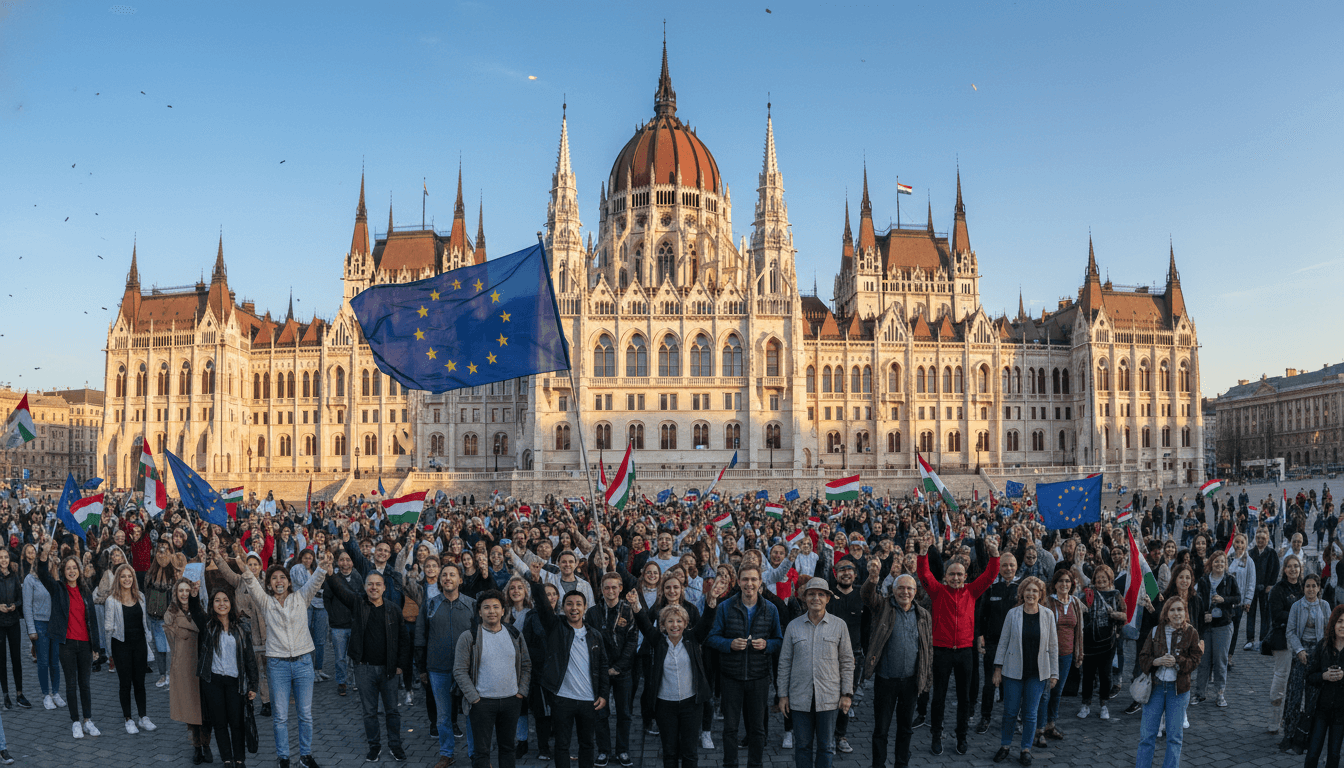
The European Commission President, Ursula von der Leyen, has already welcomed Magyar’s premiership, viewing it as a “hope and promise of renewal.” This sentiment was visibly echoed on Kossuth Square outside Parliament, where thousands gathered for an all-day “regime-change” celebration. Waving Hungarian and EU flags, attendees witnessed the symbolic reinstallation of the EU flag on the Parliament building’s facade, a sight not seen since Orbán’s government removed it in 2014.
Domestic Reforms and Public Expectations
Domestically, Magyar’s agenda is ambitious. A central promise is to establish a National Asset Recovery and Protection Office, tasked with investigating and recovering public funds allegedly misused during Orbán’s tenure. He plans comprehensive health and education reforms, aiming to rebuild public services that have deteriorated. Furthermore, he intends to review the constitutional system to prevent the over-concentration of power and propose limits on prime ministerial terms. In a move to restore media objectivity, he has vowed to suspend the news services of Hungary’s public broadcaster until reforms are implemented.
Public expectations are high. A recent poll indicated that over three-quarters of Tisza voters expect Magyar’s government to actively address the climate crisis, and more than 70% also anticipate protection for LGBTQ+ rights. These figures underscore the broad spectrum of issues the new administration is expected to tackle.
The economic landscape presents immediate challenges. Hungary faces a stagnating economy, exacerbated by the freeze of EU funds. The successful unlocking of these funds is paramount for economic revitalization and for Magyar to deliver on his promises. The departure from Orbán’s contentious policies and the embrace of a more transparent, pro-European stance could very well be the catalyst Hungary needs to attract investment and foster sustainable growth. For more trending stories, visit our news section.
What’s Next for Hungary Under Péter Magyar?
The immediate future will see Magyar’s government navigating the complexities of implementing its ambitious reform agenda while simultaneously repairing international relations. The focus will be on the tangible steps taken to combat corruption, restore democratic institutions, and engage constructively with the European Union to unlock crucial funding. The world will be watching closely to see if Magyar can translate his overwhelming electoral mandate into lasting systemic change and truly usher in an era where the government serves, not rules.