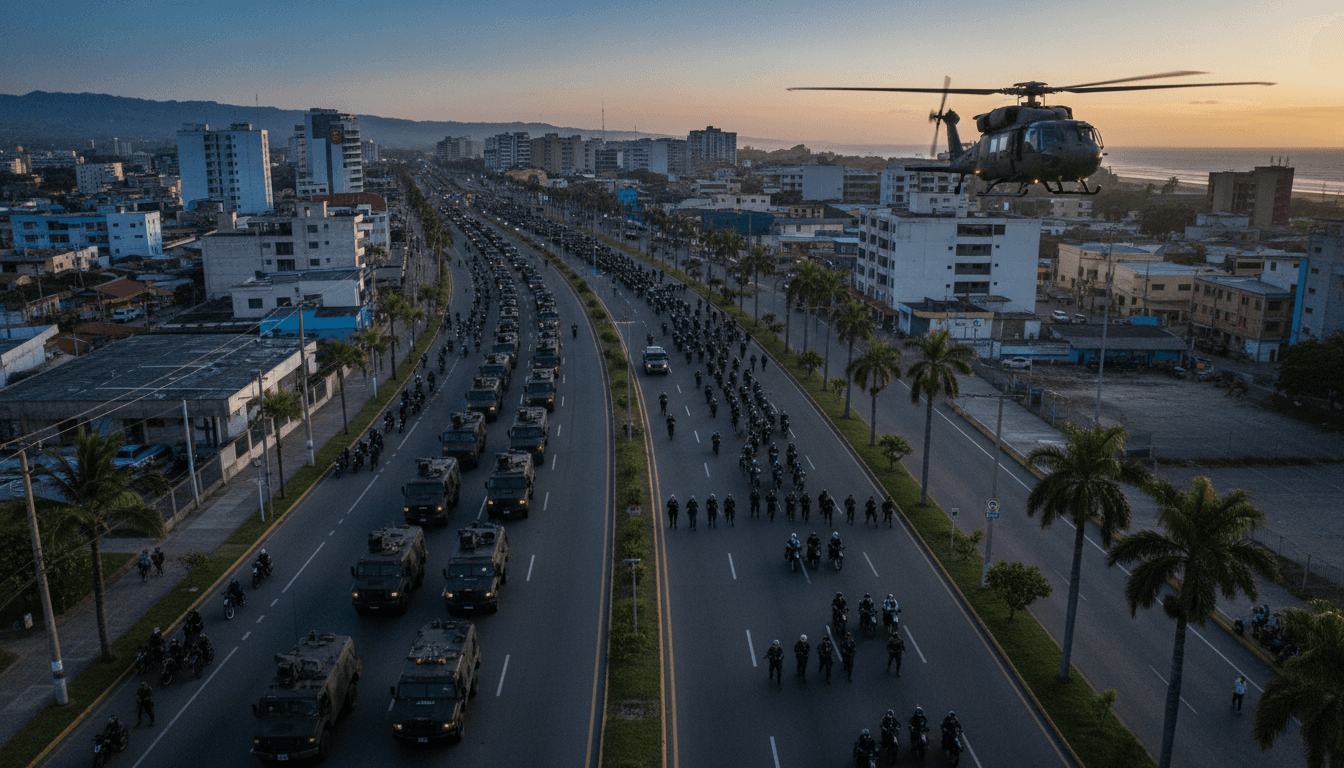
Ecuador deploys soldiers combat drug gangs in a massive, unprecedented mobilization of 75,000 soldiers and police officers across the nation, aiming to suppress escalating drug gang violence. This significant deployment, which commenced in mid-March 2026 and is scheduled to conclude on March 31, represents a “very strong offensive” against organized crime groups, particularly concentrated in the coastal provinces that have borne the brunt of drug-related violence.
The Battle for Control: Ecuador’s Escalating Crisis
Once lauded as one of South America’s safest nations, Ecuador has undergone a dramatic transformation, rapidly emerging as one of the most violent countries in the region. Its strategic location between Colombia and Peru, the world’s primary and secondary cocaine producers respectively, has made its ports critical conduits for drug trafficking. Approximately 70% of cocaine originating from these neighboring countries now passes through Ecuador. This surge in illicit trade has ignited brutal turf wars between rival gangs, heavily influenced by Mexican cartels such as the Sinaloa Cartel and Jalisco New Generation Cartel, all vying for control of lucrative drug routes and the country’s prison systems. The nation’s homicide rate, a stark indicator of this escalating crisis, reached an alarming 52 per 100,000 inhabitants in 2025 – a record high.
President Noboa’s Iron Fist and the Current Operation
President Daniel Noboa, who assumed office in November 2023, has responded to this dire situation with an “iron-fisted” security policy. In January 2024, his administration declared an “internal armed conflict,” officially designating numerous organized crime groups as “terrorist organizations” and empowering the military to neutralize them. This decisive move followed a period of intense unrest, characterized by the escape of a notorious gang leader, widespread prison riots, and targeted attacks on public institutions. The current operation is a direct manifestation of this aggressive stance. It involves roughly 75,000 security forces, bolstered by armored vehicles, motorcycles, and helicopters. Strict night-time curfews have been enforced in the most affected coastal provinces, including Guayas, Los Ríos, Santo Domingo de los Tsáchilas, and El Oro, with residents prohibited from leaving their homes between 11 PM and 5 AM.
Global Implications and International Alliance
The crisis in Ecuador extends beyond its borders, carrying significant global implications. As a pivotal transit point for cocaine destined for Europe and the United States, the instability in Ecuador directly impacts international drug markets and security efforts. In response, Ecuador has significantly deepened its security partnership with the United States. This collaboration encompasses logistical support for operations, crucial intelligence sharing, maritime interdiction, and specialized training for Ecuadorian forces. The US further solidified this alliance by launching a 17-country cartel-fighting initiative named “Shield of the Americas” in March 2026, which Ecuador has readily joined. Joint military operations between Ecuador and the US commenced earlier this month, signaling a concerted international effort to combat the entrenched power of these criminal organizations. For more trending stories on global security, visit our news section.
Ecuador Deploys Soldiers Combat Drug Gangs: Expert Perspectives and Challenges Ahead
While President Noboa’s aggressive strategy initially led to a reduction in the homicide rate in 2024, violence regrettably surged again in the first half of 2025, marking it as the most violent semester on record. Experts caution that while such crackdowns send a powerful message, military deployments alone may not be sufficient to dismantle the complex and deeply rooted drug markets. There are growing concerns among human rights groups regarding potential abuses by security forces, with frequent states of emergency and heavy military presence drawing criticism. Amnesty International, for instance, documented enforced disappearances in 2024, directly linked to the militarized security strategy.
“While military force is a necessary component, a sustainable solution demands a multi-pronged approach that addresses corruption, strengthens public services, and tackles the socio-economic roots of gang recruitment.”
The drug trade has not only fueled violence but also diversified gang activities into arms trafficking, illegal mining, and other illicit enterprises. Rampant corruption within ports, prisons, and state institutions is widely recognized as a critical enabler of the escalating crime wave. Critics emphasize the urgent need for robust public services in crime-hit areas and a more resolute stance against systemic corruption to effectively combat the issue. The government has pledged a record investment of $230 million to fight crime, earmarking $180 million specifically for security equipment, including helicopters, vessels, radars, scanners, and drones, demonstrating a significant commitment to bolstering its capabilities.
What’s Next: A Nation at a Crossroads
The coming weeks will be crucial in determining the immediate effectiveness and long-term implications of this massive security operation. As Ecuador deploys soldiers combat drug gangs, the success of this offensive will hinge not only on military might but also on the government’s ability to address underlying systemic issues, including corruption and socio-economic disparities. The international community will closely watch for signs of sustained reduction in violence, adherence to human rights, and the implementation of comprehensive strategies that go beyond mere repression. The outcome will significantly impact Ecuador’s future, its economic stability, and its role in the global fight against organized crime.