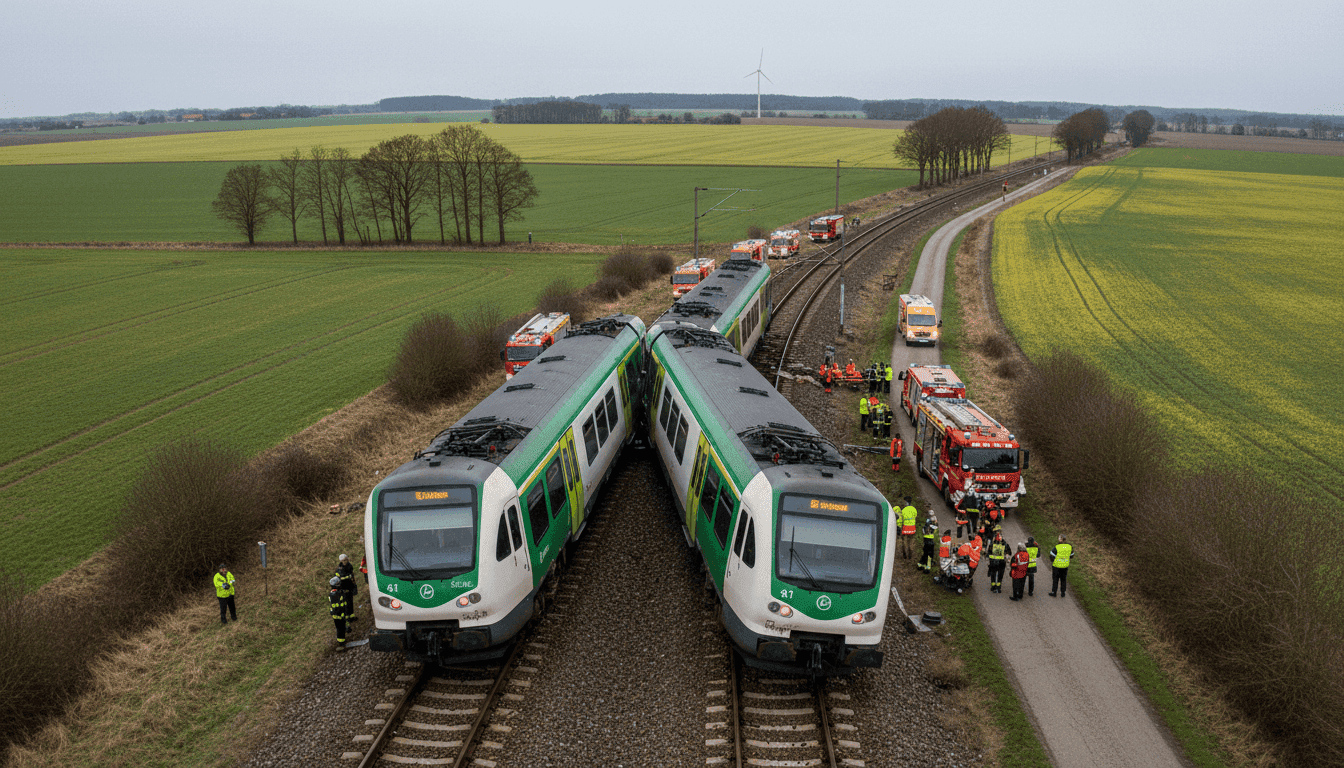
A major Denmark train collision has sent shockwaves through the Scandinavian nation, leaving five individuals in critical condition and a total of 17 injured following a head-on impact between two local trains. The devastating incident occurred around 6:30 AM on Thursday, April 23, 2026, on the Gribskov Railway line connecting the towns of Hillerød and Kagerup in North Zealand, approximately 40 kilometers north of Copenhagen. With 38 passengers on board the two trains, the early morning commute turned into a scene of significant emergency response and urgent medical evacuation.
The Unfolding Disaster in North Zealand
The collision, which took place near a level crossing at Isterødvejen, north of Hillerød, prompted an immediate and extensive emergency operation. A total of 18 vehicles and 47 personnel were deployed to the scene, working to extract and treat the injured. Critically hurt individuals were swiftly transported by helicopter and ambulance, underscoring the severity of their conditions. For those involved and their anxious relatives, a crisis center has been established in Hillerød, offering support and information in the wake of the traumatic event.
Photographs from the crash site reveal substantial damage to the front sections of both trains, though remarkably, they remained upright on the tracks. This detail, while perhaps preventing a more catastrophic derailment, highlights the force of the head-on impact. The local railway line, a vital artery for residents, employees, and schoolchildren in the region, has been completely shut down, causing significant disruption to rail connectivity north of Copenhagen. Commuters in northern Zealand have been advised to anticipate considerable delays and to seek alternative travel arrangements.
Investigation into the Denmark Train Collision
The immediate aftermath of the Denmark train collision has centered on an intensive investigation led by Denmark’s Accident Investigation Board (Havarikommissionen) in close cooperation with the North Zealand police. Inspector Morten Pedersen of the North Zealand police has cautioned that it is “far too early” to definitively state the cause of the crash. However, he confirmed that information regarding potential signal errors will be a crucial component of the ongoing inquiry.
“We are deeply shaken and shocked by this incident. It is imperative that we understand precisely what happened to ensure such a head-on collision never happens again.”
While official conclusions are pending, expert perspectives have begun to emerge, offering preliminary theories. One expert suggested that a train driver might have overridden a stop signal while departing from a local station, potentially leading to one of the trains veering onto the wrong line. Such an error, if confirmed, would point to a critical lapse in operational safety or system failure, demanding a thorough review of protocols and technology. The investigation will undoubtedly scrutinize signaling systems, human factors, and track infrastructure.
Broader Context and Market Repercussions
Train accidents, particularly head-on collisions, are a relatively rare occurrence in Denmark, a country generally known for its robust infrastructure and safety standards. However, this incident adds to a series of notable rail accidents in recent years, prompting concerns about overall rail safety. In January 2019, eight people died and 16 were injured on the Great Belt Bridge when a passenger train struck a semi-trailer that had been blown off a freight train during a storm. More recently, in August of the previous year, an express train collided with a farm truck at a crossing, resulting in one fatality and 27 injuries. These preceding events provide a somber backdrop to the current situation, intensifying the public and political pressure for a comprehensive understanding of this latest disaster.
The immediate market impact of the Denmark train collision appears to be localized to the affected rail services. The suspension of operations on the Gribskov Railway line between Hillerød and Kagerup for safety checks has directly impacted local commuter routes. While there isn’t a broader national or international market disruption, the incident underscores the vulnerability of critical infrastructure to unexpected events and the ripple effect on daily life and local economies. Hillerød Mayor Christoffer Lorenzen expressed his profound sadness, describing the collision as “very serious,” while Trine Egetved, the mayor of Gribskov Municipality, where the accident occurred, emphasized the need to prevent any recurrence.
What’s Next for Danish Rail Safety
The coming weeks and months will be critical for the Accident Investigation Board as they piece together the precise sequence of events that led to this tragic Denmark train collision. The findings will likely have significant implications for rail safety protocols, driver training, and potentially the technological upgrades of signaling systems across Denmark’s railway network. Beyond the immediate recovery and investigation, there will be intense scrutiny on how preventative measures can be strengthened to safeguard commuters and ensure public confidence in the nation’s rail system. The local communities, still reeling from the shock, will be keenly watching for answers and assurances that such a devastating event will indeed never happen again. For more trending stories, visit our news section.