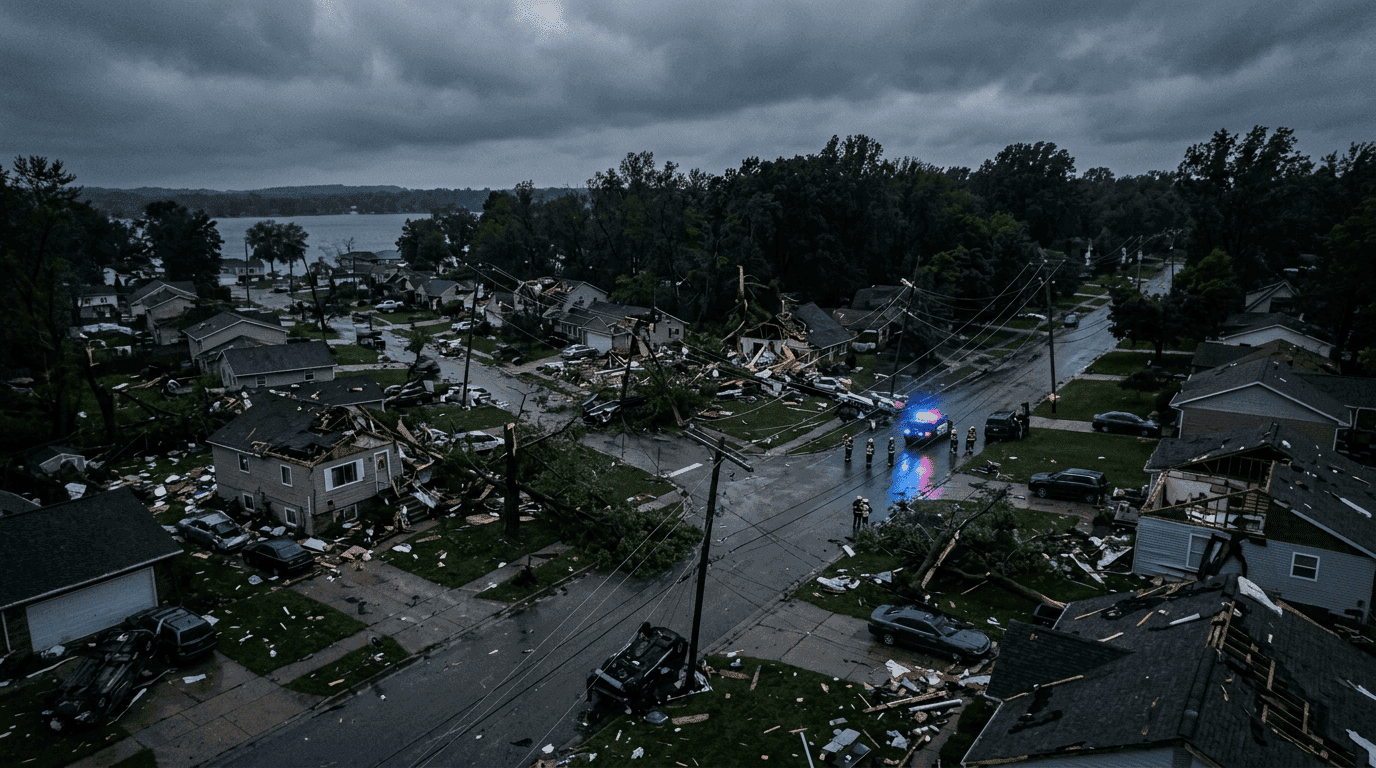
Deadly tornado outbreak conditions have shattered a period of relative atmospheric calm in the United States, leaving a trail of destruction across the Heartland and claiming at least eight lives between March 5 and March 7, 2026. This violent series of storms, which impacted 12 states stretching from the Southern Plains to the Great Lakes, has effectively ended a 256-day streak without a tornado-related fatality—the second-longest such period in American history. As recovery efforts begin in earnest, the global community is closely monitoring the economic and environmental signals sent by this unseasonably early and intense meteorological event.
The human toll of the storms has been concentrated most heavily in Michigan and Oklahoma, where the speed and intensity of the twisters caught many residents off guard. In Michigan, the southwestern portion of the state bore the brunt of the violence on Friday, March 6. The Branch County Sheriff’s Office confirmed three fatalities in the Union Lake area near Union City. Tragically, the loss of life extended to neighboring Cass County, where 12-year-old Silas Anderson was killed when a tornado struck near Edwardsburg. These events represent a rare and chilling start to the spring storm season in a region where March tornadoes are historically infrequent.
Oklahoma experienced the initial surge of the outbreak on Thursday, March 5. Near Fairview in the western part of the state, an EF-2 tornado intercepted a vehicle, resulting in the deaths of 47-year-old Jodie Owens and her 13-year-old daughter, Lexie Owens. The violence continued into Friday evening when two additional fatalities were confirmed in Beggs, located in Okmulgee County, after a residential home was completely leveled by the wind. Beyond the confirmed deaths, dozens of injuries have been reported, and emergency rooms across both states remain at high capacity as they treat victims of the more trending stories emerging from the debris fields.
Analyzing the Deadly Tornado Outbreak
Meteorologists at the National Weather Service (NWS) are describing the event as a “perfect storm” of rare atmospheric conditions. According to NWS expert David Roth, the primary catalyst was a significant destabilization of the stratospheric polar vortex, which underwent a complete split between March 3 and March 5. This rare phenomenon allowed an anomalous thermal ridge to build over the eastern United States, driving temperatures 20 to 30 degrees above seasonal averages. This heat provided the energy necessary for a powerful weather system to pull deep moisture from the Gulf of Mexico, which then collided with a sharp, fast-moving cold front.
The resulting instability produced an EF-3 tornado in Union Lake, Michigan, featuring winds exceeding 150 mph. This marks the strongest March twister to hit the state in 16 years. Other confirmed ratings from the NWS include an EF-2 near Three Rivers, Michigan, and multiple EF-2 tracks across Oklahoma with wind speeds reaching 120 mph. Lonnie Fisher, another NWS meteorologist, noted that the storms intensified with “terrifying speed” as they crossed the state line from northern Indiana into Michigan, leaving little time for advanced warnings to reach the public.
“The sheer volume of debris and the speed at which these cells developed created a worst-case scenario for emergency responders. We are looking at miles of debris and downed power lines that have made search-and-rescue operations incredibly difficult.”
Jeff Moore, the Emergency Management Director for Okmulgee County, emphasized the logistical nightmares facing local authorities. The scale of the destruction following this deadly tornado outbreak has prompted Governors Gretchen Whitmer of Michigan and Kevin Stitt of Oklahoma to declare states of emergency in several counties, a move designed to expedite the flow of state and federal recovery funds to the hardest-hit municipalities.
The economic ramifications of the 2026 outbreak are expected to be felt far beyond the local communities. Infrastructure damage is widespread; a Menard’s store in Three Rivers and the Tulsa Tech Peoria campus are among the major commercial structures that sustained significant damage. Industry analysts are already drawing parallels to a similar March outbreak in 2017 that resulted in $2.2 billion in inflation-adjusted damages. For the insurance industry, the timing could not be worse. Reinsurance experts suggest that the consequences of the deadly tornado outbreak will further strain a regional insurance market that has already seen a 31% average increase in Midwestern home insurance rates over the last five years.
On the global stage, the disaster coincided with heightening geopolitical tensions, contributing to a surge in crude oil prices. Traders, weighing the potential impact of natural disasters on domestic energy infrastructure, pushed oil prices above $90 per barrel as news of the destruction spread. This intersection of environmental catastrophe and market volatility highlights the fragile nature of the current global economic landscape.
As the NWS continues to survey damage paths and finalize data, the focus remains on the immediate needs of the survivors. However, the broader implications of an early-season EF-3 tornado in the Great Lakes region cannot be ignored. Climate scientists and emergency managers alike warn that the 2026 season may demand a fundamental shift in how the public perceives early-spring weather risks. The rapid intensification of these storms suggests that the traditional “tornado alley” boundaries and timelines are becoming increasingly obsolete in a changing climate.
Looking ahead, the recovery process will likely take months, if not years, for towns like Union Lake and Beggs. Investors and policymakers will be watching the reinsurance market closely to see if this event triggers another round of premium hikes or coverage withdrawals in the Midwest. For now, the focus is on the eight lives lost and the urgent need for heightened vigilance as the 2026 storm season begins with a devastating and historic reminder of nature’s power.