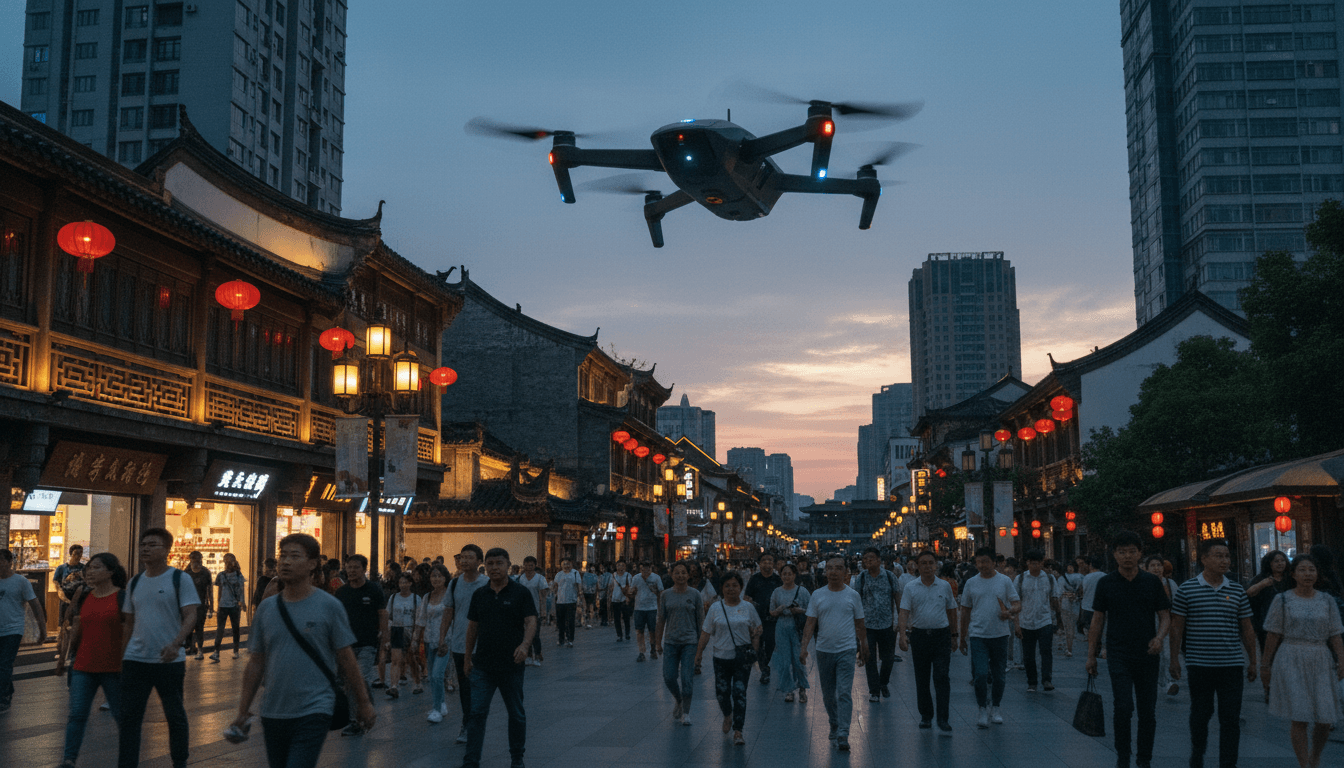
China’s drone industry control is tightening its grip on domestic airspace, a move that reverberates globally and raises significant international concerns about technology access and pervasive surveillance. As the undisputed global leader in drone manufacturing and export, Beijing’s escalating regulations, particularly since 2024, are not merely an internal housekeeping exercise but a strategic maneuver with far-reaching implications for the future of drone technology worldwide.
The new regulatory framework, culminating in sweeping changes by May 2026, fundamentally transforms how drones operate within Chinese borders. At its core, it mandates real-name registration for virtually all drones, from micro-drones under 250 grams to light drones under four kilograms. This means linking flight equipment to official identification or cellphone numbers, creating an unprecedented level of traceability. Furthermore, permits are now a prerequisite for flights in most urban restricted zones, requiring at least a day’s advance notice. Beijing, for example, has enacted a near-total ban on drones within its limits, prohibiting the sale, rental, or import of drones or their key components into the capital as of May 2026.
The Aerial Surveillance Grid Takes Shape
Perhaps the most significant development is the requirement for real-time flight data transmission to the government. This establishes a persistent aerial surveillance grid, meticulously mapping every drone movement across the country. Coupled with hardware-level restrictions that ground unregistered or unactivated aircraft and mandate remote identification support for all drones, older models may soon become unusable in China. The consequences for non-compliance are severe: since January 2026, penalties for unauthorized drone flying have been ramped up to include possible jail time, with social media already rife with accounts of users facing questioning, fines, detention, and confiscation of their equipment.
“China’s regulatory framework fundamentally differs from Western systems, prioritizing security and economic development over individual privacy. The government’s approach transforms drones into networked nodes within a national surveillance infrastructure,” observes Drew Thompson, a former Pentagon official and senior fellow at Singapore’s S Rajaratnam School of International Studies.
This aggressive regulatory push is understood to be driven by a dual imperative: to prepare for a burgeoning ‘low-altitude economy’ and, crucially, to bolster national security. The global proliferation of inexpensive drones for surveillance and attack in conflicts such as those in Ukraine and Iran has undoubtedly underscored to Beijing the potential vulnerabilities to its senior leadership and critical infrastructure. This proactive approach to China’s drone industry control is a direct response to these evolving threats.
Global Repercussions of China’s Drone Industry Control
China’s dominance in the global drone market, largely spearheaded by Shenzhen-based DJI, which commands over 90% of the consumer drone market and nearly 70% of the overall sector, is a direct outcome of strategic government industrial policy, including the ‘Made in China 2025’ initiative. However, Beijing’s tightening grip extends beyond its borders, sending ripples across the international drone landscape.
In late 2025, the FCC’s decision to add all foreign-made drones and Chinese components to its Covered List effectively banned future Chinese drones and subsystems from the U.S. market, citing national security concerns. This move significantly impacts U.S. drone manufacturers who have historically relied on Chinese components like batteries, motors, and flight controllers. Concurrently, China imposed export restrictions on drone parts to Ukraine and Russia in September 2024, following an earlier ban in June 2023 on long-range drones. These restrictions have demonstrably hampered Ukraine’s ability to produce critical frontline drones, while Russia, despite its heavy reliance on Chinese components, continues to find avenues for supply.
The U.S. and its allies are in an accelerated race to reduce their dependency on Chinese drones, driven by concerns over data transmission, surveillance, and national security risks. The U.S. Army banned PRC-origin drones in 2017, and the Pentagon labeled DJI a “Chinese military company” in 2022. Yet, Chinese-made drones remain pervasive in various U.S. commercial, government, and consumer applications due to their competitive pricing and advanced features. The new Chinese regulations and export controls are expected to accelerate consolidation among drone manufacturers, pushing out smaller companies unable to absorb the costs of incorporating identification modules and registration locks. This scenario simultaneously presents a significant opportunity for the U.S. and other Western nations to cultivate their own domestic manufacturing capacity for drone components.
What’s Next for the Drone Ecosystem
The trajectory set by China’s drone industry control indicates a future where drone operations, both domestically and internationally, will be subject to unprecedented scrutiny and fragmentation. The immediate challenge for global players will be to navigate a market increasingly bifurcated by geopolitical tensions and diverging regulatory philosophies. For Western nations, the imperative to de-risk supply chains and foster indigenous drone technology will intensify, potentially leading to significant investments in research, development, and manufacturing.
The global drone industry stands at a critical juncture. China’s tightening of its domestic skies, while ostensibly for internal security and economic development, is undeniably reshaping global access to drone technology and pushing the boundaries of state-sponsored aerial surveillance. The implications for privacy, national security, and technological innovation will continue to unfold, demanding close attention from governments, industries, and consumers worldwide.