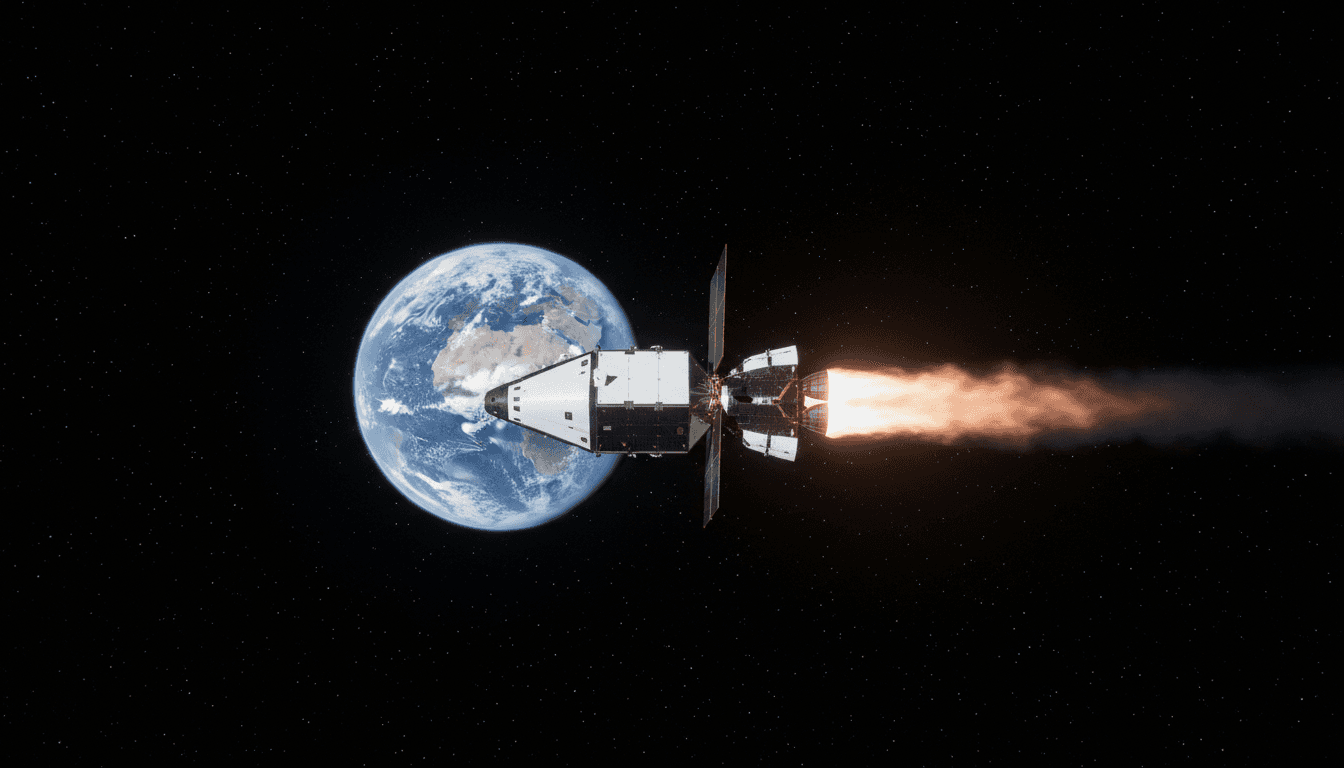
The Artemis II lunar mission has successfully left Earth’s orbit, marking a monumental achievement for NASA and its international partners, propelling humanity back towards the Moon for the first time in over half a century. Launched on April 1, 2026, at 6:35 p.m. EDT from Kennedy Space Center’s Launch Complex 39B, this mission carries four astronauts on a 10-day journey around the Moon and back, reigniting the flame of deep-space exploration.
The Orion spacecraft, atop NASA’s powerful Space Launch System (SLS) rocket, performed a flawless translunar injection (TLI) burn on April 2, accelerating out of Earth’s gravitational pull after approximately 24 hours of meticulous system checks in low Earth orbit. This critical maneuver has set the crew – Commander Reid Wiseman, Pilot Victor Glover, and Mission Specialist Christina Koch (all from NASA), alongside Mission Specialist Jeremy Hansen from the Canadian Space Agency (CSA) – on a precise trajectory towards the Moon. The journey to the Moon is anticipated to take about four days, culminating in a free-return trajectory that will loop them around Earth’s celestial neighbor before their return.
The Historic Artemis II Lunar Mission Crew and Objectives
This mission is etched into the annals of history not just for its destination, but for its trailblazing crew. Victor Glover becomes the first person of color, Christina Koch the first woman, and Jeremy Hansen the first Canadian to venture to the Moon. Their presence underscores a new era of inclusivity and international collaboration in space exploration.
The primary objectives of Artemis II are rigorously focused on validating the Orion spacecraft’s systems and hardware under the harsh conditions of deep space. This critical test flight will assess life-support, navigation, and communication systems, ensuring their reliability for future lunar surface missions. The data gathered from this 10-day endeavor will be invaluable in paving the way for Artemis III, which aims to land humans on the Moon once more.
The astronauts are projected to break new ground in terms of distance, traveling farther from Earth than any humans before them. Orion will pass approximately 4,700 miles (7,600 km) beyond the Moon, surpassing the record set by the Apollo 13 crew in 1970. Upon their return, the spacecraft’s atmospheric reentry speed is expected to be a blistering 25,000 miles per hour (40,000 km/h), a testament to the engineering marvels involved.
“Today, for the first time since Apollo 17 in 1972, humans have departed Earth orbit. Reid, Victor, Christina, and Jeremy now are on a precise trajectory toward the Moon,” stated Dr. Lori Glaze, acting associate administrator for the Exploration Systems Development Mission Directorate at NASA Headquarters.
The crew themselves are keenly aware of the momentous journey. Canadian astronaut Jeremy Hansen described the experience as being “glued to the windows,” captivated by the shrinking view of Earth – a perspective few humans have ever witnessed.
Global Economic and Technological Impact
The Artemis program, with the Artemis II lunar mission at its forefront, is generating profound economic impacts and driving innovation across the global space sector. This ambitious undertaking is fueling demand for advanced manufacturing, propulsion systems, and autonomous technologies. Companies like Lockheed Martin, the builder of the Orion crew capsule, and Intuitive Machines, involved in communication and navigation services, are significant beneficiaries, seeing increased investment and development opportunities.
Canada’s involvement, particularly through Mission Specialist Jeremy Hansen, reinforces its pivotal role in the space economy, especially in robotics and future lunar surface logistics. The program’s long-term vision of establishing a sustained human presence on the Moon and eventually sending humans to Mars is catalyzing a new wave of technological advancements that extend beyond space, impacting terrestrial industries as well. The global space economy is projected to expand significantly, with Artemis serving as a powerful catalyst. Find more trending stories here.
Challenges and Future Horizons
While the initial phases of the Artemis II lunar mission have been a resounding success, experts like Phil Anderson, a professor of physics and director of the William B. Hanson Center for Space Sciences, emphasize the critical factors of space weather and radiation exposure for astronauts beyond Earth’s magnetic protection. These challenges underscore the importance of this test flight in gathering crucial data for the long-term safety and sustainability of deep-space human exploration.
The successful departure from Earth’s orbit is not merely a technical achievement; it is a profound declaration of humanity’s enduring quest for exploration. It lays the groundwork for Artemis III, which aims to return humans to the lunar surface, and ultimately for the audacious goal of sending astronauts to Mars. The insights gained from Artemis II will be instrumental in refining the technologies and protocols required for these even more ambitious endeavors.
As the Orion spacecraft continues its journey towards the Moon, the world watches with bated breath, recognizing the historical significance of this mission. The Artemis II lunar mission is a testament to international collaboration, scientific ambition, and the indomitable human spirit of exploration, setting the stage for the next giant leaps for humankind.