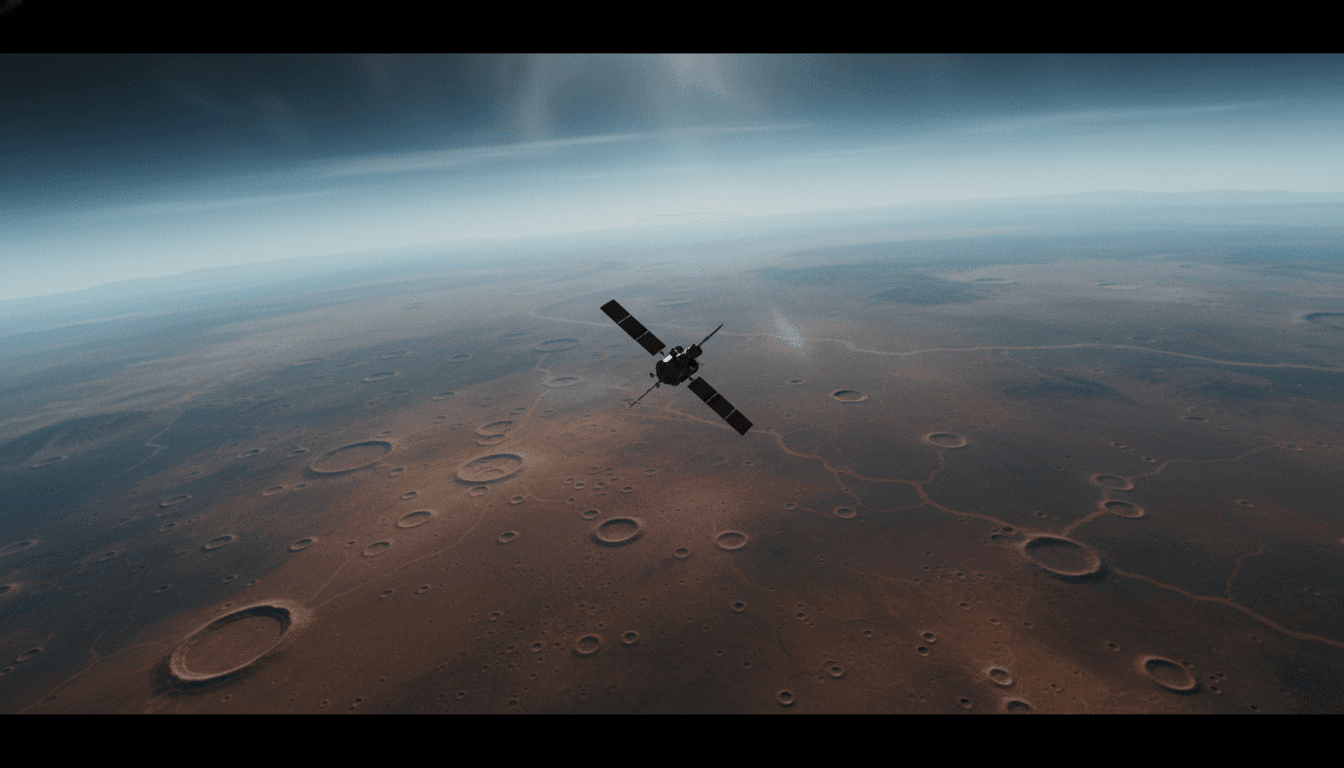
The defunct MAVEN Mars orbiter, a key NASA asset in understanding the Martian atmosphere, is projected to crash into the Red Planet within the next 100 years. This impending demise, announced on Friday, June 5, 2026, highlights a growing challenge for space agencies: the management of end-of-life spacecraft in planetary orbit. While MAVEN’s operational mission concluded, its eventual impact underscores the long-term environmental considerations of space exploration, even for missions that have ceased functioning.
The Story: MAVEN’s Final Trajectory
NASA’s MAVEN (Mars Atmosphere and Volatile Evolution) mission, launched to study the Martian atmosphere’s loss to space, has been a cornerstone of our understanding of how Mars transformed from a potentially habitable world to the arid planet it is today. Although its primary mission concluded, the spacecraft remained in orbit, a silent sentinel circling Mars. The recent announcement confirms that gravitational forces and residual atmospheric drag will inevitably pull the dead Mars orbiter into the planet’s surface within the century. This isn’t an immediate threat, but rather a calculated prediction based on its current orbital parameters and the subtle, continuous interaction with the tenuous Martian atmosphere. The precise date of impact remains uncertain, but the window of the next 100 years provides a clear timeline for its ultimate fate.
Impact Analysis
The projected crash of the MAVEN Mars orbiter carries significant implications for the broader science and space landscape. Primarily, it reignites discussions surrounding planetary protection protocols. While MAVEN is not considered biologically contaminated in the same way a lander might be, the principle of preventing uncontrolled impacts of Earth-originating materials remains paramount. As the ‘Mars morgue’ of defunct probes grows, each uncontrolled re-entry, however distant, adds to the cumulative risk of future contamination or interference with ongoing missions. This event serves as a reminder that even dead spacecraft continue to occupy a critical space in orbital mechanics and planetary stewardship. It also prompts a re-evaluation of mission planning to include more robust end-of-life disposal strategies, such as controlled de-orbit burns, to mitigate such long-term uncertainties. The financial and logistical challenges of implementing such measures for every past, present, and future mission are substantial, requiring international cooperation and technological innovation.
“The eventual impact of MAVEN serves as a stark reminder of the long-term responsibility we bear for the objects we send into space, particularly when it comes to planetary protection and the preservation of pristine environments.”
Context & Background: The Mars Morgue
MAVEN is not alone in its post-operational state. Mars orbit is becoming increasingly populated with defunct spacecraft, earning it the moniker ‘Mars morgue’. Over decades of exploration, numerous orbiters and landers have completed their missions, some crashing, some remaining in silent orbits. This accumulation highlights a trend in space exploration: while getting to Mars is an immense challenge, ensuring a clean exit strategy often takes a backseat to primary mission objectives. Historically, the focus has been on mission success and data return, with less emphasis on the environmental legacy of these endeavors. This approach is slowly shifting as agencies like NASA and ESA recognize the need for sustainable space exploration. The growing number of objects in Earth orbit, leading to concerns about space debris, provides a cautionary tale that planetary orbits must also be managed carefully to ensure future access and scientific integrity. For more on orbital debris, see our related science & space articles.
What’s Next: Future Implications
The projected crash of the MAVEN Mars orbiter will undoubtedly influence future mission designs and international space policy. While no immediate action is required for MAVEN given its long timeline, the discussion around end-of-life protocols for Martian orbiters will intensify. We can expect greater emphasis on designing missions with built-in mechanisms for controlled de-orbiting or graveyard orbits, even if these add to mission complexity and cost. Furthermore, this event might accelerate the development of international guidelines and agreements for responsible space debris management around other planetary bodies. The scientific community will also be keen to ensure that any future impacts do not compromise potential astrobiological sites or future human exploration targets on Mars. Decisions made now regarding debris mitigation will shape the accessibility and scientific value of Mars for generations to come, moving beyond simply launching missions to considering their entire lifecycle.
Key Takeaway: The Legacy of Exploration
The eventual, albeit distant, crash of the dead Mars orbiter MAVEN underscores a critical aspect of humanity’s venture into space: every mission leaves a legacy, both in scientific discovery and in physical presence. As we push the boundaries of exploration, the responsibility to manage our technological footprint beyond Earth grows ever more pressing. The ‘Mars morgue’ serves as a tangible reminder that sustainable space exploration demands foresight, international collaboration, and a commitment to protecting the cosmic environments we seek to understand. The fate of MAVEN, while not an immediate crisis, is a potent symbol of the long-term stewardship required for our continued journey among the stars.