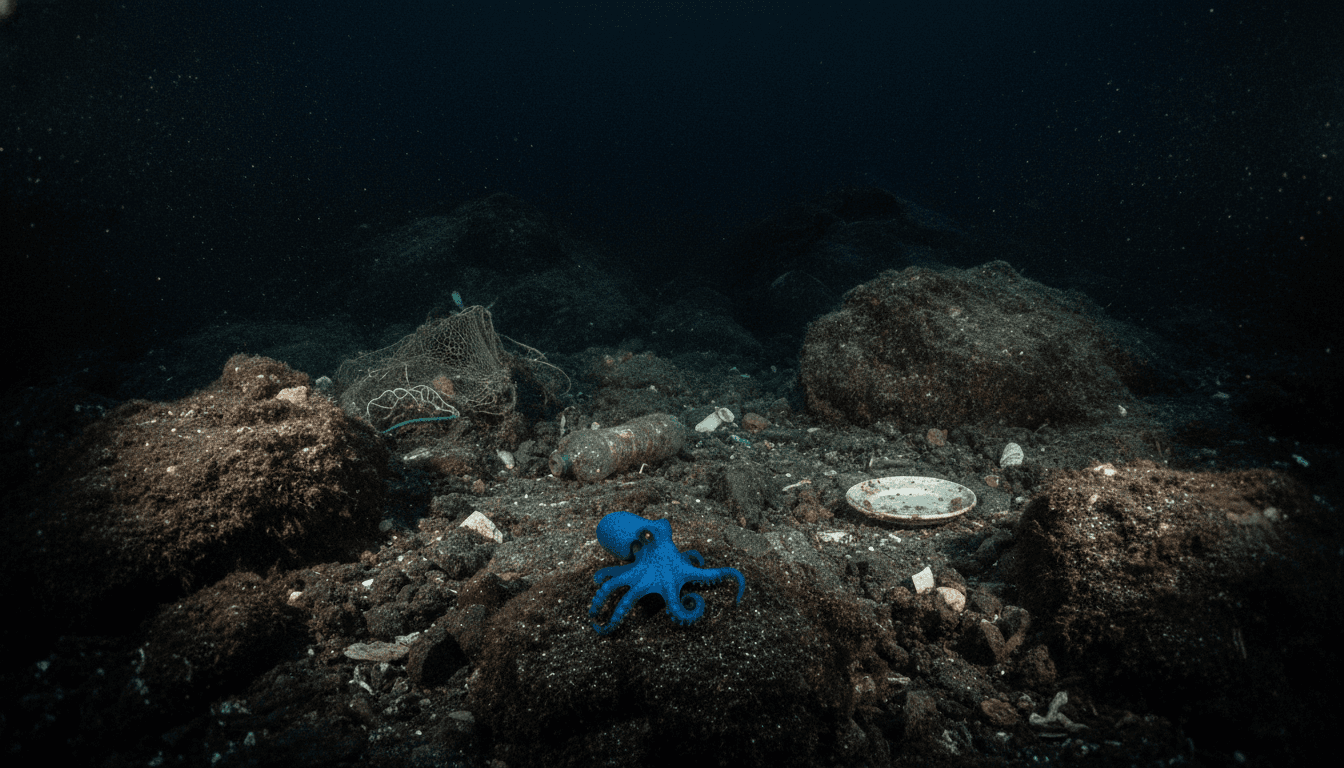
A new golf ball-sized blue octopus species, Microeledone galapagensis, has been formally identified by scientists, shedding light on the biodiversity of the deep sea. This discovery, published in a recent study, confirms the existence of a unique cephalopod first sighted during a deep-sea expedition in the Galapagos in 2015. The diminutive, short-armed creature, found roughly 5,800 feet below the Pacific Ocean surface near Darwin Island, represents a significant addition to marine biology and underscores the vast unknowns of our planet’s underwater ecosystems.
The initial encounter with Microeledone galapagensis occurred via a remotely operated vehicle (ROV). Expedition researchers from the Charles Darwin Foundation and the Galápagos National Park Directorate successfully collected one specimen, while two others were observed on video. The collected octopus was then preserved and dispatched to Janet Voight, a distinguished octopus expert at the Field Museum in Chicago, Illinois, U.S. There, Voight and her colleagues employed advanced computed tomography (CT) scanning to generate a detailed 3D model of the specimen. This non-invasive technique allowed researchers to meticulously examine its internal organs and mouth parts without dissecting the sole available sample.
Unveiling a New Golf Ball-Sized Blue Octopus Species
The meticulous comparison of the blue octopus’s anatomical features with those of known species definitively established its status as new to science. Unlike many of its octopus relatives, Microeledone galapagensis is characterized by its small, squat body and notably short, stubby arms equipped with a limited number of suckers. This morphology presents an intriguing biological puzzle, particularly concerning its survival strategies in the resource-limited deep-sea environment.
“When you describe a new species of octopus, you have to look at all the parts, including the mouth, the beak, and the teeth. And to see those things, you have to cut the specimen open. We only had the one specimen, so I didn’t want to take it apart,” Voight explained in a press release.
Voight further questioned the adaptive advantage of such short arms for a species that likely forages for prey by sifting through sediment. “If you gather prey by moving your arms through the sediment (as we think they do), wouldn’t it be better to have longer arms with more suckers than short little arms?” she mused, highlighting the unique evolutionary paths taken by deep-sea organisms. This particular adaptation of the new golf ball-sized blue octopus species offers a fertile ground for future research into deep-sea foraging behaviors and metabolic efficiency.
Broader Implications for Deep-Sea Exploration
The discovery of Microeledone galapagensis is not an isolated incident but rather indicative of the immense, unexplored biodiversity lurking in the deep ocean. Voight suggests that finding new octopus species in these depths is not unusual, primarily because so few expeditions have ventured into these vast, inaccessible regions. The Pacific Ocean alone, larger than all landmasses combined, represents an enormous frontier for discovery.
Jim Barry, a senior scientist at the Monterey Bay Aquarium Research Institute (MBARI) in California, U.S., who was not involved in the study, echoed this sentiment in an interview with CNN. “We just don’t know enough about the biodiversity of the deep sea in general, so as discoveries like this keep coming up every dive, you may see something new that’s never been seen before,” Barry stated, emphasizing the continuous unveiling of life forms with each deep-sea exploration. The limited dispersal patterns of deep-sea octopus young further suggest that many localized, undiscovered species may exist, promising a long future of cephalopod discoveries.
This finding reinforces the critical importance of continued investment in deep-sea research and technological advancements in ROV capabilities. As humanity grapples with climate change and its impact on marine ecosystems, understanding the full scope of deep-sea biodiversity becomes increasingly urgent. Species like Microeledone galapagensis not only expand our biological catalogues but also offer insights into extreme adaptations and the resilience of life in challenging environments. The ongoing exploration of these abyssal plains and seamounts promises to yield further revelations, continually reshaping our understanding of life on Earth. Related science & space articles frequently highlight the rapid pace of discovery in marine environments, underscoring the dynamic nature of our planet’s ecosystems.