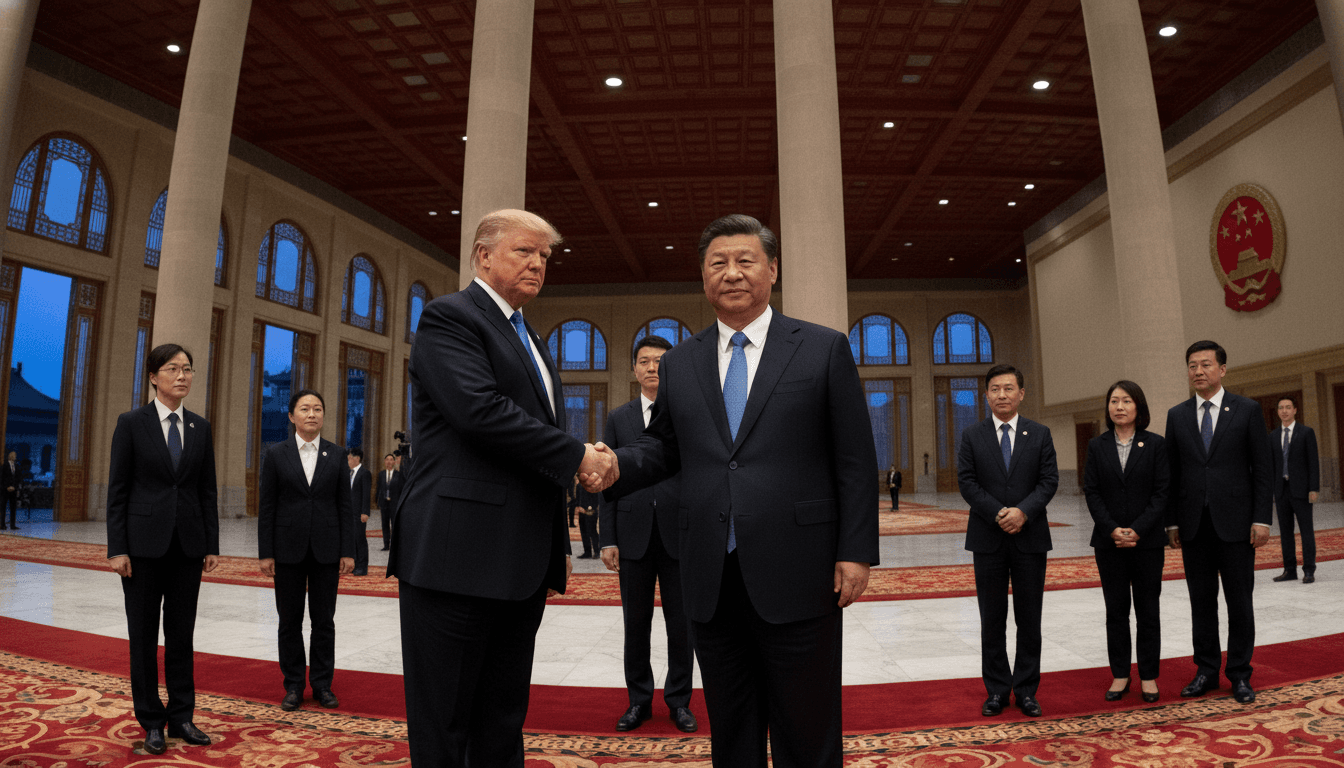
The recent Trump-Xi summit in Beijing has intensified South Korea’s familiar pressures, forcing Seoul to navigate an increasingly complex geopolitical landscape where its two most critical partners, the United States and China, are recalibrating their own delicate relationship. U.S. President Donald Trump and Chinese leader Xi Jinping held a bilateral summit at the Great Hall of the People in Beijing on May 14, marking Trump’s first visit to China since 2017. Notably, this was the first time since 2001 that a U.S. president visited China without making a stop in the capital of a regional ally like Japan, South Korea, or Australia, signaling a direct bilateral engagement that leaves allies like Seoul to interpret the implications.
During the summit, the two global powers found common ground on some critical issues while clearly delineating red lines on others. Both sides agreed on the importance of keeping the Strait of Hormuz open, a crucial artery for global energy supply. Beijing, for its part, reaffirmed its hawkish stance on Taiwan. Conspicuously absent from public discourse was any mention of North Korea, implying that Pyongyang’s nuclear weapons are no longer a pressing agenda item for Washington and Beijing. This silence carries significant weight for Seoul.
The United States framed the initial talks positively, with the White House citing progress on economic cooperation and energy. According to White House statements, President Xi “expressed interest in purchasing more American oil to reduce China’s dependence on the Strait [of Hormuz],” and both leaders agreed to work towards deeper commercial engagement. President Trump, touting Xi as a “great leader,” declared the meeting “the biggest summit ever” and expressed optimism that the relationship between China and the United States is “going to be better than ever before.”
In contrast, Xi offered a more measured tone, invoking the Thucydides Trap – the theory that war is likely when a rising power confronts a declining one. “Can we meet global challenges together and provide greater stability for the world?” Xi posed to Trump, as reported by the Chinese Foreign Ministry. Despite these overtures for cooperation, Xi unequivocally articulated China’s red line regarding Taiwan. He stated that “safeguarding peace and stability across the Taiwan Strait is the biggest common denominator between China and the U.S.,” warning that improper handling of the issue could lead to “clashes and even conflicts, putting the entire relationship in great jeopardy.” Trump did not publicly address Taiwan after the summit, and the White House statements omitted any mention of the subject.
Chinese state media indicated that discussions also touched upon the Middle East, Ukraine, and the Korean Peninsula, though specific details remain undisclosed. For South Korea, the Trump-Xi summit clarified, rather than created, the complex pressures Seoul now faces, requiring a delicate balancing act.
South Korea’s Navigating Familiar Pressures
On Taiwan, South Korea has historically adopted a posture of strategic ambiguity, neither endorsing Beijing’s territorial claims nor explicitly committing to intervention in a cross-strait contingency. While this stance has largely held, it is becoming increasingly difficult to maintain. Washington, particularly under the Trump administration, appears to be demonstrating less tolerance for such equivocation among its allies. Should the U.S. press Seoul for clearer political alignment or seek operational flexibility for U.S. Forces Korea in a Taiwan scenario, South Korea would be confronted with a choice devoid of easy answers, potentially jeopardizing its economic ties with China or its security alliance with the U.S.
The U.S.-China discussions on the Strait of Hormuz present a more immediate pressure point. South Korea is one of the world’s largest importers of Middle Eastern oil, making a China-U.S. consensus on keeping the strait open economically beneficial. However, this alignment may also accelerate Washington’s push for South Korea to contribute militarily to the multinational mission securing the waterway. Defense Secretary Pete Hegseth explicitly made this request during his May 11 meeting with South Korean Defense Minister Ahn Gyu-back at the Pentagon, urging Seoul to “stand shoulder to shoulder with its allies.” Ahn responded that South Korea would “review ways to contribute in phases.” With both the U.S. and China now publicly aligned on Hormuz, Seoul’s ability to remain on the sidelines has significantly diminished.
“For the Lee administration, which has signaled interest in resuming the stalled inter-Korean dialogue, the silence carries real consequences as it strongly implies that the North’s growing nuclear threats are no longer a priority for Washington and Beijing.”
The Korean Peninsula itself received minimal attention during the summit, a significant concern for Seoul. The White House made no mention of it, and Chinese state media merely noted that the issue was discussed. This silence strongly implies that North Korea’s escalating nuclear threats are no longer a priority for Washington and Beijing. Any meaningful engagement with Pyongyang requires at minimum tacit support from both powers, a signal entirely absent from the Trump-Xi summit. Some analysts had held out hope for a potential meeting between Trump and North Korean leader Kim Jong Un on the sidelines of the Beijing visit, but no such indications emerged.
Consequently, the Trump-Xi summit has laid bare a challenging future scenario for Seoul: maintaining alignment with Washington on critical security issues while simultaneously seeking to avoid damaging its indispensable economic and political ties with Beijing. Furthermore, it will be a major task for Seoul to generate momentum for reviving the deadlocked U.S.-North Korea talks and inter-Korean dialogue, particularly at a time when the leaders of the United States and China appear to be prioritizing other global concerns over the Korean Peninsula. South Korea’s diplomatic agility will be tested as it navigates these converging pressures, striving to safeguard its national interests in an increasingly multipolar and transactional international order.