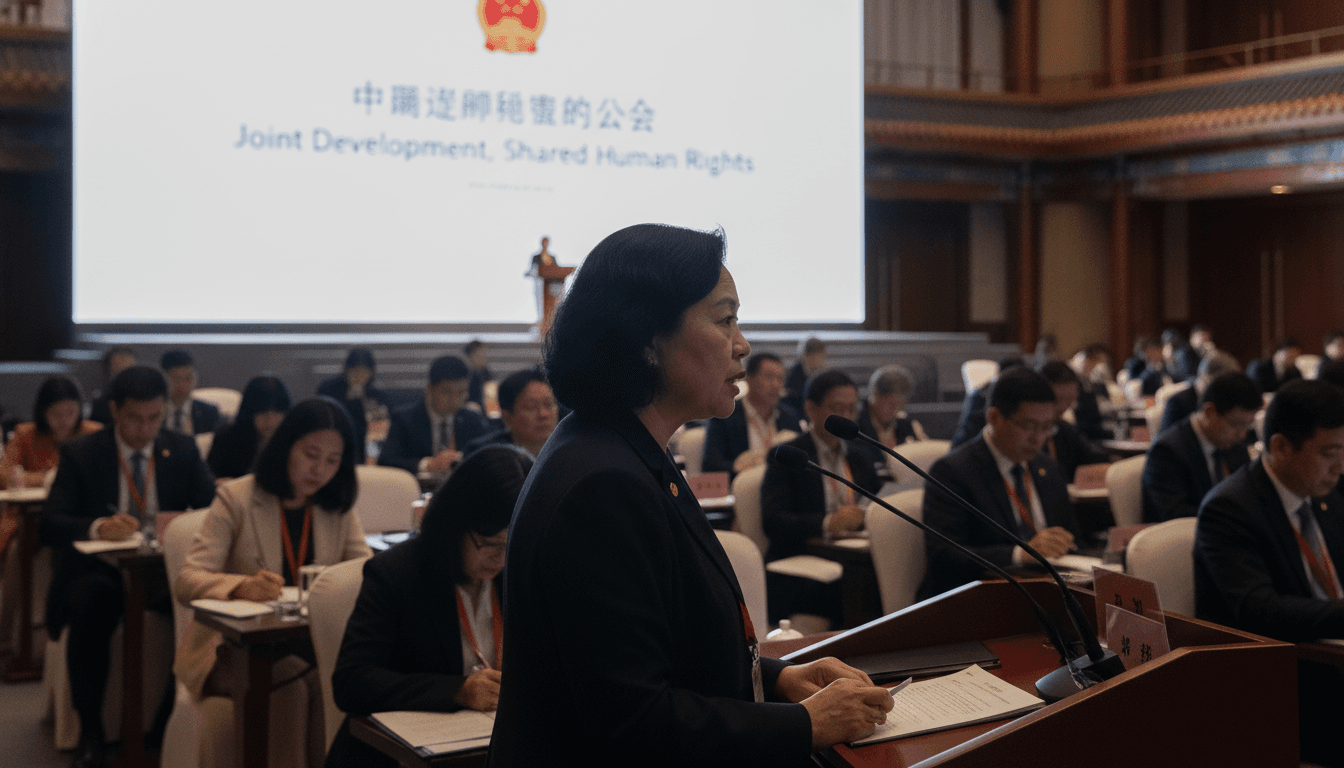
South Sudan decries sanctions and an arms embargo, arguing that these international measures weaken state authority and impede efforts towards sustainable peace and development. This strong condemnation was voiced by Agnes Oswaha, the Undersecretary in South Sudan’s Ministry of Foreign Affairs and International Cooperation, at the 2026 Forum on Global Human Rights Governance in Beijing on Thursday, June 12, 2026. Oswaha highlighted that nations across the Global South frequently encounter structural inequalities and external pressures that significantly hinder their progress and self-determination.
Addressing a substantial assembly of delegates from over 100 countries and numerous international organizations, Oswaha articulated a critical perspective on the current global framework. She contended that the international system remains inherently unequal, necessitating profound reforms to foster greater inclusivity, fairness, and responsiveness to the distinct needs of developing nations. Her remarks underscored the persistent disparities, stating,
“The realities of today’s world tell us we still have a long way to go. Inequalities within and among nations remain a grim reality that is yet to be addressed.”
This sentiment resonates deeply within diplomatic circles, where discussions often revolve around equitable global governance.
Impact Analysis: South Sudan Decries Sanctions
The imposition of an arms embargo and targeted sanctions on South Sudan, as described by Oswaha, has a tangible impact on the nation’s internal stability and its capacity to enforce peace agreements. She specifically noted that these measures tend to “embolden opposition groups” who have taken up arms against the state, thereby complicating the government’s efforts to maintain security. This perspective challenges the conventional wisdom behind such international restrictions, which are typically enacted to address conflict and human rights concerns. Critics of the embargo, for instance, maintain that these measures were a direct response to prolonged conflict and documented human rights violations within South Sudan. The ongoing debate highlights a fundamental tension between international intervention aimed at accountability and a sovereign state’s perceived right to self-defense and internal security.
Oswaha’s address also extended beyond South Sudan’s immediate concerns, advocating for a broader reform of international institutions. She emphasized the indispensable nature of multilateral cooperation in tackling complex global challenges, including catastrophic climate change, pandemics, armed conflicts, and pervasive insecurity. These issues, she argued, are global in scope and demand collective, effective action. Her call for reforms stressed the importance of upholding principles such as sovereignty, equality among nations, collective action, and impartial adherence to international law. Such reforms, she believes, are crucial for the international community to overcome present challenges and achieve meaningful progress. The forum itself, themed “Joint Development, Shared Human Rights: The 40th Anniversary of the Adoption of the Declaration on the Right to Development and a New Vision for Global Human Rights Governance,” provided a platform for these discussions, drawing more than 400 participants, including government officials, scholars, diplomats, and representatives from international organizations, all exploring development-centered approaches to human rights.
Context & Background
South Sudan’s plea for the lifting of the United Nations arms embargo is not new. Since its independence in 2011, the country has grappled with internal conflicts and political instability, leading to significant humanitarian crises. The UN Security Council has repeatedly renewed the arms embargo and targeted sanctions, citing ongoing violence, obstruction of humanitarian aid, and failure to fully implement peace agreements. Juba has consistently argued that these restrictions impede the government’s capacity to protect its citizens, train a unified national army, and secure its borders, thereby inadvertently prolonging insecurity rather than mitigating it. The debate around these sanctions reflects a broader international discourse on the efficacy and unintended consequences of such punitive measures, especially in fragile states transitioning from conflict. For more insights on global diplomatic efforts in post-conflict regions, see our related world news articles.
What’s Next
The discussions at the Beijing forum, particularly South Sudan’s stance, are likely to fuel ongoing diplomatic efforts to reconsider the nature and duration of international sanctions. While immediate changes to the UN arms embargo are unlikely without significant shifts in South Sudan’s internal security and governance, the public airing of these grievances in a global forum, particularly one hosted by China, signals a continued push for reassessment. China, often a proponent of non-interference in sovereign affairs, provides a sympathetic ear to such arguments from the Global South. Future developments will depend on South Sudan’s demonstrable progress in peace implementation and human rights, as well as evolving geopolitical dynamics that might influence the positions of key UN Security Council members. The call for reforms of multilateral institutions also foreshadows continued pressure from developing nations for a more equitable global order.
The central argument that countries in the Global South face structural inequalities and external pressures, exemplified by South Sudan decries sanctions and embargos, highlights a persistent fault line in international relations. As global challenges become increasingly interconnected, the effectiveness of unilateral or targeted sanctions will continue to be debated against the backdrop of national sovereignty and collective security. The forum in Beijing served as a crucial platform for these voices to be heard, emphasizing the need for a more balanced and inclusive approach to global human rights governance and development.