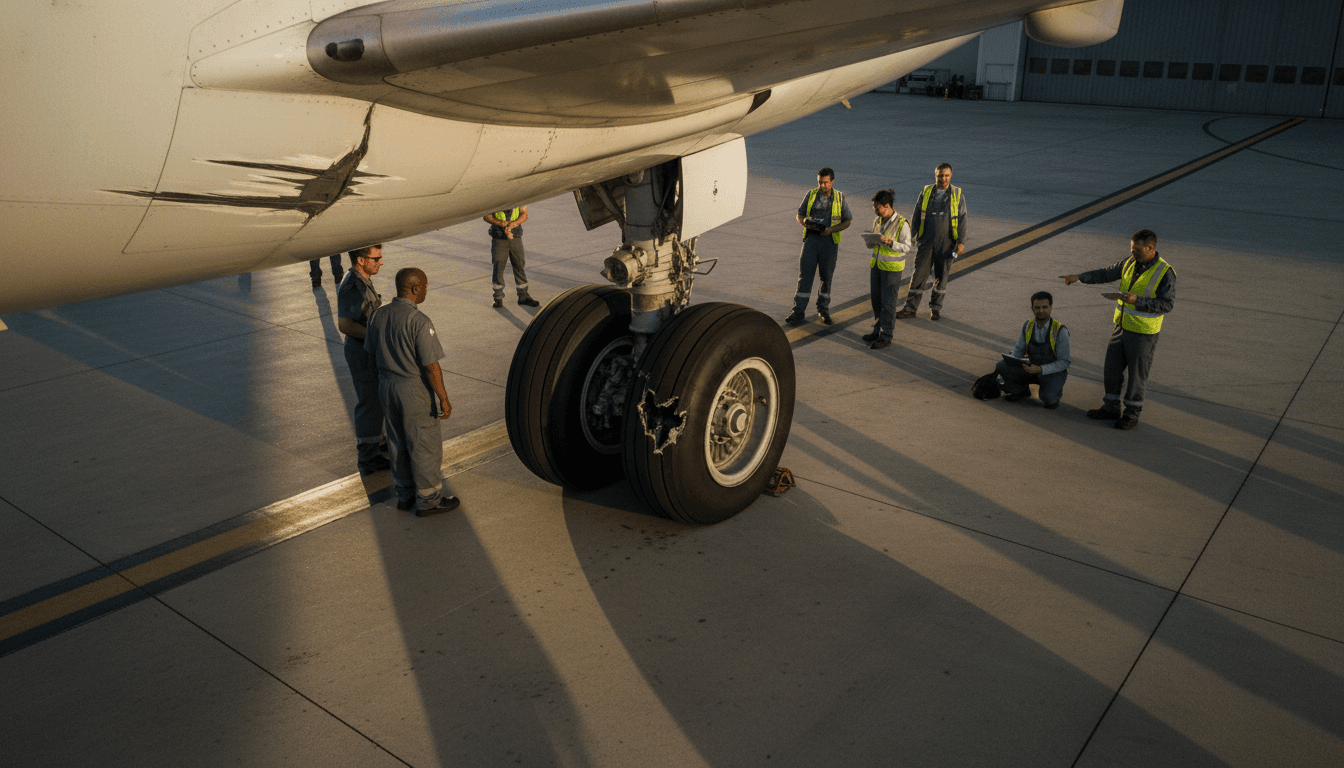
United Flight 169 struck a highway vehicle and a light pole on May 3, 2026, during its landing approach at Newark Liberty International Airport, an incident underscoring the deepening crisis within the US aviation system. The Boeing 767, inbound from Venice, Italy, was landing on Runway 29 when its fuselage and a landing gear tire made contact with a light pole and an 18-wheeler semi-truck on the New Jersey Turnpike. The aircraft was traveling at approximately 160 miles per hour at the time of the collision. New Jersey State Police confirmed the incident, and CBS News reported that the truck driver sustained minor injuries but was recovering at home as of May 4.
Both the National Transportation Safety Board (NTSB) and the Federal Aviation Administration (FAA) have initiated investigations, with officials present at Newark to interview the flight crew and air traffic controllers. While the NTSB’s final findings could take months or even years, the incident immediately raises questions about aviation safety protocols and infrastructure. Runway 29, a shorter runway at Newark, requires precise approach profiles, with aircraft crossing the New Jersey Turnpike at low altitudes. Motorists have long expressed concerns about the proximity of landing aircraft to highway traffic, although under normal circumstances, planes clear all vehicles.
Newark Landing Incident Prompts Systemic Review
The conditions on May 3 included gusty westerly winds, which prompted the use of Runway 29 and created the potential for low-altitude wind shear. Wind shear can cause a sudden, rapid descent below the established glide path. Pilots and controllers are equipped with hourly meteorological forecasts, real-time field conditions, and onboard flight management systems that provide continuous glide path data and audible warnings. The critical question for the NTSB is why the approach was not aborted despite these warning systems.
However, this Newark landing incident cannot be viewed in isolation. It is a stark symptom of a broader systemic crisis plaguing American aviation, stemming from decades of profit-driven neglect of vital public infrastructure. Air traffic control facilities nationwide face historic understaffing, with over 90 percent of US airport towers short on personnel. Only about 70 percent of staffing targets are met by fully certified controllers at terminal approach facilities. The Philadelphia TRACON, responsible for Newark’s airspace, has been “chronically understaffed for years,” according to United Airlines’ CEO. This chronic understaffing is exacerbated by the erosion of real wages due to inflation and high living costs in urban centers where FAA facilities are concentrated. Furthermore, the FAA’s ground-based navigation infrastructure, including radar arrays and instrument landing systems, has been in a state of disrepair for years, with budget appropriations often diverted to inadequate replacement systems. A prime example was the April 2025 equipment failure at Newark, where a burned-out copper wire caused controllers to lose radar and communications for 90 seconds.
“This collision must be understood as a product of the systemic crisis of American aviation. This is the predictable consequence of decades of profit-driven neglect of the public infrastructure on which millions of workers and travelers depend daily.”
Economic Pressures and Safety Compromises
Compounding these issues are the economic ramifications of geopolitical events. The US-Israeli war on Iran and the resulting fuel crisis have significantly impacted the airline industry. Disruptions in Persian Gulf oil flows drove jet fuel prices from approximately $90 per barrel to $119 in the war’s initial weeks. Spirit Airlines, a major casualty of this crisis, ceased all operations on May 2, the day before the Newark landing incident, leading to 17,000 job losses. This collapse, which the government allowed in line with industry consolidation, immediately resulted in sharp increases in ticket prices, with Transportation Secretary Sean Duffy claiming the government lacked the funds to intervene while spending $1 billion daily on the war. This marks the beginning of a wave of cost-cutting measures across the industry.
One direct consequence of these economic pressures is the pressure to minimize go-arounds—a standard safety procedure where pilots abort unsafe landings. A go-around for a Boeing 767 consumes over 4,400 pounds of jet fuel, costing an airline $2,000 to $3,000 in fuel and maintenance. Airlines are now training crews to reduce these maneuvers, and management scrutinizes every decision leading to extra fuel burn. Under normal safety conditions, the pilots of United Flight 169, if faced with an approach below safe parameters due to wind shear or other factors, would routinely execute a go-around. The systemic economic and institutional pressure to avoid that $3,000 cost cannot be isolated from the investigation into why the approach continued to the point of collision.
Future Implications for Aviation Safety
The NTSB’s eventual factual record will undoubtedly shed more light on the specific circumstances of United Flight 169’s collision. However, the broader implications are clear. This incident is not an isolated mechanical failure or human error but a symptom of a deeply strained system. The same logic of capitalist cost-cutting that impacted the Newark approach systems, running on burned-out copper wire, also contributed to the January 2025 collision between a passenger jet and a military helicopter over Washington D.C., where one controller was performing the duties of two. Addressing these systemic vulnerabilities requires a fundamental shift away from short-sighted, profit-driven decisions towards a renewed commitment to public safety infrastructure and adequate staffing. The safety of millions of travelers and aviation workers depends on it.