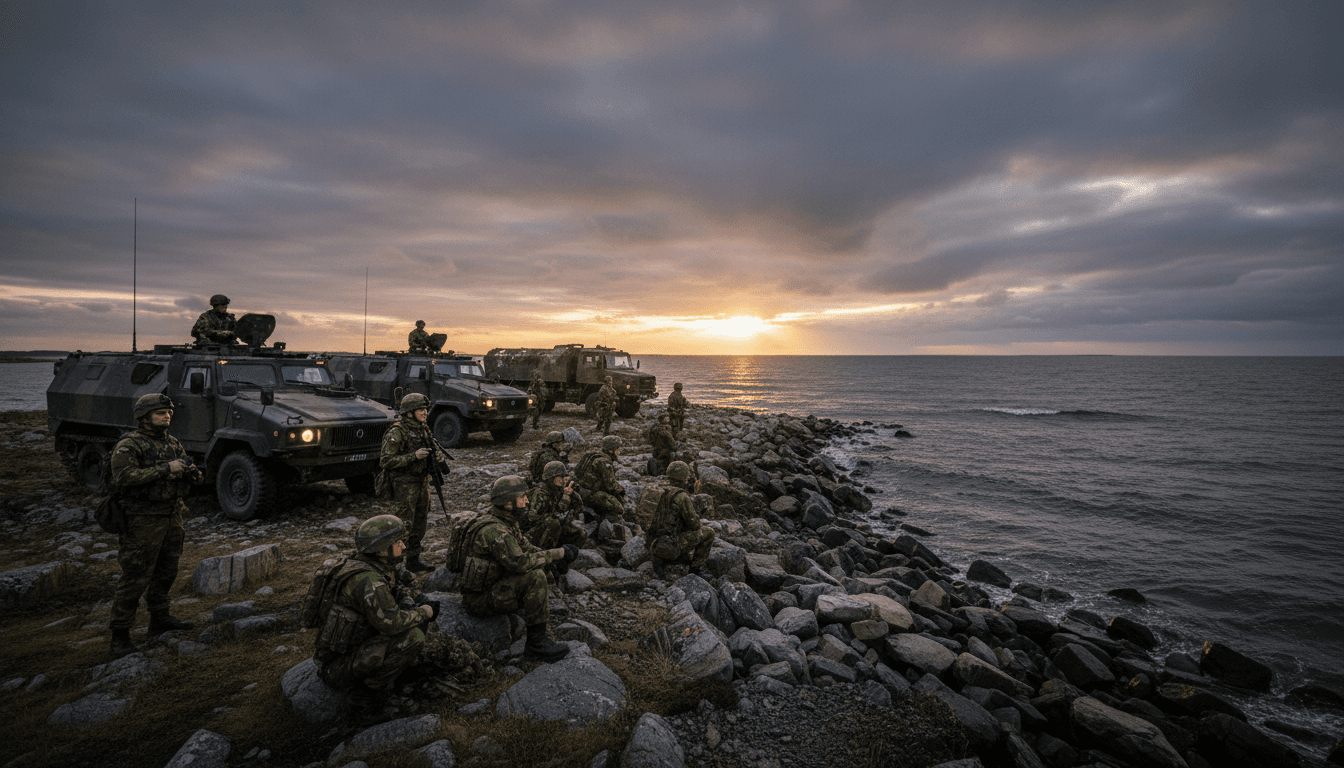
A recent NATO war game tested the alliance’s response to an unnamed country threatening Sweden, a critical exercise that underscored growing concerns over Russian aggression and the reliability of US support. Conducted on the strategically vital Swedish island of Gotland, the exercise, witnessed by The Associated Press, simulated a pre-Article 5 scenario involving sabotage, power outages, and food shortages – a plausible threat Rear Adm. Jonas Wikström, director of the exercise, warned “could happen tomorrow.”
The war game’s unusual twist saw non-NATO member Ukraine providing critical advisory on drone warfare, leveraging its direct battlefield experience against Russian forces. This collaboration highlights the evolving nature of modern conflict and the urgent need for Western forces to adapt. Ukrainian drone pilots, playing the aggressor role, starkly demonstrated the lethal effectiveness of their tactics against Swedish troops, leading to training stoppages and a sobering realization for the alliance.
Impact Analysis
The exercise comes amidst a backdrop of escalating Russian sabotage across Europe, including cyberattacks and disinformation campaigns, as detailed by an AP investigation. This hybrid warfare strategy targets critical infrastructure, aiming to destabilize nations without overt military intervention. The scenario on Gotland specifically mirrored these real-world threats, forcing NATO members to consider responses before the invocation of Article 5, the collective defense clause that guarantees mutual assistance if a member is attacked.
Beyond the immediate Russian threat, the broader world news landscape is shaped by the volatile approach of former US President Donald Trump towards NATO. His past descriptions of the alliance as a “paper tiger,” coupled with recent orders to withdraw at least 5,000 US troops from Germany and threats of further reductions, have created palpable anxiety among European allies. Gen. Michael Claesson, Sweden’s chief of defense, acknowledged that any change in American presence significantly affects overall dynamics, even while denying that recent European defense initiatives are a direct hedge against a US withdrawal.
“Everything that offers European allies freedom of action is good.”
This sentiment underpins new collaborations, such as a “hybrid navy” by Nordic and Baltic nations, the UK, and the Netherlands, and a combined frigate fleet planned by the UK and Norway. Such moves signal a growing European resolve to bolster its own defense capabilities, irrespective of Washington’s future stance.
Europe Considers Trump’s Volatile Approach to NATO
Since his return to the White House in January 2025, Trump’s actions, including pausing intelligence sharing with Ukraine and aligning with Moscow in negotiations, have further fueled European anxieties. The shift of US air defense systems and missiles from Europe to the Middle East has also raised concerns about potential protection gaps, with some European nations facing delays in US weapons orders.
The Ukrainian contribution to the war game was particularly illuminating. Drone pilots, identified by their call signs Tarik and Karat, shared invaluable insights, emphasizing the need for Western forces to rapidly improve drone technology, tactics, and commander understanding. Tarik recounted how Ukrainian forces “destroyed Sweden’s troops” in the exercise, forcing multiple training halts. Karat stressed the unreplicable nature of front-line experience, stating, “You need to see this with your own eyes.” Brig. Gen. Curtis King of the US military affirmed the necessity of learning “rapidly” from Ukrainians on drone and counter-drone operations, particularly focusing on survivability and deep detection capabilities, a critical need along Russia’s border where drone incursions are frequent.
What’s Next
The strategic importance of Gotland cannot be overstated. Located in the Baltic Sea, it lies between Russia’s Kaliningrad exclave, a heavily militarized zone, and Sweden. Gen. Claesson underscored its significance: “If you control Gotland, you pretty much control the central part of the Baltic Sea.” This body of water is a crucial financial artery for Russia, with its “shadow fleet” transporting oil and liquefied natural gas to fund its ongoing war in Ukraine. Russia’s full-scale invasion of Ukraine in 2022 prompted Sweden, along with Finland, to abandon decades of neutrality and join NATO in 2024, significantly strengthening its military presence on Gotland.
A “very reasonable scenario,” according to Claesson, is that Russian President Vladimir Putin could attempt to seize a small sliver of NATO territory, such as Gotland, to test the alliance’s collective reaction. This provocative act, falling short of a full-scale invasion, would force NATO to confront its resolve and cohesion, particularly in light of uncertain US commitment.
Key Takeaway
The war game on Gotland serves as a stark reminder of the complex and volatile security environment in Europe. It highlights not only the immediate and evolving threat posed by Russia’s hybrid warfare tactics but also the profound implications of shifting geopolitical alliances and the potential for a less reliable United States as a NATO partner. The integration of Ukrainian battlefield expertise underscores a critical lesson: adaptation and rapid learning are paramount for Western forces. As European nations increasingly seek greater strategic autonomy, the collective defense of the continent will depend on their ability to integrate advanced capabilities, share intelligence seamlessly, and present a united front against both traditional and unconventional threats, with or without unwavering US backing.