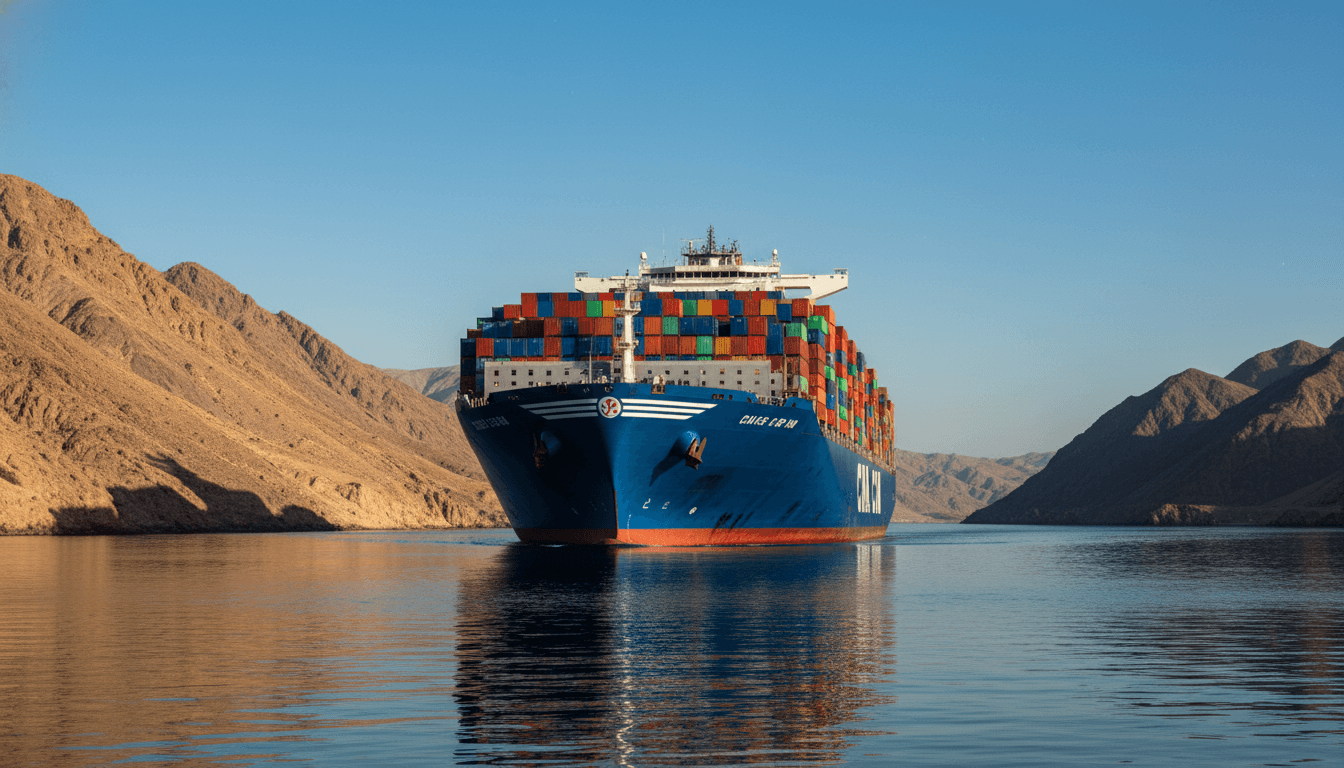
The Middle East crisis continues to reshape global trade, as evidenced by CMA CGM’s first-quarter 2026 results, which highlight persistent disruptions and the shipping giant’s strategic adaptations. The world’s third-largest container carrier reported a “resilient” performance despite a challenging geopolitical landscape, volatile freight markets, and shifting global trade flows. Revenue for the quarter stood at $13.2 billion, virtually flat year-over-year, while EBITDA saw a significant 31.6% decline to $2.1 billion, primarily due to weaker freight markets and elevated operating costs.
Rodolphe Saadé, Chairman and CEO of CMA CGM, emphasized the ongoing impact of the Middle East crisis and its ripple effect on global supply chains. The tensions, particularly around the Strait of Hormuz, have necessitated a fundamental redesign of the company’s logistics network. This includes the implementation of “alternative multimodal corridors” to maintain cargo flows into Gulf countries, signaling that these navigation constraints are now a structural feature rather than a temporary hurdle for container shipping. Carriers are grappling with sustained security risks, increased insurance costs, and uncertainty regarding vessel access, forcing comprehensive adjustments to routes and schedules.
Navigating a Volatile Environment
Despite the formidable operational challenges, CMA CGM’s maritime volumes saw a modest 1.5% increase year-over-year, reaching 5.9 million TEUs. However, maritime revenue declined by 8.5% to $8 billion, as the average revenue per container dropped by nearly 10% compared to the previous year. The shipping division’s EBITDA sharply decreased from $2.5 billion a year earlier to $1.5 billion, underscoring the pressure on profitability within its core business.
In response to this volatile environment, CMA CGM has aggressively pursued its diversification strategy. The quarter saw significant expansion across logistics, terminals, air cargo, and infrastructure. A notable development was the launch of its new “DAY 10” OCEAN Alliance network, which encompasses 41 services across major East-West trades with a combined capacity of 5.3 million TEUs. The carrier also introduced new services connecting Asia, Europe, the Caribbean, and the U.S. West Coast, enhancing its global reach.
“In an uncertain geopolitical context, the Group delivered resilient performance in the first quarter of 2026, pointing specifically to continued disruptions in the Middle East and global supply chains.”
Further strategic moves included a deeper penetration into the Indian market, marked by an order for six LNG-powered containerships from Cochin Shipyard and a new AI and digital R&D partnership with Capgemini. The company also finalized key acquisitions, including UK rail operator Freightliner and Italian heavy-lift specialist Fagioli, both integrated under its CEVA Logistics arm.
The Middle East Crisis: A Structural Shift
The financial results and strategic maneuvers by CMA CGM unequivocally indicate that the Middle East crisis has evolved beyond a transient operational challenge into a structural issue for global trade. The Strait of Hormuz, a critical chokepoint for a significant portion of the world’s oil and gas shipments, has become a zone of sustained geopolitical tension. This necessitates long-term strategic adjustments by shipping companies, impacting everything from route planning and vessel deployment to insurance premiums and supply chain resilience. The ongoing security concerns force a re-evaluation of established trade routes, leading to increased transit times and operational costs.
The company’s diversification efforts have proven crucial in mitigating the impact of the challenging maritime market. Revenue from “other activities,” which includes terminals and air cargo, surged by 59.1% to $1.3 billion. EBITDA from these segments also jumped by 90%, demonstrating how port operations and aviation businesses are effectively offsetting the persistent weakness in ocean freight. This strategic pivot provides a buffer against the inherent volatility of container shipping, particularly when core routes are compromised by geopolitical events.
Outlook and Future Implications
Looking ahead, CMA CGM remains cautious about the remainder of 2026. The company warns that escalating Middle East tensions, coupled with rising oil prices and evolving trade policies, continue to cloud the outlook for global shipping markets. The sustained instability in the region suggests that the need for alternative multimodal corridors and redesigned logistics networks will persist, further embedding these changes into the fabric of global trade. The adaptability shown by major carriers like CMA CGM will be critical in navigating these complex geopolitical currents.
The ongoing adjustments by shipping giants highlight a broader trend: the increasing vulnerability of global supply chains to regional conflicts. As geopolitical flashpoints continue to emerge, companies are compelled to build more resilient, diversified, and flexible logistics networks. This shift could lead to higher costs for consumers and businesses as efficiency is traded for security and reliability. The Middle East crisis is not just a regional conflict; it is a catalyst for a fundamental re-evaluation of global trade pathways and the strategic imperatives for international commerce.