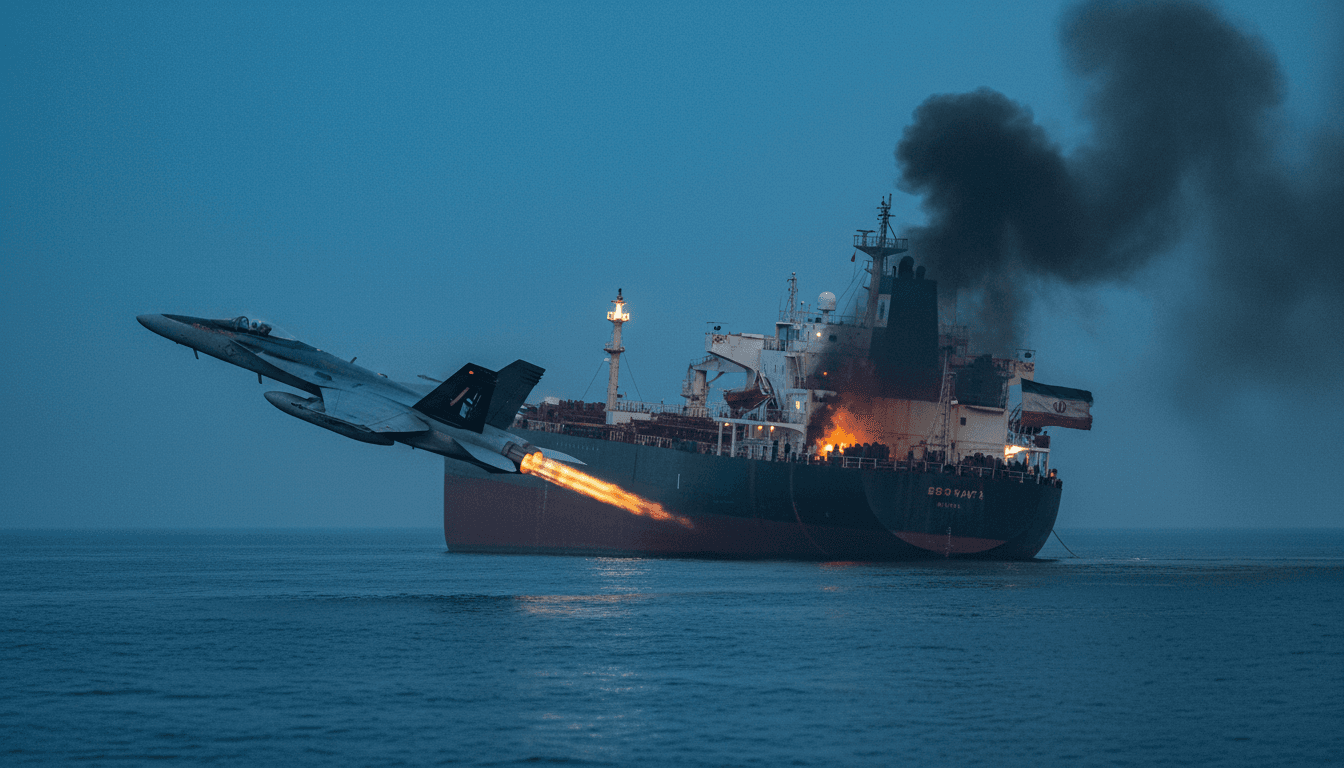
New U.S. strikes on two Iranian-flagged oil tankers on Friday have significantly escalated the ongoing Iran conflict, with Tehran accusing Washington of ‘reckless military adventure’ and undermining diplomatic efforts. U.S. Central Command confirmed disabling the vessels as they attempted to reach an Iranian port, marking the latest direct confrontation in a week that has seen increased hostilities in the strategically vital Strait of Hormuz.
This latest military action follows an exchange of fire a day earlier in the Strait, which Iran claims was provoked by an earlier U.S. attack on another Iranian tanker. The timing is particularly precarious as both nations are reportedly deliberating a one-page U.S. proposal aimed at reopening the Strait and implementing a 30-day cessation of hostilities to negotiate a comprehensive peace deal. Despite these escalating attacks, both President Trump and Iran’s foreign ministry maintain that a monthlong ceasefire, however fragile, remains in effect.
Secretary of State Marco Rubio, when pressed on the state of negotiations, indicated that the United States anticipated a ‘response’ from Iran on Friday regarding the proposal. President Trump, speaking on Thursday evening, downplayed the prior day’s exchange as a ‘trifle’ but issued a stark warning for Iran to ‘better sign their agreement fast,’ clearly referencing the U.S. diplomatic overture.
Iran’s Foreign Minister, Abbas Araghchi, publicly questioned the U.S. strikes, suggesting they were a ‘crude pressure tactic.’ In a social media post, he lamented,
“Every time a diplomatic solution is on the table, the U.S. opts for a reckless military adventure.”
Senior Iranian officials, speaking anonymously due to the sensitivity of the diplomacy, highlighted a key sticking point: U.S. demands for advance commitments on Iran’s nuclear program and its highly enriched uranium stockpile.
Mounting Pressure and Economic Fallout
Beyond military engagements, Washington is intensifying economic pressure on Tehran. The United States on Friday announced a fresh wave of sanctions targeting individuals and companies in China and Hong Kong accused of aiding the Iranian military’s access to supplies and war equipment. These sanctions specifically aim at disrupting Iran’s missile and drone program supply chain, extending to entities in Belarus and the United Arab Emirates.
The move comes just ahead of a critical summit between President Trump and Chinese leader Xi Jinping in Beijing next week. China, as Iran’s largest oil buyer, has become a significant point of contention for the Trump administration, which views Beijing’s continued support as underwriting terrorism. Treasury Secretary Scott Bessent asserted that the U.S. would ‘continue to act to keep America safe and target foreign individuals and companies providing Iran’s military with weapons for use against U.S. forces.’
Earlier this month, the Treasury Department sanctioned Chinese ‘teapot’ refineries for purchasing Iranian oil, though China reportedly invoked a domestic policy ordering its companies to disregard these sanctions. Bessent indicated that Trump would urge Xi to leverage China’s influence to compel Iran to reopen the Strait of Hormuz, a critical conduit for global oil flow that has seen sporadic access since the war began.
The broader economic implications of the Iran conflict are also becoming clearer. Satellite images reveal a large oil slick, spanning over 20 square miles, spreading off Kharg Island, Iran’s primary crude oil export terminal. This apparent spill raises concerns about the integrity of Iranian oil infrastructure amidst the U.S.-imposed naval blockade. Despite the escalating tensions, oil prices and global stocks saw slight upticks on Friday afternoon, with Brent crude rising about 1 percent to $101.29 a barrel, as investors grappled with conflicting signals from the Persian Gulf.
Regional Instability and Humanitarian Concerns
The ripple effects of the Iran conflict are extending across the region. Fighting intensified between Israel and Hezbollah, the Iran-backed Lebanese militant group, further fraying an already delicate ceasefire. Israel conducted airstrikes in southern Lebanon, resulting in at least four fatalities, according to Lebanon’s health ministry. The Israeli military reported subsequent rocket launches into northern Israel, though without casualties.
Domestically, Iran continues to experience a severe internet blackout, now in its 70th day. NetBlocks, an internet watchdog group, reports national connectivity remains at a mere 1 to 2 percent of normal levels, marking the most extensive and prolonged internet disruption in their records. This digital isolation further compounds the challenges facing the Iranian populace amidst the ongoing conflict.
Iran’s ambassador to the United Nations, Amir Saeid Iravani, formally accused the United States of violating the ceasefire and breaching the U.N. Charter through its strikes on tankers and coastal areas. In a letter to the U.N. secretary general and Security Council president, Iravani warned that continued U.S. military action in the Persian Gulf and the Strait of Hormuz could lead to ‘catastrophic’ consequences extending far beyond the immediate region. The international community watches with bated breath as the volatile situation in the Persian Gulf teeters on the brink, with diplomatic efforts seemingly outpaced by military actions and the persistent threat of broader regional destabilization.