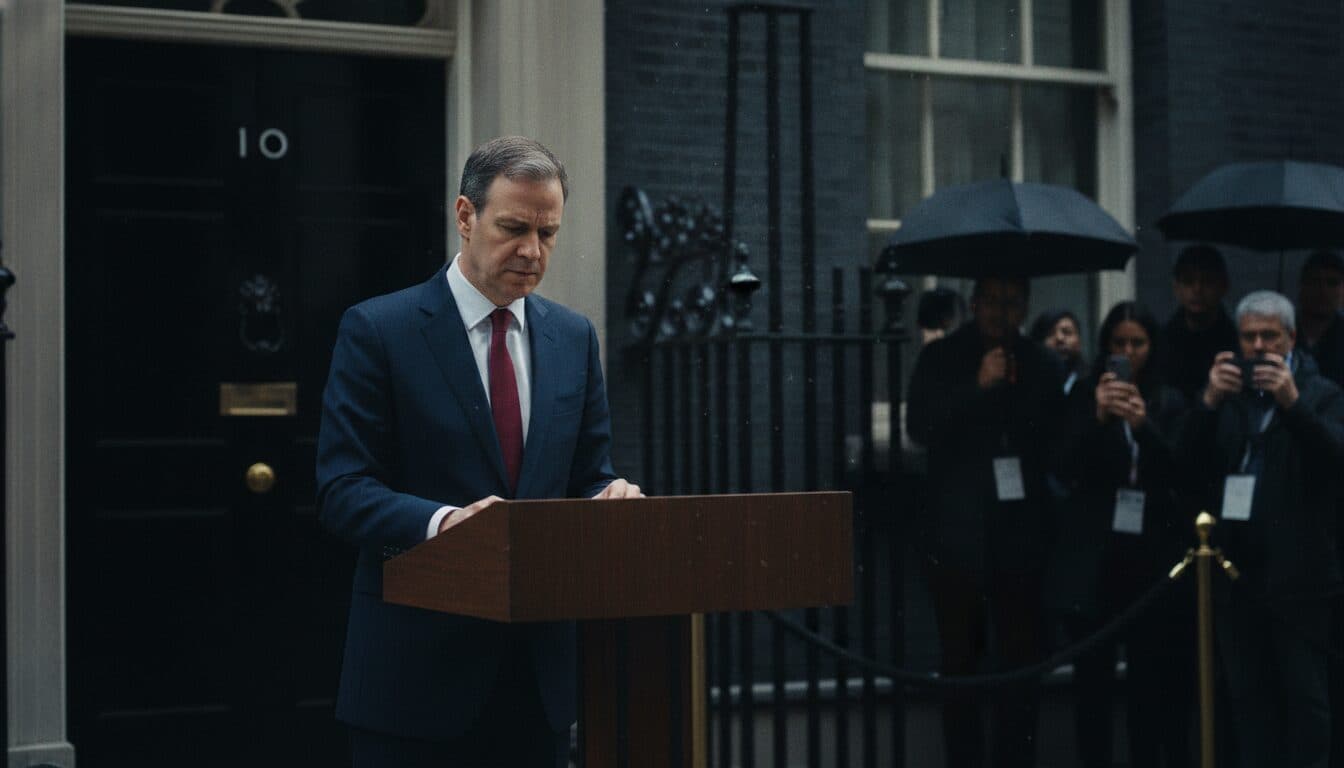
Keir Starmer’s tenure as UK Prime Minister has concluded abruptly, with his resignation on Monday, June 22, 2026, marking a significant and sudden shift in British politics. His departure, barely two years after leading the Labour Party to a commanding victory in the 2024 general election, makes him the seventh leader in a decade to leave 10 Downing Street prematurely. The unexpected move immediately triggers a new Labour leadership contest, with profound implications for the nation’s political and economic landscape.
The pressure on Starmer intensified following Labour’s disappointing performance in the local elections in May 2026. The decisive blow, however, appears to have been the victory of Andy Burnham, the former Mayor of Greater Manchester, in the Makerfield by-election on June 18, 2026. Burnham, who had openly declared his ambition to challenge Starmer for the Labour leadership, rapidly garnered substantial support from Labour MPs, with over 200 backing him by June 20.
Starmer’s premiership, which commenced on July 5, 2024, after Labour ended fourteen years of Conservative rule, was characterized by persistent challenges in fulfilling pledges of economic growth, enhanced public services, and alleviating the cost of living crisis. He also faced scrutiny over his handling of international affairs, notably the Iran war, which the UK did not join, and controversies surrounding his appointment of Peter Mandelson as U.S. ambassador. Allegations concerning Mandelson’s ties to Jeffrey Epstein are currently under investigation, adding another layer of complexity to Starmer’s final months in office.
In an emotional address outside 10 Downing Street, Starmer reflected on his decision.
“The question my party is asking now is whether I am best placed to lead us into the next general election. I have heard the answer of my parliamentary party to that question, and I accept that answer with good grace.”
He underscored that every decision he made was “about putting the country I love first.” Starmer will remain in a caretaker capacity until a new Labour leader is elected, a process anticipated to conclude by September 1, 2026.
Starmer Resigns, Leadership Race Heats Up
The Labour Party now faces the urgent task of electing a new leader amidst an ongoing economic crisis. The timeline for the leadership contest is tight, with nominations expected to open on July 9 and close on July 16. The party aims to have a new leader in place by September 1, 2026.
Andy Burnham wasted no time in announcing his candidacy, immediately securing the endorsement of Wes Streeting, who had previously shown interest in the leadership. This swift backing for Burnham suggests that a “coronation” is highly probable, despite some reservations among certain MPs. To qualify as a candidate, nominees must secure the support of 20% of Labour MPs (81 MPs), 5% of Constituency Labour Parties, or at least three affiliated organizations, including a minimum of two trade unions. All party members with at least six months of continuous membership are eligible to vote using a preferential ballot system.
The impact of this sudden change on financial markets and investor confidence is a key concern. Political instability often leads to market volatility, and the speed of this transition, coupled with an unresolved economic crisis, could exacerbate existing pressures. Businesses and international partners will be closely watching the leadership contest for signs of continuity or a significant shift in economic policy direction. For more insights into political shifts and their economic repercussions, readers can explore related trending articles on our platform.
Keir Starmer’s political career began long before his premiership. Born on September 2, 1962, he built a distinguished career as a barrister specializing in human rights, being appointed Queen’s Counsel (QC) in 2002. He served as the Director of Public Prosecutions (DPP) and head of the Crown Prosecution Service from 2008 to 2013, overseeing critical cases such as the Stephen Lawrence murder. His contributions to criminal justice were recognized with a knighthood in 2014.
Starmer entered Parliament in May 2015 as the Member of Parliament for Holborn and St Pancras. He ascended to the leadership of the Labour Party in April 2020, winning with 56.2% of the vote in the first round, succeeding Jeremy Corbyn after the party’s substantial defeat in the 2019 general election. As Leader of the Opposition, his stated aims included uniting the party, tackling antisemitism, and repositioning Labour towards the political center. His efforts culminated in leading Labour to a landslide victory in the general election, becoming Prime Minister on July 5, 2024. His resignation marks a dramatic end to a premiership that promised much but ultimately struggled to deliver amidst a turbulent political and economic climate.
The forthcoming leadership election will be crucial in defining Labour’s immediate future and its strategy for addressing the nation’s challenges. The rapid succession of leaders at 10 Downing Street underscores a period of profound political flux in the UK, demanding close attention from both domestic and international observers.