Moscow experienced its most significant drone attack to date on Thursday, June 18, 2026, as Ukrainian forces targeted a major oil refinery and caused widespread disruption to air traffic across the capital. This escalation of hostilities directly impacts Russia’s economic heart, following Ukrainian President Volodymyr Zelenskyy’s stark warning: “If Ukraine burns, your Moscow will burn.”
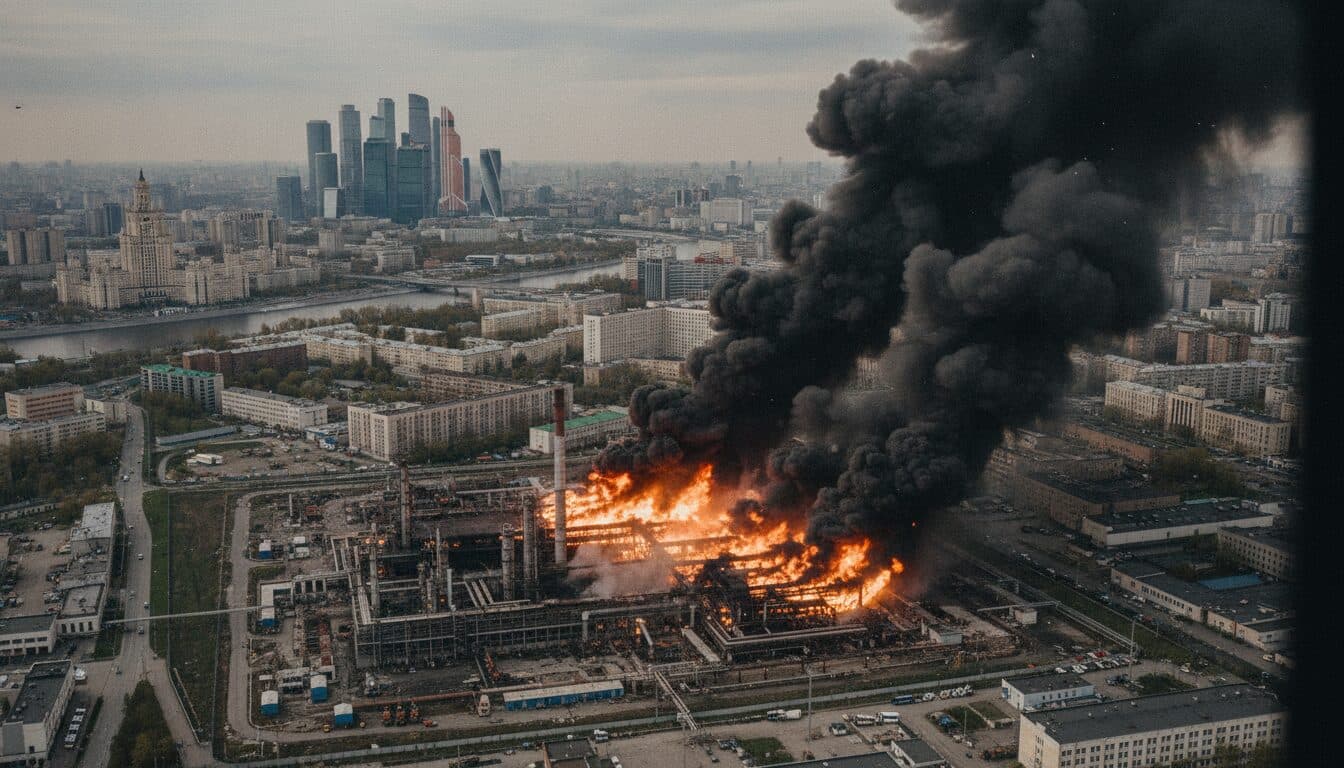
The primary target of the assault was the Moscow Oil Refinery in the Kapotnya district, a critical component of the capital’s fuel infrastructure. Located just 15 kilometers (9.3 miles) southeast of central Moscow, and approximately 9 miles from the Kremlin, this facility supplies around a third of the capital region’s fuel market, up to 40% of its gasoline, and 50% of its diesel fuel. It also provides aviation fuel, including for military purposes.
Russian officials reported an unprecedented scale to the attack, claiming 555 Ukrainian drones were shot down over multiple regions, with nearly 200 intercepted as they approached the Russian capital. Moscow Mayor Sergei Sobyanin confirmed the interception of almost 200 drones during the early morning barrage over the city. This figure dramatically surpasses Moscow’s previous record attack in March of this year, which involved 74 drones. Despite Russian claims of extensive interceptions, Ukrainian sources indicated that several drones successfully reached their intended targets, causing substantial damage.
The impact of the drone strikes was immediate and visible. Massive fires erupted at the Moscow Oil Refinery, sending thick black smoke billowing over the city. Social media platforms were inundated with videos depicting huge columns of smoke and multiple large fires. Beyond the refinery, the attack severely disrupted commercial flights at Moscow’s four airports, leading to hundreds of delays and cancellations. In the surrounding Moscow region, a drone struck a residential building in Zhukovsky, while debris damaged private houses, a car, a fitness center, an industrial facility, and a large mall whose roof caught fire. At least 17 people, including two children, were reported injured. Residents in areas like Balashikha even reported “black rain” due to pollutants from the refinery blaze, underscoring the direct consequences for the civilian population.
This was the second time in a week the Moscow Oil Refinery faced a Ukrainian drone attack, with a previous strike on June 16, 2026, causing a fire and reportedly halting operations. The repeated targeting of this key asset highlights Ukraine’s evolving strategy and enhanced capabilities.
Ukraine Drone Attack Signals Strategic Shift
President Zelenskyy directly confirmed Ukraine’s involvement in the strike, framing it as “a fully justified response to Russian attacks on our cities and communities.” He explicitly linked the assault to a recent Russian strike that damaged the historic Kyiv Pechersk Lavra monastery. Zelenskyy reiterated his earlier warning, stating, “We do not want this war, we never did, and everyone knows it, and our partners know it. But if Ukraine burns, your Moscow will burn.” This defiant rhetoric, coupled with the precision and scale of the Ukraine drone attack, demonstrates Ukraine’s increasing ability to penetrate even Moscow’s formidable three-ring air defense system.
Zelenskyy’s comments also included a call for intensified international pressure on Russia. He urged for expanded sanctions on Russia’s energy sector, shadow fleet, banking system, and defense industry, aiming to make the Russian populace feel the direct consequences of the ongoing conflict.
The sophistication of this latest assault underscores Ukraine’s growing capacity for long-range drone strikes deep within Russian territory. Ukraine has been actively developing and mass-producing increasingly advanced, largely domestically produced long-range drones. These newer models boast extended ranges and heavier explosive payloads, enabling Ukraine to target Russian logistics, infrastructure, and military assets well behind the front lines. The broader objective of Ukraine’s drone campaign is to diminish Moscow’s war revenue and impose a tangible cost on Russians for the invasion. Previous attacks have reportedly impacted Russia’s refining capacity, leading to fuel shortages in some regions.
“We do not want this war, we never did, and everyone knows it, and our partners know it. But if Ukraine burns, your Moscow will burn.”
In response to the Moscow raid, Russian Foreign Minister Sergei Lavrov promised “massive coordinated strikes on a regular basis” against Ukraine. While Russian officials consistently claim high interception rates for Ukrainian drones, the sheer scale and impact of this latest attack suggest that Ukraine’s tactics are increasingly straining Russian air defense systems. The psychological impact on Muscovites is also becoming a significant factor, with residents witnessing smoke over the capital and expressing growing concerns about the war reaching their city directly.
The recent Ukraine drone attack marks a significant inflection point in the conflict. It signals a clear shift in tactics from Kyiv, demonstrating an enhanced capability to project force deep into Russian territory and target critical economic infrastructure. For investors and policymakers, this escalation introduces new layers of geopolitical risk, particularly concerning global energy markets and the potential for a prolonged and intensifying conflict. The direct targeting of Moscow’s fuel supply and the disruption of air travel underscore the growing vulnerability of Russia’s capital, suggesting that the war’s economic and psychological tolls will increasingly be felt within Russia itself. The coming weeks will likely see a robust Russian response, further fueling an already volatile situation and demanding close attention to its broader international implications.