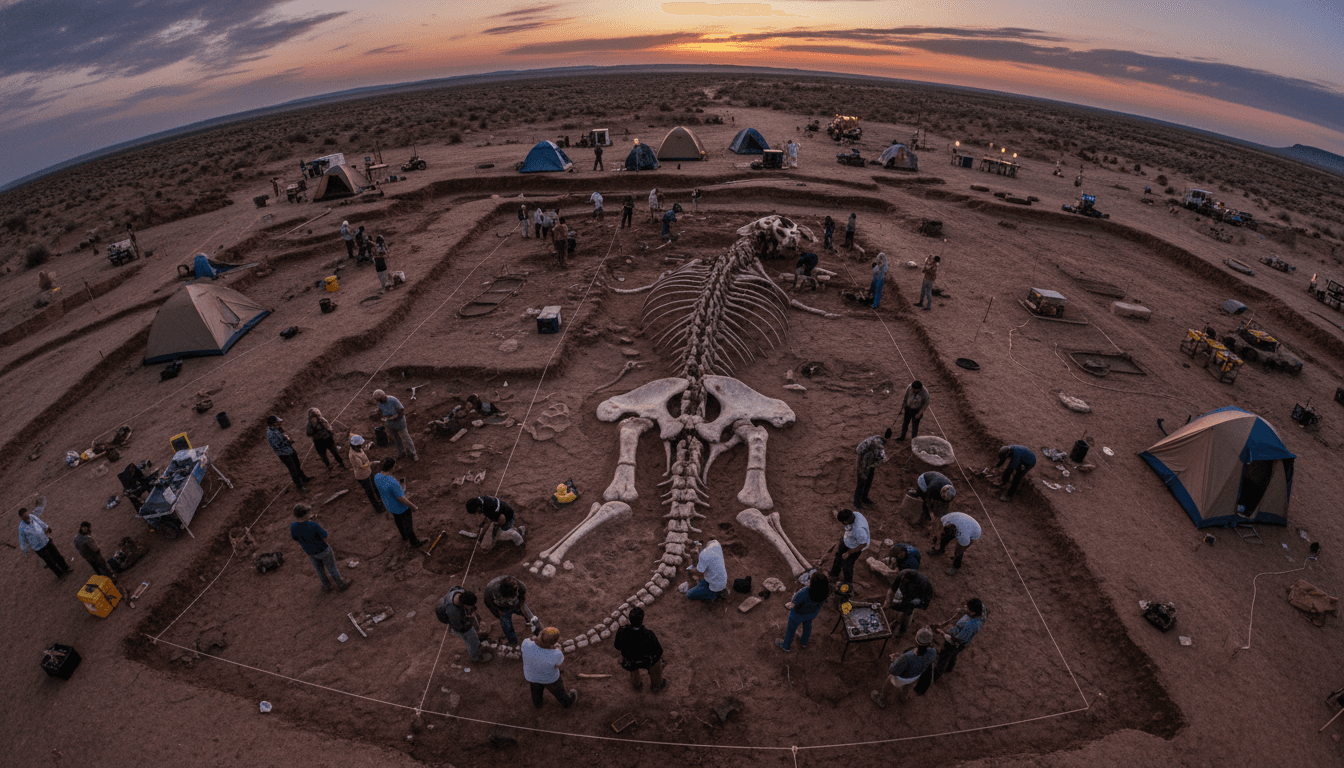
A recent T. rex fossil discovery rewrites dinosaur history, fundamentally altering our understanding of the longevity of these apex predators. Announced on Wednesday, June 3, 2026, this significant find challenges previous assumptions about the Tyrannosaurus rex’s lifespan, suggesting they lived considerably longer than scientific consensus once held. The implications extend beyond a single species, potentially prompting a re-evaluation of growth rates, ecological roles, and evolutionary pressures across various large theropods.
The details surrounding the discovery remain under close scientific scrutiny, but preliminary reports indicate the fossil provides unprecedented insights into the life cycle of the Tyrannosaurus rex. While specific locations and the names of the paleontological teams involved have not yet been publicly disclosed, the announcement from MSN underscores the find’s immediate and profound impact on paleontology. This isn’t merely another bone fragment; it represents a critical piece of the puzzle that has long eluded researchers: definitive proof of extended lifespans.
The Longevity of Tyrannosaurus Rex
For decades, scientific models for T. rex growth and age relied on a combination of bone histology and comparisons with modern large animals. These models generally posited a lifespan in the range of 28-30 years, characterized by a rapid growth spurt in adolescence. This new T. rex fossil discovery rewrites dinosaur history by presenting evidence of individuals living significantly past these estimated ages. This extended longevity implies a different metabolic rate, a longer period of reproductive maturity, and potentially a more complex social structure than previously imagined.
The impact of this discovery resonates deeply within the broader science and space landscape. Understanding the true lifespan of a dominant predator like T. rex influences our models of ancient ecosystems. Longer lifespans mean individuals spent more time at the top of the food chain, exerting prolonged predatory pressure on herbivore populations. This could lead to a re-evaluation of population dynamics and biodiversity during the late Cretaceous period. Furthermore, the techniques used to ascertain the age of this new fossil could be applied to other dinosaur remains, potentially revealing similar extended lifespans across various species and epochs. This could lead to a broader paradigm shift in dinosaur paleontology, affecting how we interpret fossil records globally. Related science & space articles often highlight how new discoveries in one field can ripple through others.
“This T. rex fossil discovery rewrites dinosaur history, forcing us to recalibrate our fundamental understanding of their biology and the intricate web of life they inhabited.”
Historically, the study of dinosaur lifespans has been fraught with challenges. Unlike tree rings, bone growth lines in dinosaurs are complex and can be influenced by environmental factors, making precise age determination difficult. Previous estimations were often based on extrapolations from growth curves, which this new find now challenges. The scientific community will undoubtedly engage in rigorous debate and verification processes, but the initial data suggests a significant departure from established norms. This discovery builds upon a trend of increasingly sophisticated paleontological techniques, from advanced imaging to molecular analysis, which are continually refining our picture of prehistoric life.
What’s Next for Dinosaur Paleontology
The immediate next steps will involve detailed scientific publications outlining the methodology and evidence supporting the extended lifespan claims. Peer review will be crucial in validating these findings. Beyond that, researchers will likely revisit existing T. rex fossil collections, applying new analytical techniques to see if similar evidence of greater longevity can be found. This could spark a wave of re-examinations across various theropod species, potentially leading to a widespread adjustment of dinosaur age estimations. Furthermore, the implications for evolutionary biology are profound. If T. rex lived longer, what does that suggest about their evolutionary fitness, their ability to adapt to environmental changes, and their reproductive strategies? This T. rex fossil discovery rewrites dinosaur history and opens new avenues for research into these fundamental questions.
This T. rex fossil discovery rewrites dinosaur history, serving as a powerful reminder of the dynamic nature of scientific understanding. It underscores how even in well-studied fields like paleontology, a single, significant find can overturn decades of conventional wisdom, pushing the boundaries of our knowledge and revealing a richer, more complex ancient world than we ever imagined. The implications will undoubtedly fuel scientific inquiry for years to come, reshaping textbooks and inspiring a new generation of researchers.