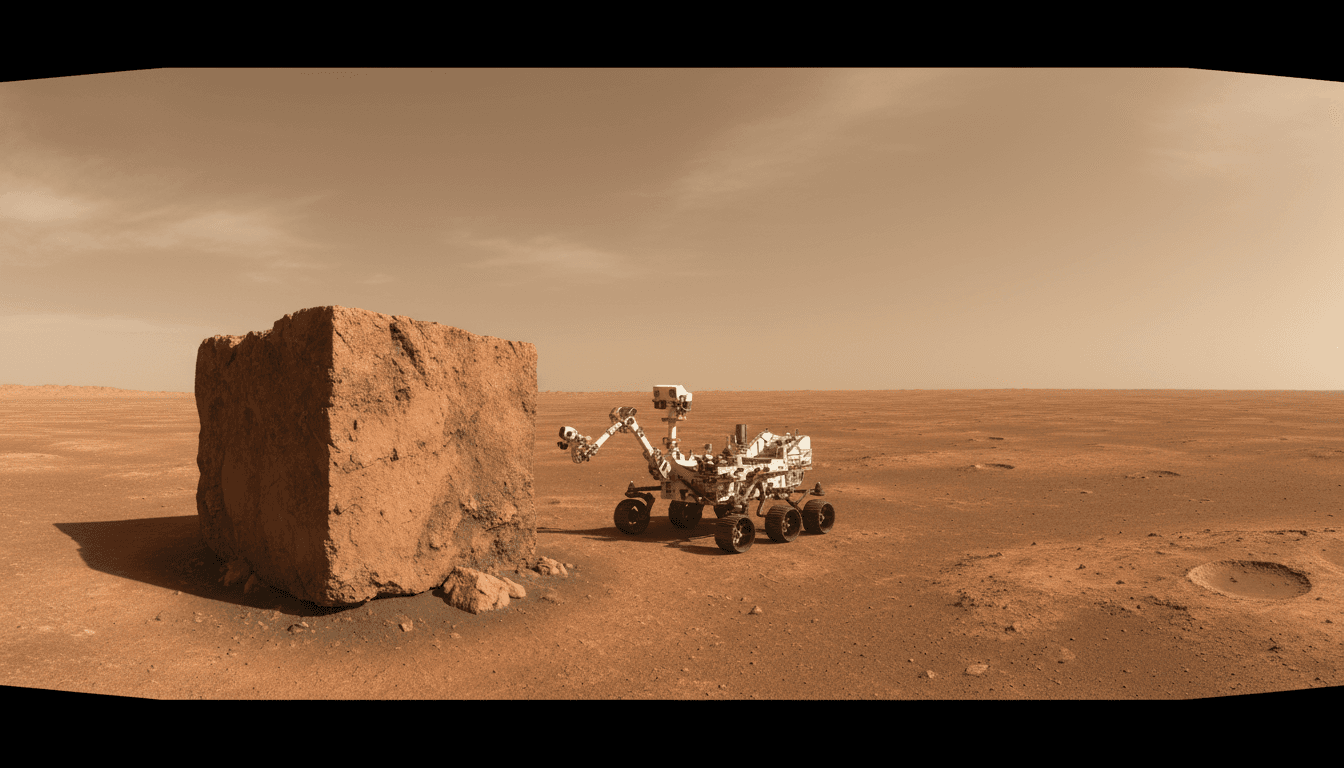
NASA’s Martian ‘Square on Mars’ image, which went viral overnight on May 3, 2026, has been definitively identified by scientists as a naturally occurring geological formation, dispelling widespread speculation of artificial structures on the red planet. The image, captured by a Mars rover, had ignited a global frenzy across social media and scientific communities alike due to its striking geometric precision.
The Viral Phenomenon and Scientific Scrutiny
The anomaly, dubbed the ‘Square on Mars,’ first appeared in raw imagery transmitted from the Martian surface. Its almost perfect rectilinear shape immediately caught the public’s imagination, leading to intense debate and theories ranging from ancient alien civilizations to previously undiscovered geological processes. Within hours of its release, the image had garnered millions of views and shares across digital platforms, making it one of the most widely discussed Martian discoveries in recent memory.
Scientists from NASA’s Jet Propulsion Laboratory (JPL) quickly mobilized to analyze the phenomenon. Using advanced imaging techniques and comparative geological data from previous Mars missions, they embarked on a rapid investigation. The initial assessment, released on May 3, 2026, confirmed that the ‘Square on Mars’ was not an artificial construct but rather a product of erosion and geological stress.
“The precision of the ‘Square on Mars’ was indeed astonishing, and it’s a testament to the public’s enduring fascination with Mars that it captured so much attention. However, our detailed analysis confirms it’s a beautiful example of natural Martian geology at play,” stated a lead researcher from the JPL team.
Further high-resolution imagery and spectroscopic analysis revealed that the ‘square’ was likely a fractured block of bedrock, where natural fault lines and weathering processes created the illusion of a man-made structure. Similar, albeit less perfectly formed, angular formations have been observed in other rocky terrains on Mars and Earth, often resulting from thermal expansion and contraction, or tectonic stresses.
Impact on Mars Exploration
The incident surrounding the ‘Square on Mars’ underscores the dual nature of public engagement in space exploration. While it sparked immense interest and brought Mars exploration into mainstream conversation, it also highlighted the challenge of managing public expectations and interpreting complex scientific data. This event, however, ultimately served to reinforce the scientific process, demonstrating how initial anomalies are rigorously investigated and explained through empirical evidence.
This episode also provides valuable insight into the public’s readiness to embrace extraordinary explanations for seemingly unusual phenomena. NASA’s transparent and swift response in clarifying the nature of the ‘Square on Mars’ was crucial in maintaining scientific credibility and fostering informed public discourse. It reinforces the agency’s commitment to presenting findings based on rigorous scientific methodology, even when initial observations might suggest otherwise. For more on how public perception shapes space missions, see our related science & space articles.
The Allure of the Unknown on Mars
Mars has long been a canvas for human imagination, fueled by its potential for past or present life, and the tantalizing possibility of ancient civilizations. From Percival Lowell’s erroneous canals to the ‘Face on Mars’ in the 1970s, geometric anomalies have consistently captured public attention. Each instance, while eventually explained by natural processes, serves to reignite the enduring human quest to understand our place in the cosmos and whether we are alone. The ‘Square on Mars’ is the latest chapter in this long-standing narrative.
The current generation of Mars rovers, equipped with increasingly sophisticated cameras and analytical instruments, continues to send back unprecedented detail from the Martian surface. This wealth of data inevitably includes images that, at first glance, appear unusual or defy easy explanation, driving both scientific inquiry and public fascination.
What’s Next for Martian Discoveries
While the mystery of the ‘Square on Mars’ has been solved, the broader mission of exploring Mars continues unabated. Future missions, including sample return initiatives and potential human expeditions, will continue to delve deeper into the planet’s geological history, climate, and potential for habitability. Each new image, each new data point, contributes to a more complete understanding of our planetary neighbor. Scientists anticipate that as more data is collected, similar intriguing formations will undoubtedly emerge, continuing to challenge perceptions and drive scientific investigation.
The rapid viral spread of the ‘Square on Mars’ image serves as a powerful reminder of the global reach and impact of discoveries from space. It underscores the importance of clear, timely scientific communication in an age of instant information. As humanity continues its ambitious journey to explore the solar system, such moments of collective wonder and scientific clarification will remain integral to the ongoing narrative of discovery.