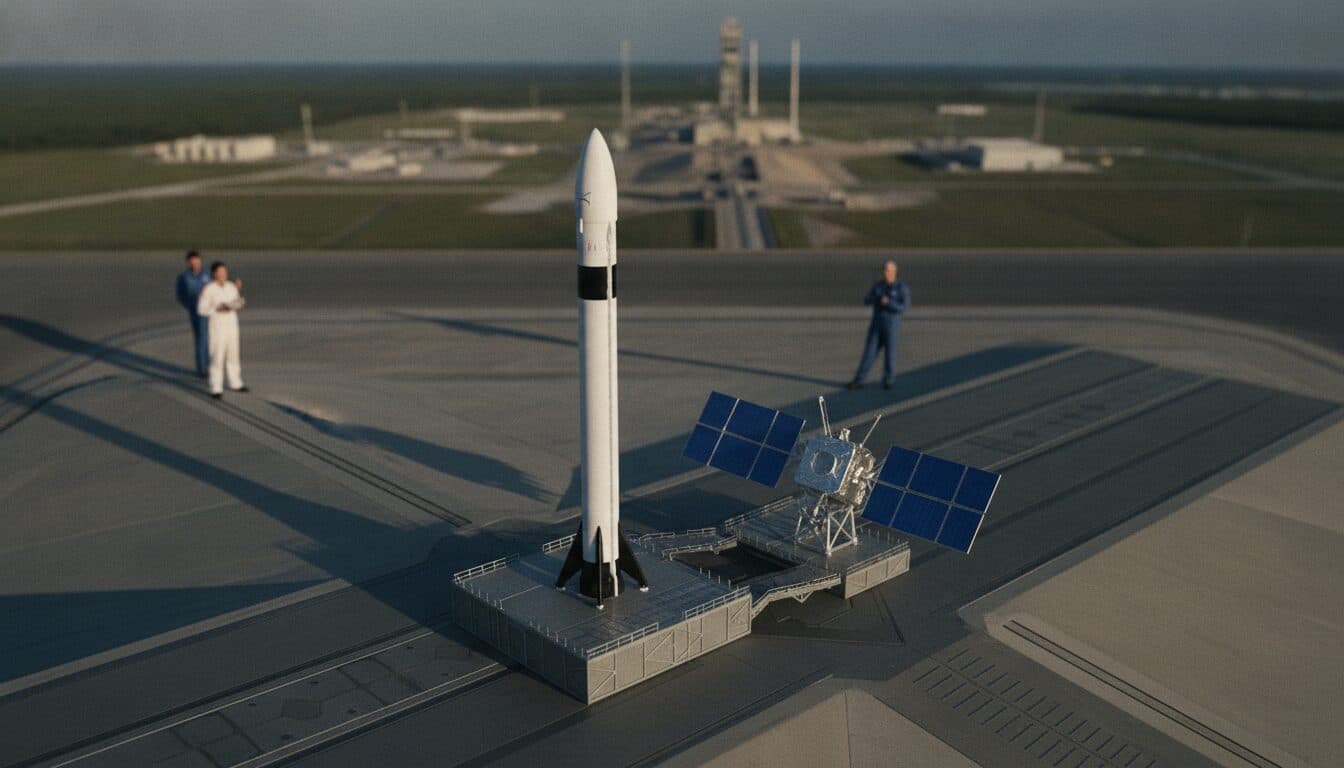
The upcoming SpaceX Starship V3 launch from Starbase, Texas, signals a critical juncture for the company’s lunar ambitions and brings into sharp relief the evolving dynamics of the commercial space industry, particularly concerning Florida’s role as a launch hub. Set for no earlier than 6:30 p.m. ET on Wednesday, May 20, this will be the 12th overall flight of the fully stacked Starship and the inaugural test of its significantly redesigned Version 3 (V3), a pivotal step towards NASA’s Artemis program goals.
This 407-foot-tall launch system is not merely a commercial venture; it is a cornerstone of NASA’s strategy to return astronauts to the moon and, eventually, to Mars. The Starship’s upper stage, or ‘ship,’ must demonstrate orbital capability, followed by in-orbit refueling — a prerequisite for lunar transit. A modified version, the Human Landing System (HLS), is slated to rendezvous with the Orion spacecraft in lunar orbit, facilitating the transfer of astronauts for lunar surface landings.
Starship V3 Launch: A Crucial Test for SpaceX
For this Flight 12, SpaceX is prioritizing the validation of its redesigned Starship’s fundamental performance. Objectives include monitoring the behavior of both the ship and booster from liftoff through landing, and intentionally stressing the ship’s heatshield by omitting one tile to assess its resilience. These tests are vital following a challenging 2025, which saw two Starship losses early in flight from Texas. A notable comeback occurred in October 2025 with Flight 11, which achieved an engine relight in space, deployed mock Starlink satellites, and nearly completed an intact ship landing in the Indian Ocean.
The Version 3 of Starship incorporates several key upgrades. The Super Heavy booster features a sleeker redesign of its 33 Raptor engines and will now utilize three larger grid fins, positioned lower on the booster to mitigate impact from the ship’s engines during stage separation. This flight will also originate from a new Texas facility, Pad 2, equipped with shorter ‘chopsticks’ catch arms on its launch tower, designed for quicker vehicle tracking during future catching operations. For this flight, the Super Heavy booster will attempt a controlled landing in the Gulf of Mexico (now referred to as the Gulf of America), while the ship targets a splashdown in the Indian Ocean after an hour-long coast in space.
“The success of this Starship V3 launch is not just about SpaceX; it’s about the accelerating timeline for lunar exploration and the commercialization of space transport. Every test, every iteration, brings us closer to a multi-planetary future.”
Florida’s Evolving Role in Starship Operations
While the immediate focus is on Texas, Florida’s space coast is actively preparing for future Starship operations. SpaceX has consistently stated that Starship will only launch from Cape Canaveral when fully ready, with a target of late 2026. This ambition drives significant infrastructure development across the Sunshine State. The launch site at Kennedy Space Center Pad 39A is nearing completion, prompting a temporary halt in Falcon 9 launches from a nearby pad to prioritize Starship preparations. Additionally, work has commenced at Launch Complex 37 in Cape Canaveral Space Force Station, earmarked as a second Florida launch location.
The company’s Gigabay facility on Roberts Road at KSC is under intensive construction, designed for stacking and preparing the 236-foot-tall Super Heavy boosters. To support the planned rapid reusability, SpaceX is mass-producing 1,000 Starship heatshield tiles daily at a facility near the Cape. Drone ships are also being repurposed; “You’ll Thank Me Later” is being modified to deliver Super Heavy boosters to Cape Canaveral, and “Just Read the Instructions” has been redeployed from Falcon 9 support to ferry Starship stages from Texas to Florida. These logistical shifts underscore the scale of operations anticipated for SpaceX Starship V3 launches.
Local concerns in Florida extend beyond the rocket’s performance, encompassing issues like road closures, noise and air pollution, potential infrastructure damage, temporary closures of Playalinda Beach, and disruption to industries such as fishing. However, NASA and the Space Force have completed environmental assessments, indicating no immediate impact. The Space Force has affirmed a Starship launch from Florida is planned by year’s end, contingent on the success of Flight 12.
The Broader Lunar Lander Race
SpaceX is not alone in the race to provide lunar landing capabilities for NASA. Blue Origin is developing its Mark II lander, which will launch atop the company’s New Glenn rocket. The Mark II’s simpler design, which does not require multiple in-orbit refuels like Starship, presents an alternative for NASA. Current Artemis plans call for one—or both—of these landers to be tested during the 2027 Artemis III mission, involving a docking demonstration with the Orion spacecraft in low Earth orbit, ahead of a planned 2028 moon landing during the Artemis IV mission. With Starship already designated for the initial moon landing, NASA is pushing both companies for accelerated progress.
The success of this week’s Flight 12 is paramount, as the entire future timeline for Starship operations, including its deployment from Florida and its role in critical NASA missions, hinges on its performance. Beyond NASA, Starship’s full reusability and potential cost reductions have secured contracts with multiple entities, including the Space Force, underscoring its broad significance for the future of space transport.