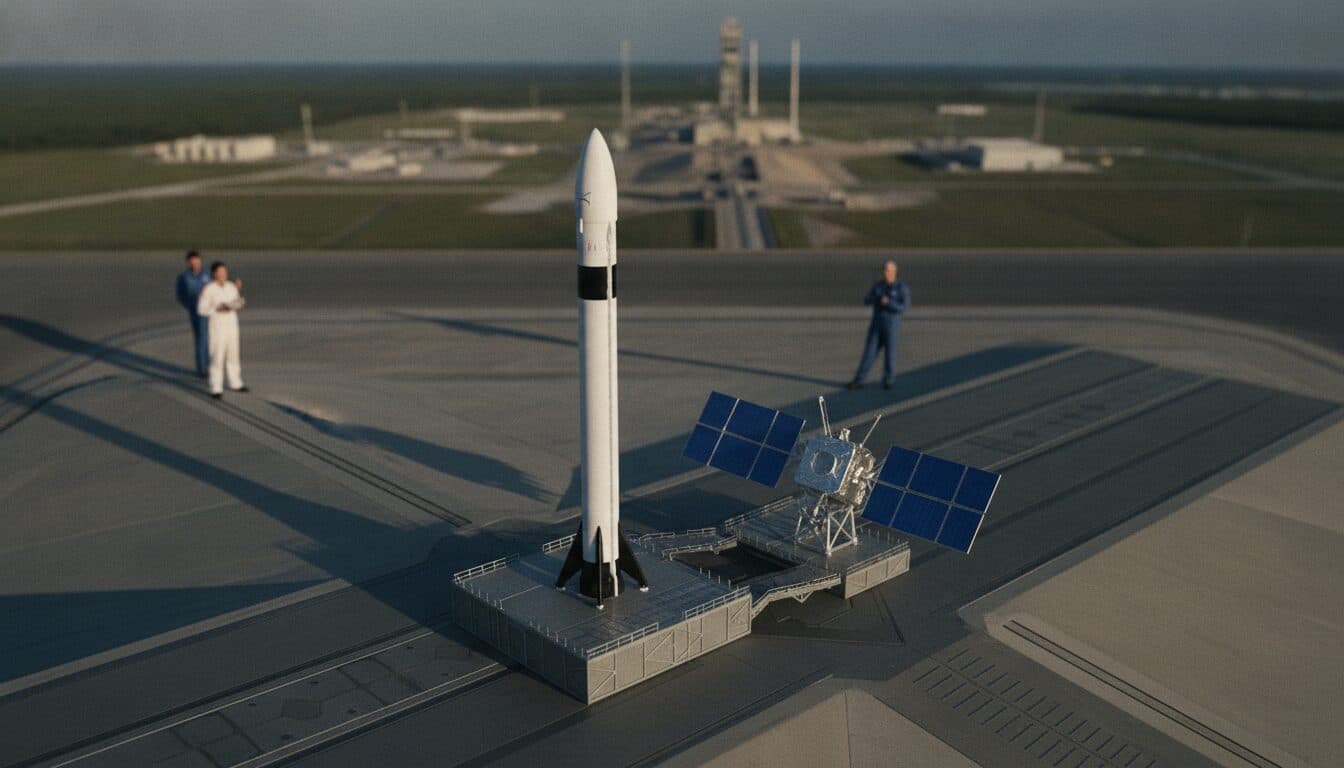
SpaceX launches 24 Starlink satellites, further expanding its ambitious broadband constellation, following a successful Falcon 9 rocket mission from Vandenberg Space Force Base on Friday, May 29, 2026. This latest deployment underscores the company’s relentless pace in building out its global internet service, bringing the total number of operational Starlink satellites significantly higher and reinforcing its market position in low-Earth orbit communications.
The Mission: SpaceX Launches 24 Starlink Satellites
The mission saw a Falcon 9 rocket lift off from Vandenberg Space Force Base, carrying a payload of 24 Starlink satellites. The launch, conducted on Friday, May 29, 2026, proceeded without incident, with the first stage successfully landing back on a drone ship in the Pacific Ocean, a now-routine but still impressive feat of engineering. Each successful launch contributes to the growing network, designed to provide high-speed, low-latency internet access to underserved areas globally. The consistent cadence of these deployments is critical for Starlink to achieve its full operational capacity and market penetration.
Impact Analysis
The regular deployment of Starlink satellites has profound implications for the global telecommunications landscape. By increasing the density of its constellation, SpaceX enhances the reliability and speed of its internet service, making it a more competitive option against traditional terrestrial and geostationary satellite providers. This expansion is particularly impactful for rural communities and regions with limited infrastructure, offering a viable solution for digital inclusion. Furthermore, the continuous launches demonstrate SpaceX’s operational efficiency and its ability to rapidly iterate and scale its space-based services. This operational tempo sets a new benchmark for commercial space ventures and challenges established players to innovate or risk being left behind. Related science & space articles often highlight the increasing competition in the satellite internet sector, driven largely by Starlink’s aggressive expansion.
“SpaceX’s consistent launch cadence for Starlink is not merely about adding satellites; it’s about fundamentally reshaping access to information globally, pushing the boundaries of what’s possible in commercial space exploration and connectivity.”
Context & Background
Since its inception, Starlink has aimed to revolutionize global internet access. The program began deploying its first operational satellites several years ago, gradually building a mesh network in low-Earth orbit. The Falcon 9 rocket, known for its reusability, has been the workhorse of these deployments, enabling the high frequency of launches necessary to populate the constellation. This strategy contrasts sharply with older satellite internet models, which relied on fewer, larger satellites in higher orbits. The shift to a large constellation of smaller, mass-produced satellites in LEO allows for lower latency and higher bandwidth, making services like streaming and online gaming feasible, which were previously challenging with satellite internet. This particular launch from Vandenberg SFB continues a pattern of regular missions from both the East and West Coasts, optimizing launch windows and orbital planes.
What’s Next for Starlink Satellites
Looking ahead, SpaceX is expected to continue its aggressive launch schedule to further densify the Starlink constellation. Future iterations of the satellites may include enhanced capabilities, such as inter-satellite laser links, to improve data routing and reduce reliance on ground stations. The company is also exploring partnerships and expanding its service into new geographical markets, pending regulatory approvals. The continuous growth of the network raises questions about orbital debris and spectrum allocation, issues that will require ongoing international dialogue and collaboration. The success of each mission to launch 24 Starlink satellites brings closer the vision of truly global, high-speed internet access.
Key Takeaway
The successful launch of 24 Starlink satellites from Vandenberg Space Force Base on May 29, 2026, is more than just another mission; it’s a testament to the relentless march of commercial space towards ubiquitous global connectivity. This ongoing expansion is not only transforming how people access the internet but also setting new standards for the efficiency and scalability of space operations. As SpaceX continues to build out its infrastructure, the implications for digital equity, global commerce, and the future of telecommunications will only grow, underscoring the profound impact of these regular deployments. Our coverage of the space economy consistently highlights the transformative power of such initiatives.