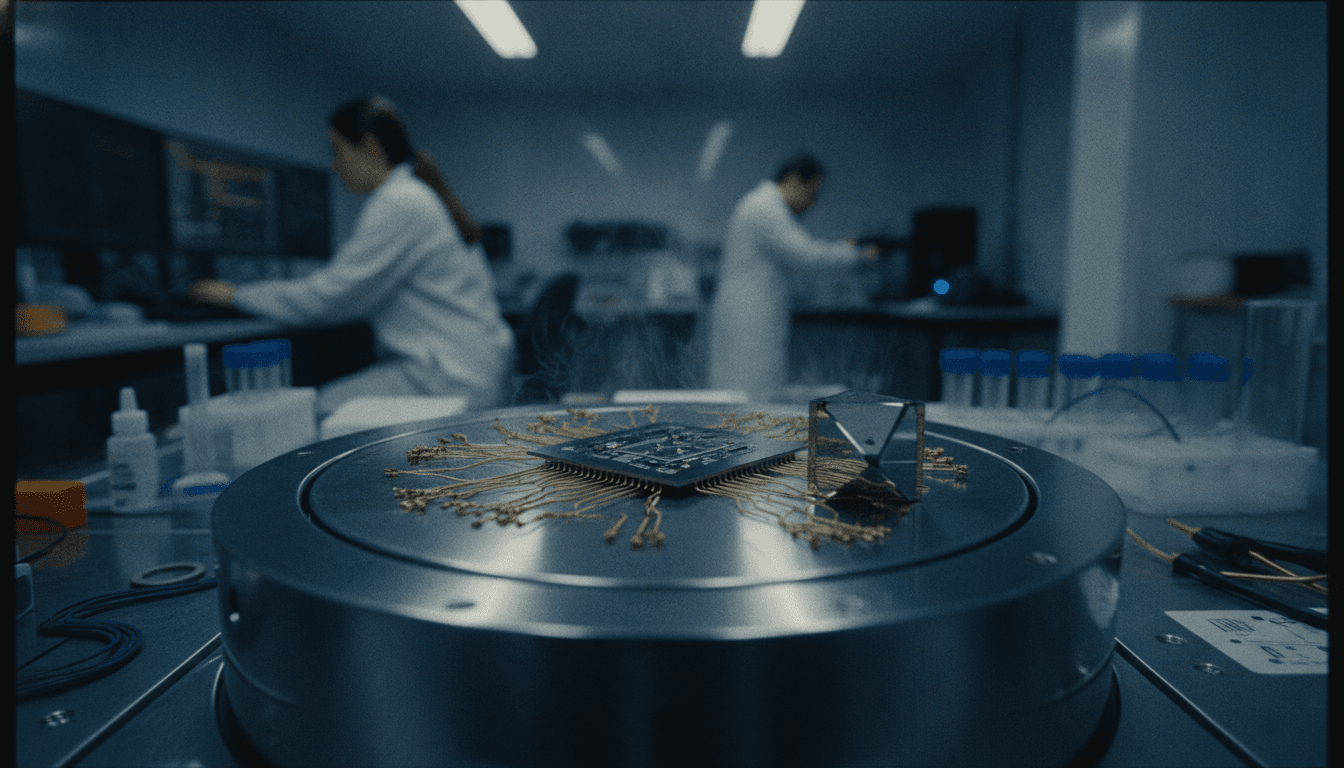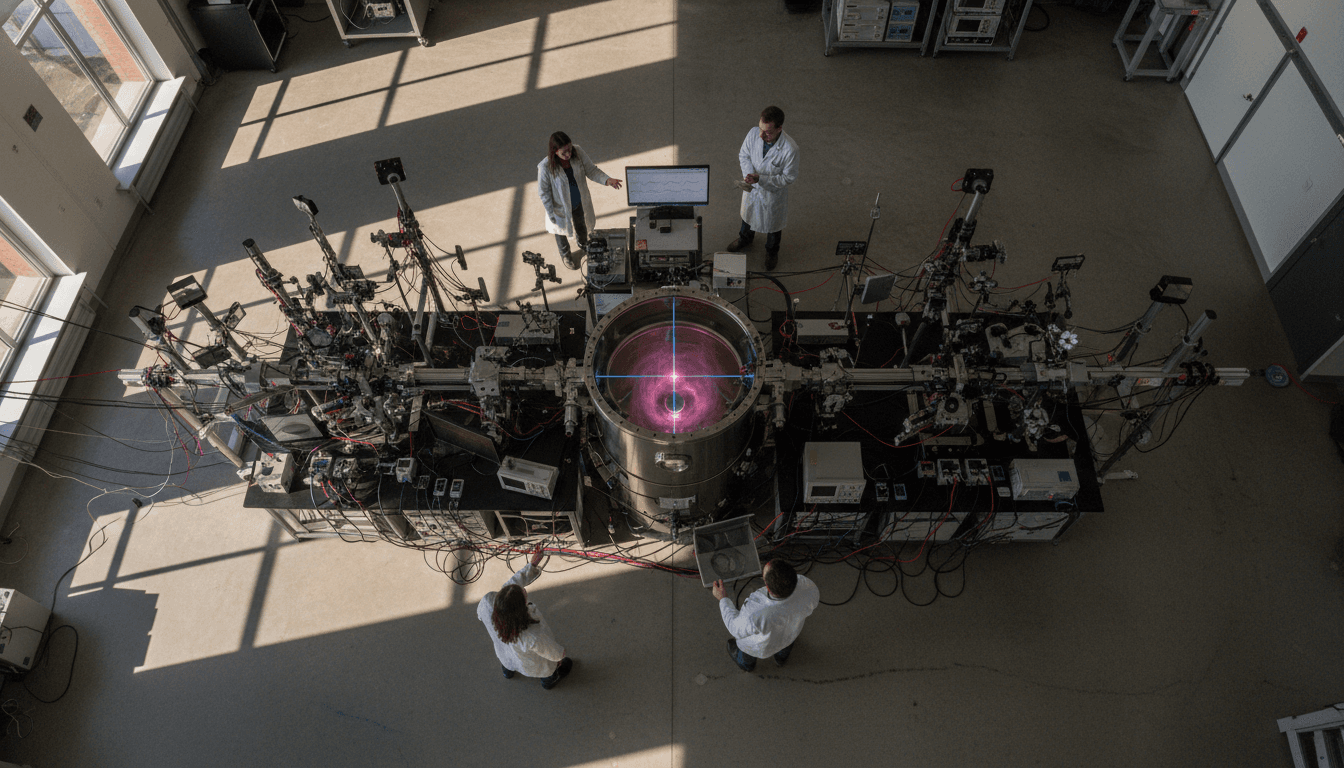
A groundbreaking quantum experiment on rubidium atoms has revealed a startling phenomenon: photons appearing to spend negative time while interacting with matter. This unprecedented finding, detailed in a study published in Physical Review Letters, challenges long-held assumptions about quantum mechanics, photon behavior, and the fundamental nature of time itself.
On Tuesday, June 2, 2026, The Economic Times reported on this significant breakthrough. Scientists, after millions of observations, confirmed that photons traveling through a cloud of rubidium atoms emerged earlier than expected, leading to calculations suggesting a ‘negative time’ interaction. While this doesn’t pave the way for time travel, it profoundly impacts our understanding of how light and matter interact at the quantum level.
The Mechanics of Negative Time Measurement
The core of this quantum experiment on rubidium atoms involved precisely monitoring photons as they traversed a medium of rubidium atoms. These specific atoms are known for their resonant properties, allowing them to temporarily absorb and then re-emit a photon’s energy. Conventionally, one would anticipate a measurable delay as photons navigate such a material. However, the experimental results defied this expectation.
Through advanced weak measurement techniques, researchers meticulously tracked the photons. They observed that the successful photons — those that traversed the atomic cloud — consistently exited *before* their calculated arrival time based on the medium’s properties. By comparing average entry and exit times, the team derived a ‘negative’ duration for the photons’ interaction within the atomic cloud. This effect, though theoretically discussed in quantum physics for decades, has now been empirically validated with compelling evidence.
“The discovery has quickly attracted attention across the scientific community because negative time measurements have long been considered one of the most puzzling effects in quantum research.”
Impact Analysis
This finding significantly reshapes discussions within the broader science and space landscape. For decades, the concept of negative time in quantum interactions was largely confined to theoretical models, often dismissed as a mathematical quirk. The robust experimental confirmation, based on millions of measurements, elevates it to a measurable quantum effect. This validates certain interpretations of quantum mechanics that allow for such counter-intuitive phenomena, pushing the boundaries of what is considered possible in the subatomic world.
The implications extend beyond pure physics. Understanding how photons can effectively ‘borrow’ time or emerge earlier than expected could inform future advancements in quantum computing, secure communication, and even novel energy transfer mechanisms. It forces a re-evaluation of the temporal aspects of quantum processes, potentially leading to new theoretical frameworks that better describe the universe at its most fundamental level. Researchers are now tasked with integrating this empirical data into existing quantum models, which may necessitate revisions or expansions of current theories.
Context and Background
The notion of time in quantum mechanics is notoriously complex and often diverges from our classical, macroscopic understanding. Concepts like quantum tunneling, where particles can pass through energy barriers seemingly instantaneously, have long hinted at the non-classical behavior of time at microscopic scales. Negative time measurements, while more extreme, resonate with these existing quantum paradoxes.
Previous experiments have explored superluminal (faster-than-light) propagation in certain media, where light pulses appear to travel faster than the speed of light in a vacuum, though this is typically explained by group velocity effects rather than individual photon speeds. The rubidium atom experiment, however, focuses on the *duration of interaction* within the medium, presenting a distinct and even more challenging temporal anomaly. This study stands on the shoulders of decades of theoretical work attempting to reconcile the probabilistic and often paradoxical nature of quantum particles with our perception of a linear, unidirectional flow of time.
What’s Next
The immediate future will likely see a flurry of activity aimed at replicating these results and exploring the specific conditions under which this negative time effect manifests. Scientists will seek to understand the precise mechanisms at play within the rubidium atom cloud that facilitate such an outcome. Further experiments may involve different atomic species or varying experimental parameters to determine the universality and limits of this phenomenon. The theoretical physics community will undoubtedly engage in intense discussions to refine models of photon-matter interaction and the role of time in quantum processes. This could lead to a deeper, more unified theory of quantum mechanics that can account for such unusual temporal dynamics. Future research might also investigate potential applications, however distant, in fields like quantum information science, where precise control over quantum states and interactions is paramount.
This remarkable quantum experiment on rubidium atoms has opened a new frontier in physics, forcing a re-evaluation of fundamental concepts. While it does not enable science fiction-esque time travel, it profoundly deepens our understanding of the universe’s most enigmatic particles and the fabric of reality itself. The implications for quantum mechanics and our perception of time are far-reaching, promising a rich vein of discovery for years to come.