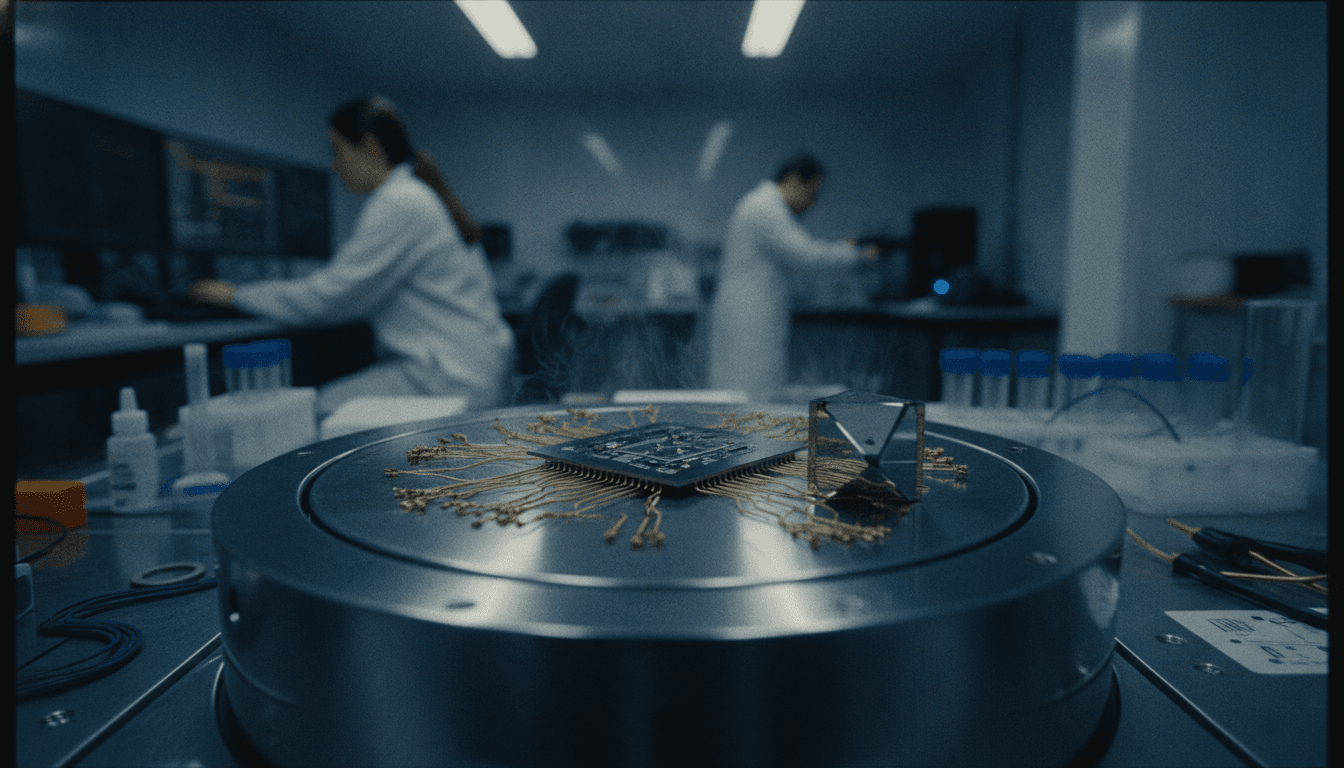
Quantum computing research has achieved a new processing milestone, marking a significant advancement in the burgeoning field. The development, announced on Sunday, May 10, 2026, by boldnewsonline.com, signifies a crucial step forward for a technology poised to redefine computational capabilities across various sectors, from finance to pharmaceuticals and beyond.
The New Processing Milestone
The core of this exciting news revolves around a significant leap in the processing power of quantum computers. While specific technical details or the entity responsible for this breakthrough were not disclosed in the initial report, the implication is clear: researchers have successfully overcome a previously limiting barrier in quantum computation. This new processing milestone likely refers to an increase in qubit stability, a reduction in error rates, or an enhancement in the number of entangled qubits that can be reliably manipulated, all critical factors in scaling quantum systems. Such advancements are vital for transitioning quantum computing from theoretical potential to practical application, enabling the tackling of complex problems currently intractable for even the most powerful classical supercomputers.
Impact Analysis
The impact of this new processing milestone reverberates across the broader science and space landscape. In scientific research, quantum computers promise to unlock unprecedented capabilities for simulating molecular structures, designing new materials, and understanding fundamental physics. For instance, simulating complex chemical reactions for drug discovery or developing more efficient catalysts could be dramatically accelerated. In the realm of space, quantum algorithms could optimize mission planning, enhance satellite communication security through quantum cryptography, and process vast datasets from deep-space probes with unparalleled speed. The ability to perform complex calculations in real-time could revolutionize everything from climate modeling to astrophysics, providing insights previously out of reach.
“This new processing milestone underscores the accelerating pace of innovation in quantum technologies, suggesting that practical applications are moving from the distant future to a much closer horizon.”
The financial implications are equally profound. Industries reliant on complex data analysis, such as financial modeling, logistics, and artificial intelligence, stand to gain immensely. Optimized algorithms for portfolio management, supply chain efficiency, and machine learning could yield significant economic advantages. This progress also fuels the competitive race among nations and corporations to dominate the quantum space, positioning early adopters for substantial gains. Related science & space articles frequently highlight the geopolitical stakes involved in this technological frontier.
Context & Background
The journey to this new processing milestone has been marked by decades of dedicated research and significant investment. Quantum computing, based on the principles of quantum mechanics, leverages phenomena like superposition and entanglement to perform calculations fundamentally differently from classical computers. Early quantum systems were highly experimental, often requiring extreme cryogenic temperatures and suffering from high error rates and limited qubit coherence times. Over the past decade, however, there has been a dramatic acceleration in progress, driven by breakthroughs in superconducting qubits, trapped ions, photonic systems, and topological qubits. Major tech giants, academic institutions, and government agencies worldwide have poured billions into research and development, recognizing the transformative potential of the technology. This latest development builds upon a foundation of continuous incremental improvements, each bringing the field closer to fault-tolerant quantum computers.
What’s Next
Looking ahead, this new processing milestone sets the stage for several critical developments. The immediate focus will likely be on further scaling these improved systems, increasing the number of reliable qubits, and enhancing error correction mechanisms. We can anticipate accelerated development of quantum algorithms tailored to these more powerful machines, particularly in areas like quantum chemistry, optimization, and machine learning. Decisions regarding standardization and interoperability across different quantum hardware platforms will become increasingly important as the technology matures. Furthermore, the commercialization of quantum computing services and specialized quantum software is expected to intensify, creating new markets and job opportunities. The next few years will likely see a proliferation of ‘quantum-as-a-service’ offerings, making quantum capabilities accessible to a broader range of businesses and researchers.
Key Takeaway
The significance of this new processing milestone cannot be overstated. It represents not just a technical achievement but a powerful indicator of the accelerating trajectory of quantum computing. This progress brings us closer to a future where problems once considered unsolvable become tractable, fundamentally altering scientific discovery, technological innovation, and economic landscapes. As researchers continue to push the boundaries of quantum mechanics, the world stands on the cusp of a computational revolution that promises to reshape our understanding and interaction with the universe. The implications for cybersecurity, material science, and even our pursuit of extraterrestrial life through advanced data analysis are vast and largely untapped, underscoring the profound importance of continued investment and innovation in this transformative field. Our coverage of science & space will continue to track these pivotal advancements.