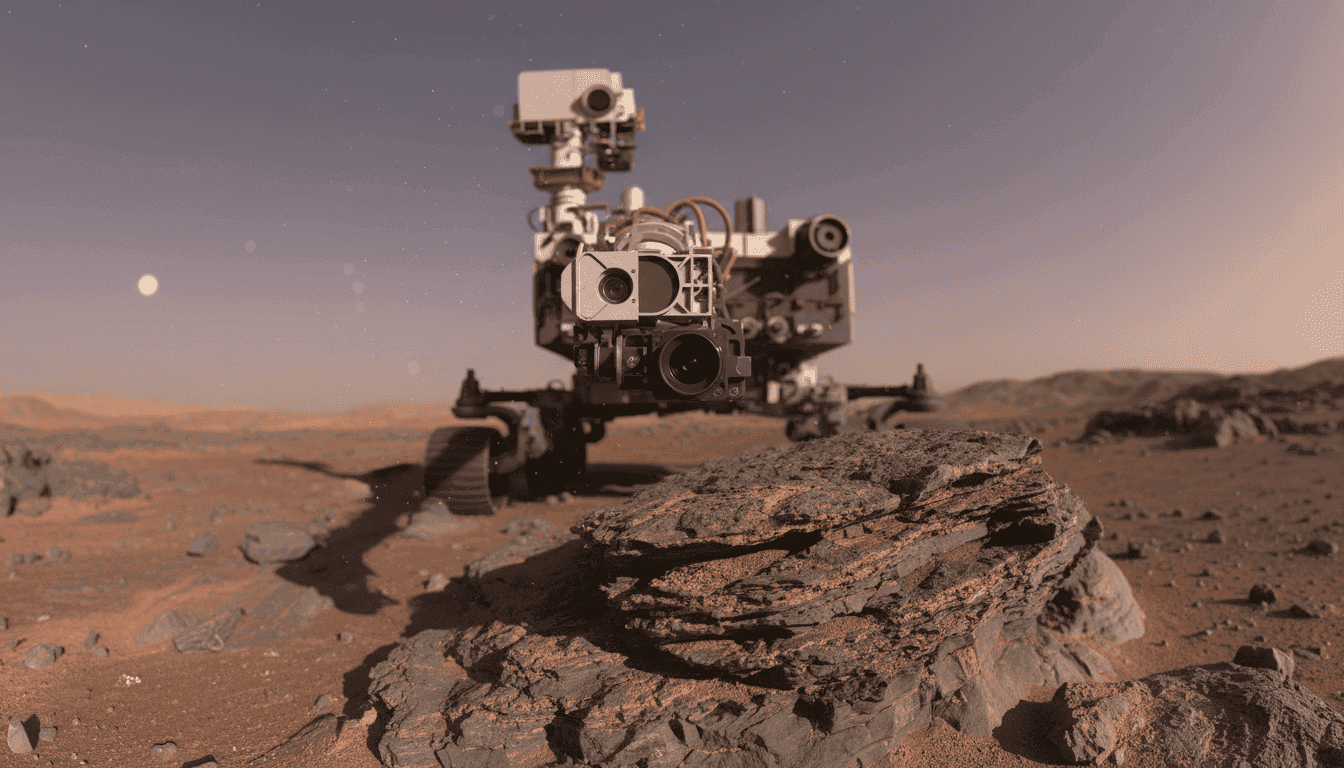
The Mars Perseverance Sol 1820 imagery from the Left Navigation Camera (Navcam) marks a routine yet critical data transmission, providing scientists with fresh insights into the Martian surface. This latest dispatch from the rover, relayed by mars.nasa.gov on Tuesday, May 5, 2026, underscores the continuous operational success of the Perseverance mission in the Jezero Crater.
The images, though not immediately revealing of any dramatic new discoveries, are integral to the ongoing geological survey and preparation for future sample collection efforts. The Perseverance rover, a cornerstone of NASA’s Mars Exploration Program, continues its methodical exploration, documenting the terrain, identifying potential scientific targets, and assessing environmental conditions.
Impact Analysis
The consistent flow of data, such as the Mars Perseverance Sol 1820 Navcam images, is fundamental to the broader scientific enterprise of understanding Mars’s past habitability and preparing for human exploration. Each set of images contributes to a continually expanding mosaic of the Jezero Crater, a site believed to have once harbored a river delta and a lake. This sustained data acquisition allows mission scientists to refine geological models, track environmental changes, and plan the rover’s intricate movements across challenging Martian topography.
“Every image from Perseverance is a piece of the puzzle, helping us reconstruct Mars’s ancient environment and guiding our search for biosignatures,” states a lead scientist involved in the mission.
The reliability of the Navcam system, consistently providing high-resolution imagery, is crucial for both scientific analysis and operational safety. These images enable engineers to identify hazards like rocks, slopes, and sand patches, ensuring the rover’s longevity and safeguarding its valuable scientific payload. The ongoing collection of Mars Perseverance Sol 1820 data exemplifies the meticulous planning and execution required for long-duration extraterrestrial missions.
Context and Background
The Perseverance rover landed in Jezero Crater on February 18, 2021, with primary objectives including astrobiology investigations, sample caching for future return to Earth, and testing technologies for human missions. Its suite of instruments, including the advanced Navcam, has been instrumental in fulfilling these goals. Previous sols have seen the rover deploy the Ingenuity helicopter, collect numerous rock and regolith samples, and conduct atmospheric experiments.
The mission builds upon decades of Martian exploration, from the early Mariner and Viking missions to the Pathfinder, Spirit, Opportunity, and Curiosity rovers. Each mission has progressively advanced our understanding of Mars, revealing a dynamic planet with a complex geological and climatic history. The Perseverance mission, with its focus on sample return, represents a significant leap towards bringing Martian material back to Earth for in-depth laboratory analysis, potentially unlocking definitive answers about life beyond Earth. For more on the broader context of Mars exploration, see our related science & space articles.
What’s Next for Perseverance Navcam
Looking ahead, the Mars Perseverance Sol 1820 imagery will be integrated into the mission’s tactical planning for upcoming traverses and scientific campaigns. The rover is expected to continue its journey through the ancient river delta, meticulously surveying and collecting samples that offer the best chance of containing evidence of past microbial life. The Navcam will remain a vital tool for navigation and contextual imaging, supporting the more specialized scientific instruments.
Future decisions will involve selecting the precise locations for drilling and caching, guided in part by the visual data provided by the Navcam. The ultimate goal remains the successful collection and sealing of these samples, preparing them for a future Mars Sample Return mission, an ambitious joint effort between NASA and ESA. The continued operational excellence, as demonstrated by the routine capture of Mars Perseverance Sol 1820 data, is paramount to achieving these long-term objectives.
Key Takeaway
The routine transmission of images like the Mars Perseverance Sol 1820 Navcam data, while seemingly incremental, is the bedrock of deep space exploration. It reflects the consistent, high-precision engineering and scientific dedication that allows humanity to extend its reach across the solar system. Each pixel transmitted from Mars contributes to our collective knowledge, pushing the boundaries of what is known and paving the way for future human endeavors on the Red Planet.