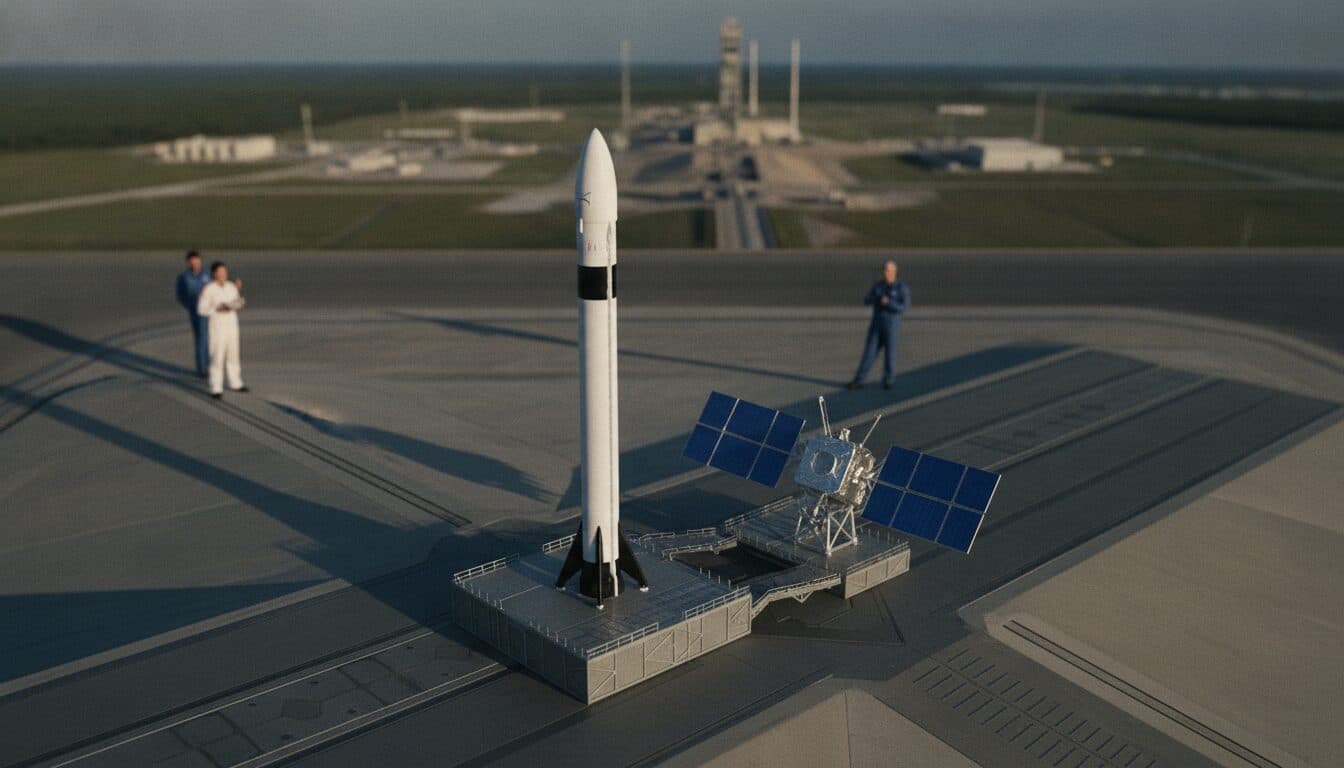
A Mars space shortcut, offering a dramatically reduced travel time, has been discovered, potentially reshaping the future of interplanetary exploration. This unprecedented finding, reported on Wednesday, May 6, 2026, details a theoretical 226-day round trip to Mars, a significant reduction from conventional mission profiles. The implications for human missions, robotic probes, and the economic viability of Martian endeavors are substantial, promising to accelerate humanity’s reach across the solar system.
The discovery of this novel trajectory, dubbed the Mars space shortcut, was announced by Meyka, though specific details about the methodology or the individuals/teams involved were not immediately available beyond the initial reporting. What is clear is the profound impact of a 226-day round trip, which drastically cuts down on the logistical challenges, radiation exposure, and resource requirements associated with longer expeditions. Traditional round trips to Mars typically span well over a year, often closer to two or three years depending on the chosen trajectory and propulsion systems. This new shortcut implies a significantly more efficient orbital mechanics solution, leveraging gravitational assists or specific planetary alignments to optimize transit times both to and from the Red Planet.
Impact Analysis of the Mars Space Shortcut
The immediate impact of a 226-day Mars space shortcut cannot be overstated. For crewed missions, it translates directly into a reduction in astronaut exposure to cosmic radiation, a primary health concern for long-duration spaceflight. Shorter travel times also alleviate the psychological strain on crews, minimize the amount of life support and provisions needed, and reduce the overall mission cost and complexity. This could make human missions to Mars more feasible within current technological and budgetary constraints, potentially moving up timelines for establishing a sustained human presence.
For robotic missions, the implications are equally significant. Scientific probes could reach Mars faster, allowing for quicker data acquisition and analysis. Sample return missions, a cornerstone of astrobiological research, would become less arduous and more frequent. Furthermore, the reduced window for mission operations could enable more frequent launch opportunities, increasing the resilience and flexibility of Martian exploration programs. The discovery also opens new avenues for propulsion research, as understanding the mechanics behind this shortcut could inspire new approaches to interstellar travel or even faster transit within our own solar system. This could also influence the development of advanced propulsion systems.
“The discovery of a 226-day round trip to Mars represents a paradigm shift in our approach to interplanetary travel, potentially making the Red Planet a far more accessible destination for humanity.”
While the specific technical details remain under wraps, the announcement signals a potential breakthrough in astrodynamics. Such shortcuts often exploit complex gravitational interactions, sometimes referred to as ‘interplanetary superhighways’ or ‘low-energy transfers,’ which utilize minimal fuel but typically involve longer transit times. The novelty here is the combination of a shortcut with a significantly reduced overall duration for a round trip. This suggests either a highly optimized low-energy transfer or a novel trajectory design that balances speed with fuel efficiency in an unprecedented way. It’s a development that will undoubtedly capture the attention of space agencies worldwide.
Context & Background
Humanity’s fascination with Mars has driven decades of scientific and technological advancement. From the Mariner probes in the 1960s to the Perseverance rover currently exploring Jezero Crater, each mission has pushed the boundaries of our understanding and capabilities. However, the immense distances and the hostile environment of space have always presented formidable challenges. The ‘tyranny of the rocket equation’ and the finite launch windows for efficient planetary transfers have dictated mission planning for generations. Previous efforts to shorten travel times have focused on advanced propulsion technologies like nuclear thermal propulsion or electric propulsion, which offer higher specific impulse but often come with their own engineering complexities and long development timelines. This newly reported Mars space shortcut, however, appears to be a purely trajectory-based optimization, offering a solution that could be implemented with existing or near-term propulsion systems.
The current planning for human missions to Mars, notably by NASA and SpaceX, typically involves transit times of six to nine months one way, with a significant stay on Mars to await a favorable return window, leading to total mission durations exceeding 500 days, often closer to 800-1000 days. A 226-day round trip would fundamentally alter these calculations, making such missions less costly, less risky, and potentially more frequent. This could also accelerate the development of sustainable habitats on Mars.
What’s Next
The immediate next steps following this announcement will undoubtedly involve detailed scrutiny by the global space community. Researchers and engineers will be eager to understand the underlying principles of this Mars space shortcut. If the claims hold up to rigorous scientific review, we can expect a rapid re-evaluation of mission architectures by major space agencies. This could lead to revised roadmaps for human exploration, potentially accelerating the timeline for the first human boot print on Mars. Investment in related technologies, such as advanced life support systems optimized for shorter missions and more robust radiation shielding for the reduced, but still present, radiation exposure, may also see a boost. The potential for international collaboration on Mars missions could also be significantly enhanced, as the reduced complexity makes joint ventures more manageable.
The discovery of this Mars space shortcut represents a pivotal moment in space exploration. It underscores the ongoing potential for innovative thinking to overcome seemingly intractable challenges. While the full technical details are yet to be revealed, the prospect of a 226-day round trip to Mars opens a new chapter in our quest to become a multi-planetary species, bringing the dream of Martian colonization significantly closer to reality.