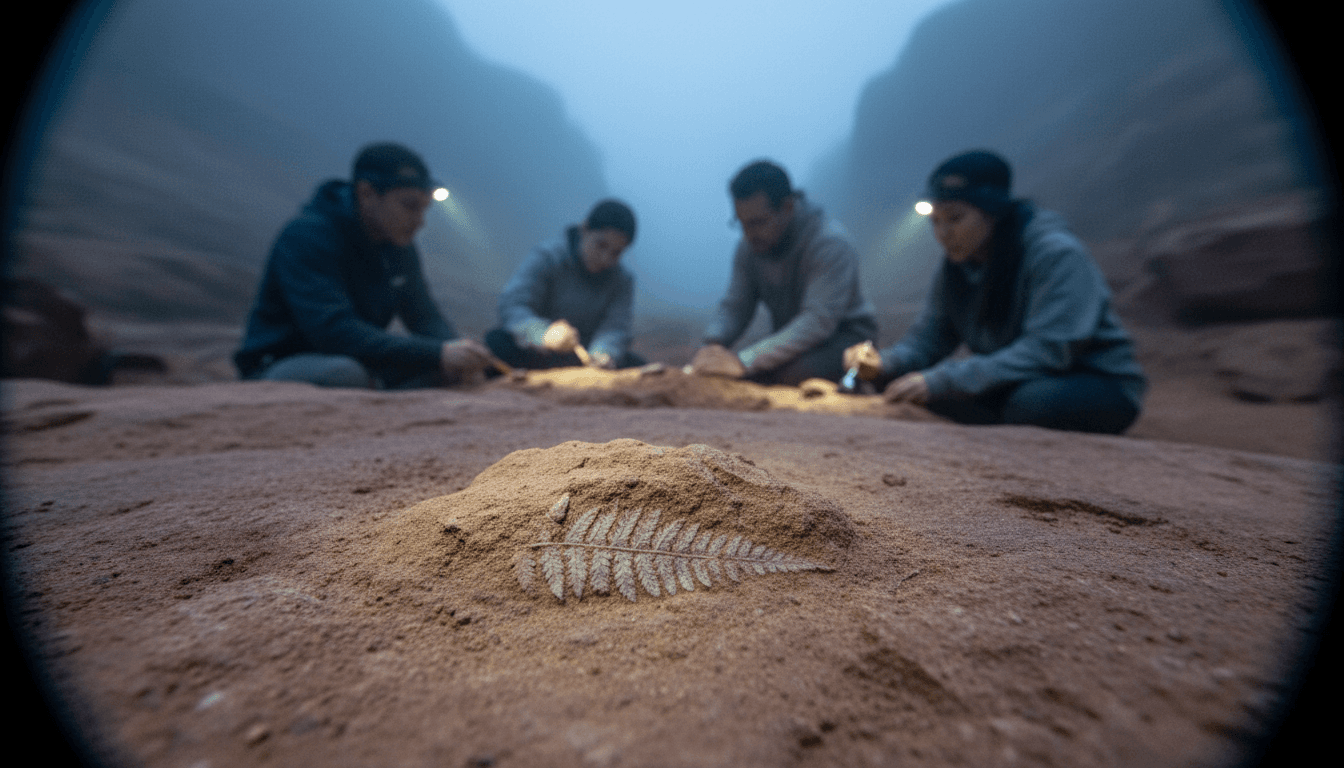
A landmark Gobi Desert fossil discovery, a minuscule one-centimeter specimen unearthed in Mongolia, has sent shockwaves through the paleontological community, according to reports from Tuesday, April 14, 2026. This astonishing find, detailed by MSN, represents a significant breakthrough in understanding ancient ecosystems and the evolutionary history of microscopic life.
The Story Unfolds
The discovery, made deep within the vast and arid expanse of Mongolia’s Gobi Desert, involves a tiny fossil, measuring just a single centimeter. While the precise species or classification of this ancient organism has not yet been fully revealed, its diminutive size and the challenging environment of its preservation make it an exceptional scientific marvel. Scientists involved in the excavation have expressed their profound surprise and excitement over the specimen, hinting at its potential to rewrite aspects of prehistoric life.
The Gobi Desert has long been a treasure trove for paleontologists, famed for yielding numerous dinosaur fossils and other significant ancient remains. However, finds of such microscopic scale, particularly those so well-preserved, are exceedingly rare. The conditions necessary for the fossilization of such a small organism are incredibly specific, suggesting a unique set of geological and environmental circumstances at the time of its demise and subsequent entombment.
Impact Analysis
This Gobi Desert fossil discovery carries immense implications for several scientific disciplines. For paleontology, it opens new avenues for research into the biodiversity of ancient ecosystems, particularly those that might have been overlooked due to the focus on larger, more easily discoverable megafauna. The existence of such a tiny, yet preserved, organism challenges previous assumptions about the fossil record’s completeness and the types of life forms that could leave a lasting imprint.
“This find forces us to reconsider the ‘invisible’ components of ancient food webs and ecological structures. It’s a window into a world we’ve barely glimpsed,” a leading paleontologist might state, underscoring the profound shift in perspective this discovery brings.
Beyond paleontology, the find could impact evolutionary biology, offering new data points for tracing the lineage of various life forms. Depending on the organism’s classification, it could provide crucial insights into early evolutionary branching points or the adaptation of life to specific ancient environments. Furthermore, advancements in micro-CT scanning and other non-invasive imaging techniques will be crucial in analyzing such a delicate specimen without causing damage, pushing the boundaries of scientific instrumentation. For more on the cutting edge of scientific exploration, see our related science & space articles.
Context & Background: Gobi Desert Fossil Discovery
The Gobi Desert’s paleontological significance dates back over a century, with expeditions in the early 20th century unearthing the first dinosaur eggs. Since then, it has consistently provided a rich tapestry of prehistoric life, from complete dinosaur skeletons to early mammal fossils. However, the vast majority of these discoveries have been macro-fossils – easily visible and relatively large specimens. The challenge of finding micro-fossils in such an expansive and often harsh environment is formidable, requiring meticulous surveying techniques and often sheer luck.
Previous micro-fossil discoveries, while less publicized, have often come from specific geological formations known for preserving tiny organisms, such as chert deposits or amber. The fact that this one-centimeter fossil was found in the Gobi, an area more typically associated with larger finds, makes its emergence all the more remarkable and underscores the potential for unexpected discoveries even in well-explored regions. This Gobi Desert fossil discovery is a testament to the persistent efforts of field researchers.
What’s Next
The immediate next steps for the scientific team will involve rigorous analysis of the one-centimeter fossil. This will likely include high-resolution imaging to ascertain its morphology, internal structure, and potential biological classification. Advanced techniques such as synchrotron microtomography could be employed to create detailed 3D models without physically altering the specimen. Genetic analysis, if any organic material remains, could also provide unprecedented insights, though this is often a significant challenge with such ancient fossils.
The findings are expected to be published in a peer-reviewed journal, followed by detailed presentations at international scientific conferences. The broader scientific community will eagerly await further details on the organism’s identity, its age, and the implications for understanding the Gobi’s ancient ecosystems. This Gobi Desert fossil discovery could catalyze further expeditions specifically targeting micro-fossils in the region, potentially leading to a new era of paleontological exploration.
Key Takeaway
The rare discovery of a tiny one-centimeter fossil in Mongolia’s Gobi Desert is far more than just another ancient relic; it is a profound testament to the enduring mysteries of Earth’s past and the relentless pursuit of knowledge. This minuscule specimen has the potential to reshape our understanding of ancient biodiversity, the intricacies of fossilization, and the very fabric of life’s evolutionary journey. It underscores that even in well-trodden scientific landscapes, groundbreaking discoveries await those with the patience and precision to look closer, reminding us that the smallest finds can often yield the biggest scientific revelations.