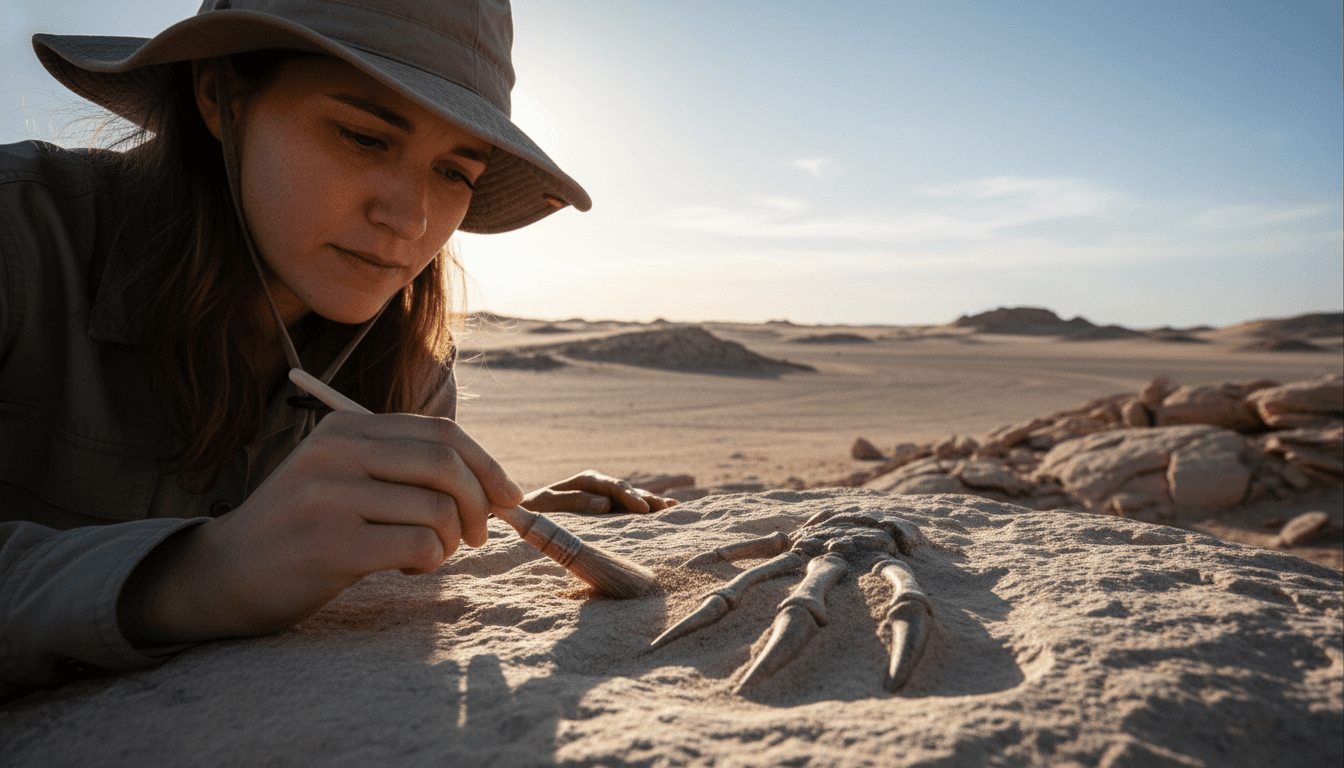
New Gobi Desert dinosaur claws from a recently discovered species, Duonychus tsogtbaatari, are turning established notions of theropod evolution on their head. Uncovered in Mongolia, this unique therizinosaur is notable for possessing only two clawed fingers, a departure from the three typically found in its relatives. This rare fossil provides scientists with unprecedented insights into the adaptive strategies and evolutionary pathways of these ancient creatures, particularly concerning the function of their massive claws.
The discovery of Duonychus, detailed in a study published in iScience, has generated significant interest among paleontologists. Therizinosaurs are generally characterized by their large claws and are recognized as plant-eating, bipedal dinosaurs. However, the unexpected presence of just two claws in Duonychus prompts critical questions regarding its environmental adaptations and the drivers behind this unusual evolutionary divergence.
A Two-Clawed Anomaly in the Gobi
The conventional understanding of therizinosaur anatomy has long centered on their distinctive three clawed fingers. Duonychus, however, directly challenges this paradigm. Darla Zelenitsky, a paleontologist at the University of Calgary and a co-author of the study, remarked,
“To find a specimen with only two fingers/claws was surprising as this was so out of the ordinary for this group of dinosaurs.”
The fossil, unearthed in the Bayanshiree Formation of southern Mongolia, included exceptionally well-preserved hands, enabling scientists to undertake a detailed examination of the dinosaur’s anatomy and, crucially, its claws.
A particularly compelling aspect of this find, as highlighted in the iScience journal, is the preservation of remnants of a keratinous sheath on the claws. Similar to human fingernails, this suggests that the claws were incredibly sharp and versatile, potentially employed for a diverse range of tasks. This level of preservation is rare and offers a clearer picture of the creature’s functional morphology.
The Purpose Behind Two Gobi Desert Dinosaur Claws
A central question arising from this discovery is the specific utility of Duonychus’s two claws. Yoshitsugu Kobayashi, the lead author of the study, posited that the dinosaur likely utilized its claws in a “hook-and-pull” motion to grasp and draw vegetation towards its mouth.
“Based on the shape of its well-preserved claw and how it curved, Duonychus was likely using its hands to grab onto branches and pull vegetation closer, kind of like how chameleons do today,”
Kobayashi elaborated. This specialized feeding strategy might have conferred an advantage to Duonychus, allowing it access to food sources that were less accessible to other therizinosaurs with their triple-clawed appendages. Beyond feeding, Kobayashi also theorizes that the claws could have served other purposes, such as defense, courtship displays, or even playful interactions, underscoring the potential multifaceted roles of these unique anatomical features.
Implications for Theropod Evolution
Kobayashi emphasized that Duonychus represents the fifth documented instance of a theropod group evolving to lose a third finger. While seemingly a minor anatomical alteration, this provides profound insights into the adaptive processes of these dinosaurs. The reduction or loss of a claw could have offered significant benefits for feeding or other behaviors, illustrating the unpredictable nature of evolutionary trajectories.
“While more fossils would help confirm this, all signs point to Duonychus representing a true evolutionary shift, not just a fluke,”
Kobayashi asserted.
“It’s a remarkable find that reshapes our understanding of therizinosaurs and theropod evolution as a whole.”
This discovery underscores the dynamic and often surprising pathways that evolution can take, even within closely related groups. The implications extend beyond therizinosaurs, offering a broader perspective on how different theropod lineages adapted to their ecological niches over millions of years.
To further validate and confirm this evolutionary pattern, scientists are now actively seeking additional specimens. Such discoveries are crucial for building a more comprehensive picture of theropod diversification and the selective pressures that drove these anatomical changes. The ongoing exploration of sites like the Bayanshiree Formation continues to yield critical fossils that challenge and refine our understanding of Earth’s ancient past. The Gobi Desert dinosaur claws of Duonychus tsogtbaatari stand as a testament to the persistent capacity of the fossil record to reveal unexpected twists in the story of life on Earth, prompting a re-evaluation of established paleontological theories and opening new avenues for research into dinosaurian adaptation and diversification.