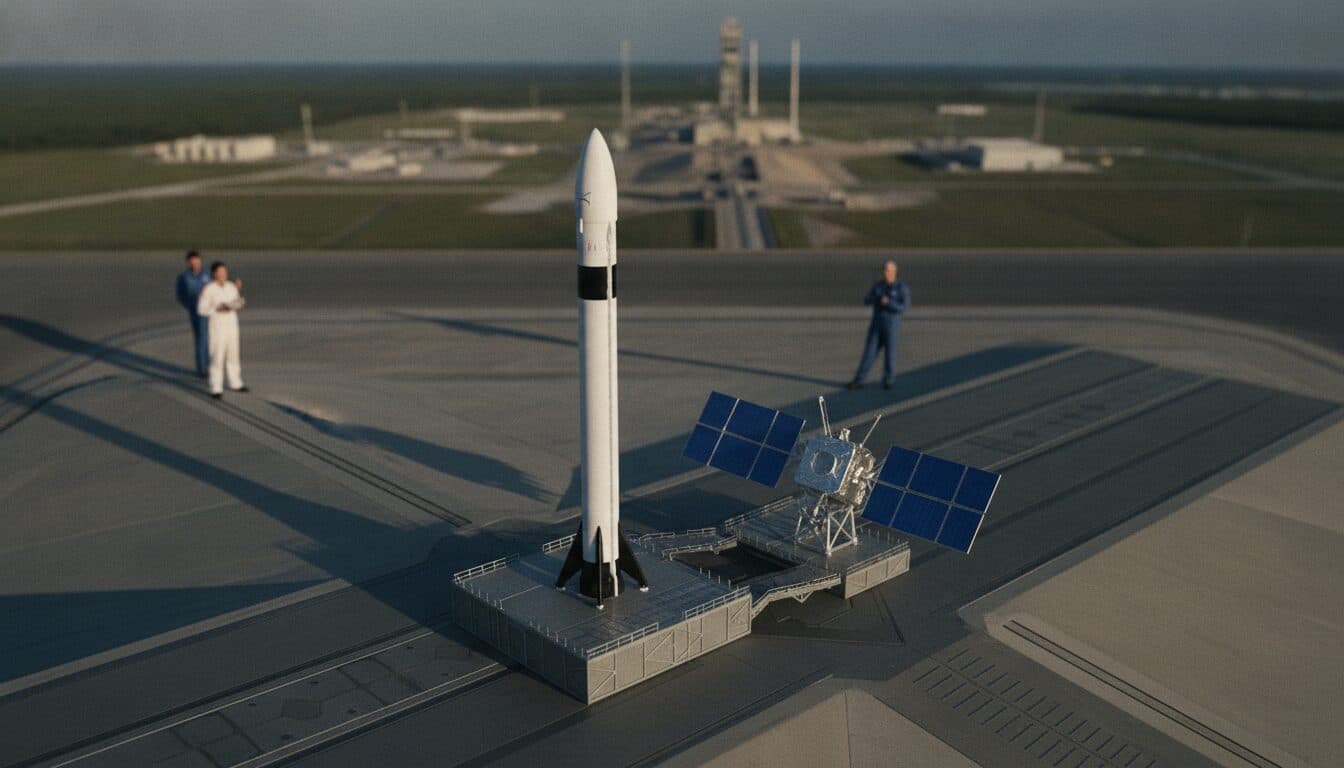
SpaceX eyes Falcon Heavy launch from Florida coast, a development that underscores the accelerating pace of private sector space exploration and its implications for both commercial ventures and national space ambitions. This anticipated launch, scheduled for Wednesday, April 29, 2026, from Florida, represents a significant moment for the company and the broader aerospace industry, showcasing the continued evolution of heavy-lift capabilities.
The Story: A Milestone on the Horizon
The core of this news revolves around SpaceX’s preparations for the launch of its Falcon Heavy rocket. While specific payload details were not disclosed, the Falcon Heavy itself is a critical asset in the company’s arsenal, known for its immense lift capacity. The launch window is set for Wednesday, April 29, 2026, originating from a Florida launch complex. This event follows a series of successful Falcon Heavy missions, each contributing to its reputation as one of the most powerful operational rockets in the world.
The Falcon Heavy’s design, essentially three Falcon 9 first-stage boosters strapped together, allows it to deliver substantial payloads to various orbits, including geosynchronous transfer orbit and beyond. Its reusability, a hallmark of SpaceX’s engineering philosophy, further reduces launch costs and increases mission frequency, a key differentiator in the competitive launch market.
Impact Analysis: Shifting the Gravitational Pull of Space Access
The ongoing deployment and utilization of the Falcon Heavy significantly affect the broader science and space landscape. For government agencies, it offers a robust alternative for launching large, complex satellites and deep-space probes, potentially at a lower cost than traditional providers. For commercial entities, it opens doors for deploying constellations of communications satellites or even private space stations, accelerating the commercialization of low-Earth orbit and beyond. This enhanced access to space fosters innovation, drives down costs, and enables more ambitious missions that were once prohibitively expensive or technically challenging.
“The Falcon Heavy’s capabilities are not just about lifting more mass; they’re about redefining the economics and accessibility of space for a diverse range of stakeholders, from national security to asteroid mining ventures.”
Furthermore, the repeated success of rockets like the Falcon Heavy reinforces the viability of reusable rocket technology, pushing other aerospace firms to adopt similar strategies. This competitive pressure ultimately benefits the entire industry by fostering efficiency and technological advancement. For more insights into the evolving landscape of private space initiatives, explore our related science & space articles.
Context & Background: A Legacy of Heavy Lift
The Falcon Heavy stands on the shoulders of decades of heavy-lift rocket development, yet it introduces a new paradigm with its reusability. Historically, heavy-lift rockets like the Saturn V or the Space Shuttle were largely government-funded, multi-billion-dollar endeavors with limited reusability. SpaceX’s approach, leveraging commercial investment and innovative engineering, has democratized access to heavy-lift capabilities. Prior to the Falcon Heavy, the market for such launches was dominated by a handful of state-backed entities. Its introduction has injected new dynamism, providing a more frequent and cost-effective option for launching some of the largest payloads.
What’s Next: Expanding Horizons
Looking ahead, the successful launch of the Falcon Heavy from the Florida coast will undoubtedly pave the way for future missions, potentially including more ambitious scientific probes, next-generation communication satellites, or even components for lunar and Martian infrastructure. The data gathered from each flight refines operational procedures and informs the design of future launch vehicles, including SpaceX’s larger Starship system. The cadence of these launches will also be a key indicator of the demand for heavy-lift services in the coming years, influencing investment decisions across the aerospace sector. This continued activity solidifies Florida’s role as a pivotal hub for global space operations.
Key Takeaway: The Commercialization of Deep Space
This anticipated launch of the Falcon Heavy from Florida coast underscores a fundamental shift in space exploration: the increasing reliance on private enterprise for capabilities once exclusive to national space agencies. It signifies not just a technological achievement but a pivotal step in the commercialization of deep space, opening new frontiers for scientific discovery, economic development, and international collaboration. The implications extend far beyond the launch pad, shaping the future trajectory of humanity’s reach into the cosmos.