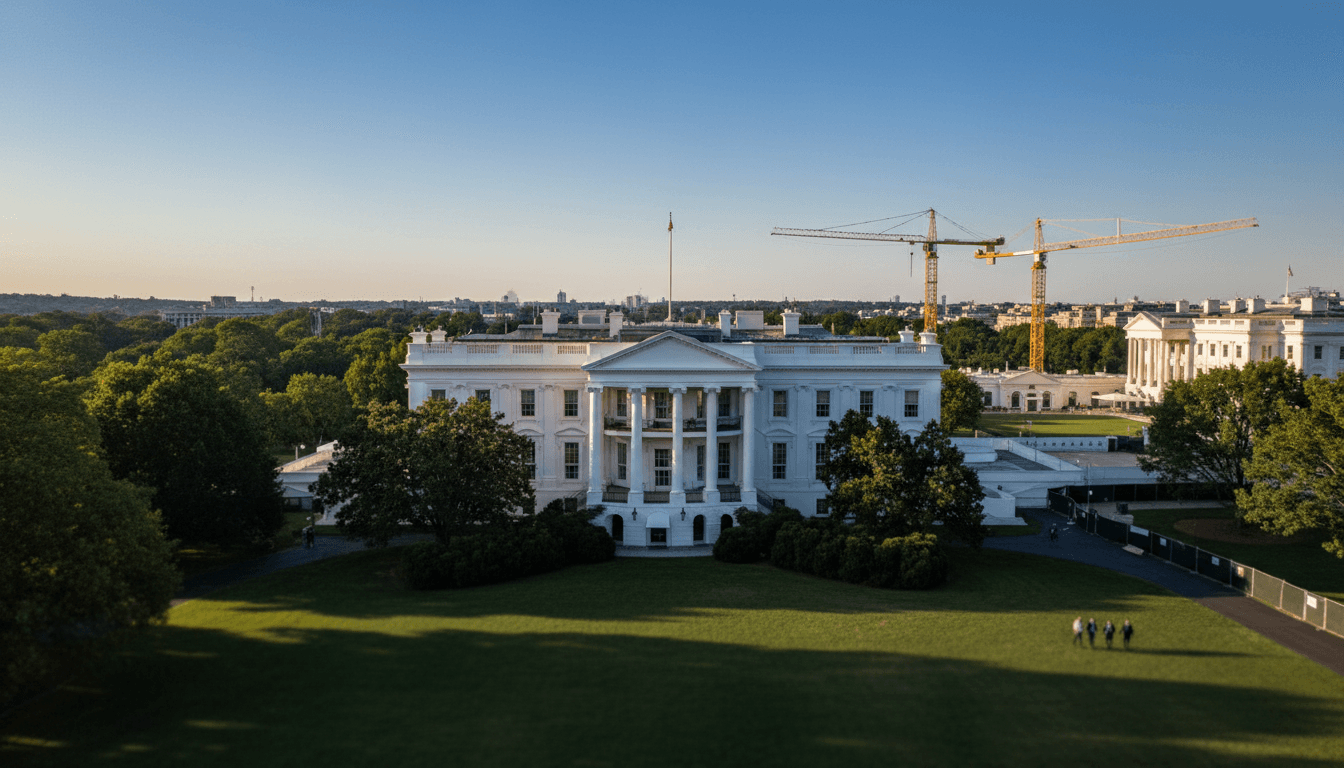
A billion-dollar White House security proposal is facing fierce opposition from Democrats, who have vowed to defeat the Republican-backed measure designed to bolster defenses around President Donald Trump’s proposed ballroom. This contentious funding, which Senate Republicans attached to a broader spending bill aimed at restoring funds for immigration enforcement agencies, has ignited a partisan battle in Washington, with Democrats accusing the GOP of fiscal irresponsibility and prioritizing a vanity project over pressing national needs.
The security proposal emerged in the wake of a significant security breach last month, where a man was charged with attempting to assassinate President Trump at the White House Correspondents’ Association dinner. This incident has clearly spurred Republicans to push for what they deem essential security upgrades. However, the sheer scale of the proposed $1 billion allocation specifically for White House security, much of which is earmarked for the forthcoming ballroom project, has drawn sharp criticism.
Senate Democratic leader Chuck Schumer wasted no time in mobilizing his caucus, sending a letter to colleagues on Monday morning outlining their strategy to combat the measure. Democrats plan to challenge the funding through various means, including appealing to the Senate parliamentarian to strike the ballroom security money from the budget bill. They also intend to offer amendments that would force Republicans to take public votes on the controversial allocation.
“The Republican-controlled Congress is preparing to answer this moment with a deficit-busting, party-line bill that pours billions more taxpayer dollars into a rogue ICE operation and a billion-dollar ballroom, while doing nothing to end the illegal war in Iran or ease the Republican affordability crisis bearing down on working families,” Schumer wrote, encapsulating the Democratic opposition.
The Republican maneuver to push this spending legislation through Congress relies on a partisan budget process, aiming to bypass Democratic votes entirely. However, the path forward for the billion-dollar White House security proposal is far from clear, even within Republican ranks. While many GOP lawmakers have remained silent during their recent recess, some have publicly expressed reservations. Rep. Rob Wittman, a Virginia Republican, stated his intent to “look at it very carefully and make sure those things are in the national interest.” Wittman emphasized the need to understand the “exact nature of the expenditures” and how they integrate with the total construction costs.
The Billion-Dollar White House Security Proposal
President Trump had previously estimated the ballroom’s construction cost at $400 million, to be financed through private funds, but had not specified security expenditures. The Senate bill, however, directly designates $1 billion for the U.S. Secret Service, explicitly for “security adjustments and upgrades” related to the ballroom. This includes both “above-ground and below-ground security features,” though it prohibits the use of funds for non-security elements.
White House spokesperson Davis Ingle praised the Republican initiative, calling the project “long overdue.” Ingle asserted that the funding would provide the Secret Service with the necessary resources to “fully and completely harden the White House complex.” Court documents filed by the White House detail plans for a “heavily fortified” East Wing project, featuring bomb shelters, military installations, and a medical facility beneath the ballroom. President Trump himself has advocated for bulletproof glass and defenses against drone attacks.
The National Trust for Historic Preservation has filed a lawsuit to halt construction of the project, though a federal appeals court ruled last month that work could proceed in the interim. This ongoing legal battle adds another layer of complexity to the already contentious funding debate surrounding the billion-dollar White House security proposal. The controversy highlights broader tensions over presidential spending, national security priorities, and the role of Congress in overseeing executive projects, especially those with significant price tags and political implications.
Context & Background
The debate over the billion-dollar White House security proposal is not an isolated incident but rather a confluence of several ongoing political and policy battles. The attempt to fund immigration enforcement agencies, blocked by Democrats since February, signals a continuation of the contentious national discourse on border security and immigration policy. By linking the White House security funding to this broader spending bill, Republicans are employing a high-stakes legislative strategy, forcing Democrats to choose between two highly unpopular options in their view: funding what they consider a lavish presidential project or continuing to block funds for federal agencies. This move also reflects a heightened focus on presidential security following the April 25 incident involving Cole Tomas Allen at the Washington Hilton, underscoring the perceived vulnerabilities of the White House complex and its occupants.
What’s Next
The Senate is poised to begin voting on its version of the legislation this week, setting the stage for a critical showdown. Democrats are prepared to deploy every procedural tool at their disposal to challenge the billion-dollar White House security proposal. The success of their efforts will depend not only on their unity but also on the willingness of some Republicans to break ranks, as indicated by Rep. Wittman’s cautious stance. The House has yet to release its own bill, and its version could further complicate the legislative path. Beyond Congress, the National Trust for Historic Preservation’s lawsuit remains a factor, and any future court rulings could impact the project’s viability. The outcome of this legislative battle will undoubtedly influence future discussions on executive branch spending and the balance of power between the branches of government.
The battle over the $1 billion White House security proposal epitomizes the deep partisan divisions currently gripping Washington. As Democrats gear up to fight this measure, the debate extends beyond mere budgetary allocations, touching upon fundamental questions of fiscal responsibility, presidential priorities, and the integrity of the legislative process. The resolution of this dispute will offer a significant indicator of the current political climate and the capacity for compromise, or lack thereof, on Capitol Hill.