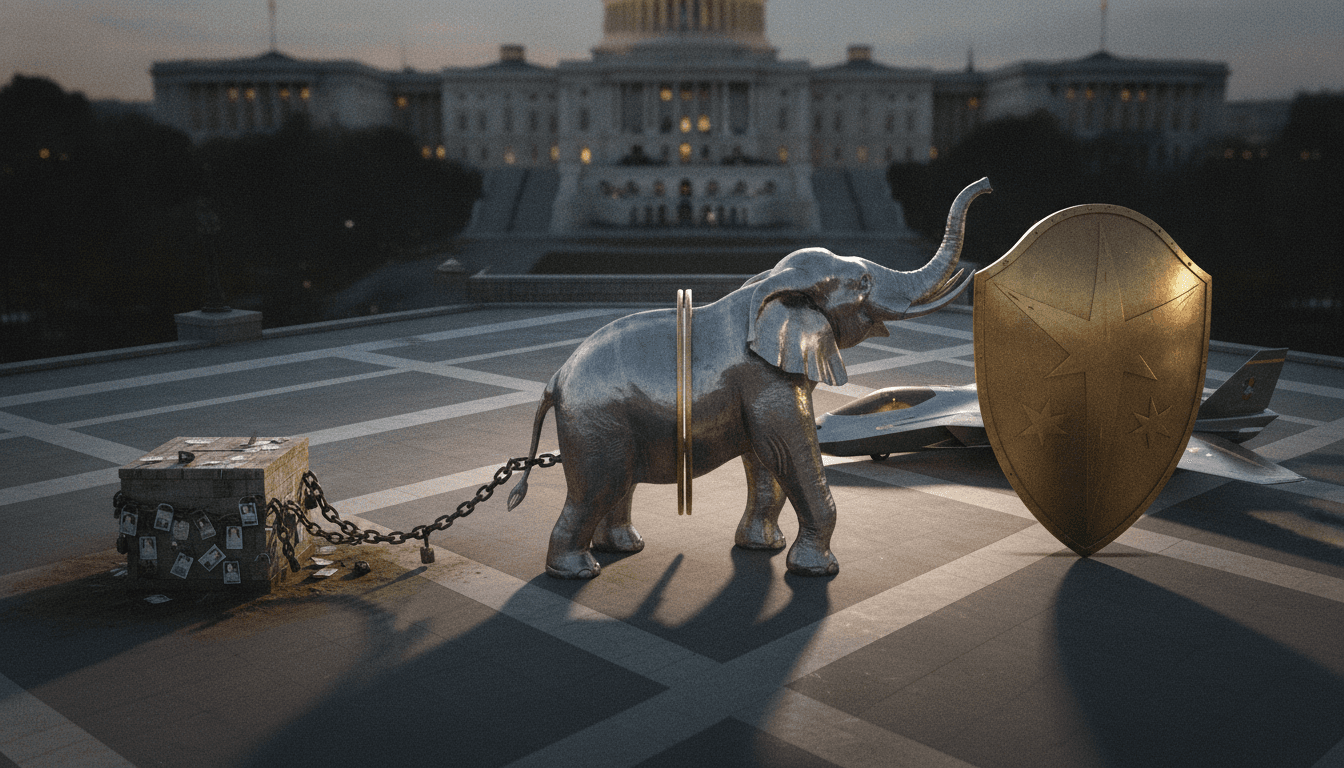
Donald Trump’s demands for a restrictive voting bill and increased defense spending through budget reconciliation are creating a notable schism among congressional Republicans. The US president, in a Truth Social post on Wednesday, June 10, 2026, called for immediate action on a “forthcoming $350 Billion Reconciliation Bill” that would include the controversial Save America Act and allocate substantial funds to defense, stating, “No games, no delays, and no weak compromises! Do this ASAP.” This directive has exposed deep divisions within the Republican ranks, particularly concerning the strategic use of budget reconciliation and the feasibility of the Save America Act.
The proposed $350 billion reconciliation measure is intended to fund a significant portion of the White House’s ambitious $1.5 trillion defense budget for the 2027 fiscal year. The overall defense request includes $1.15 trillion to be passed through normal appropriations, with the remaining $350 billion earmarked for reconciliation. Trump’s vision for this funding includes bespoke weapons systems like the “Golden Dome” missile defense system, a “golden fleet” of Trump-class battleships, and the F-47 next-generation fighter jet, a designation aligning with his status as the 47th president. While the House armed services committee has approved the $1.15 trillion component in the annual National Defense Authorization Act, the proposed use of reconciliation for the additional funds has drawn sharp criticism from prominent Republican senators.
Republicans Split on Budget Reconciliation
The president’s insistence on using budget reconciliation for defense spending has encountered significant pushback from key Republican figures. Mitch McConnell, the former Senate Republican leader, publicly stated, “I think it’s safe to conclude there will not be another reconciliation bill,” during an appropriations subcommittee hearing earlier this week. His sentiment was echoed by Susan Collins, the powerful Republican chair of the appropriations committee, who agreed with McConnell’s assessment. Their objections primarily revolve around the instability and long-term risks associated with relying on a one-off funding mechanism for sustained defense priorities.
Collins specifically warned against the administration’s approach, telling air force leaders, “I would just suggest that it is taking a terrible risk and creates instability when you’re counting on a third reconciliation bill for the bulk of the money rather than doing base funding through the defense appropriations bill.” McConnell further elaborated on these concerns in his opening statement, highlighting that multi-year weapons systems require a more enduring fiscal footing than what a reconciliation bill can provide. He cautioned that “major disruptions” could occur if Republicans fail to reach an agreement on budget reconciliation, describing the administration’s choice to structure the $1.5 trillion request in this manner as “yet another missed opportunity” for a stronger and more enduring common defense.
Beyond defense, the inclusion of the Save America Act in the reconciliation bill further complicates matters. This act, a long-standing fixation of Trump’s right-wing base, aims to implement sweeping changes to election procedures. Its provisions include new ID requirements for voters, mandates for states to regularly submit voter rolls to the Department of Homeland Security, and legal liability for election officials if individuals are improperly registered. However, the policy changes required by the Save America Act are widely considered to fall outside the strict budgetary rules of the reconciliation process, making its passage through this mechanism highly improbable. Furthermore, the bill lacks the necessary Democratic support to overcome the Senate’s 60-vote filibuster threshold, as demonstrated by its previous failure to advance after a March 2026 Senate vote to open debate.
Impact Analysis
This internal Republican struggle over legislative strategy and priorities holds significant implications for the broader political landscape and future policy initiatives. The repeated use of budget reconciliation by Republicans, first for the One Big Beautiful Bill Act in 2025 and again earlier this week for immigration funding, has become a defining feature of the current administration’s legislative approach. While effective in bypassing the Democratic filibuster for certain spending and revenue measures, its application to non-budgetary policy changes like those in the Save America Act highlights a fundamental misunderstanding or deliberate overreach of the procedure’s rules.
The public disagreement between the president and senior congressional Republicans like McConnell and Collins underscores a growing tension within the party. It suggests a potential fracturing of unity on legislative tactics, even as Trump continues to exert significant influence over the Republican agenda. The efficacy of the reconciliation process itself is under scrutiny, particularly when used for long-term defense commitments or controversial social policies. This dynamic could foreshadow difficulties in passing future legislative priorities, especially those that deviate from strict budgetary parameters or lack bipartisan consensus. The ongoing debate over funding mechanisms and election reform also sets the stage for intensified political battles heading into future election cycles, with election integrity and fiscal responsibility at the forefront of partisan discourse.
The current impasse also reveals the limitations of presidential demands when faced with legislative realities and institutional resistance. While Trump’s pronouncements on Truth Social command attention, the practicalities of Senate rules and the concerns of experienced lawmakers often dictate the actual path of legislation. The perceived impracticality of including the Save America Act via reconciliation, coupled with the objections to unstable defense funding, presents a significant hurdle for the administration’s legislative ambitions.
What’s Next
The immediate future will likely see continued negotiations and potential legislative maneuvering within Congress regarding the defense budget. It remains to be seen whether the White House will adjust its strategy for the $350 billion in defense spending or if the internal Republican dissent will force a re-evaluation of the reconciliation approach for non-budgetary items. The Save America Act, despite Trump’s renewed push, appears to have no viable path to enactment in the Senate under current conditions, suggesting its fate will remain stalled unless a significant shift in legislative strategy or political alignment occurs.
The broader implications point to ongoing challenges for the Republican party in navigating its legislative agenda while balancing presidential demands with congressional realities. The internal debate over budget reconciliation could become a recurring theme, influencing how future bills addressing spending, revenue, and policy are approached. Furthermore, the focus on defense spending and voting restrictions will undoubtedly remain central to the political discourse, shaping public debate and electoral strategies in the lead-up to the next election cycle.
The current episode serves as a powerful reminder that even with a party controlling both the White House and Congress, legislative processes and institutional norms can present formidable obstacles to even the most determined presidential directives. The ongoing Republican split illustrates the complex interplay of power, strategy, and political will in Washington.