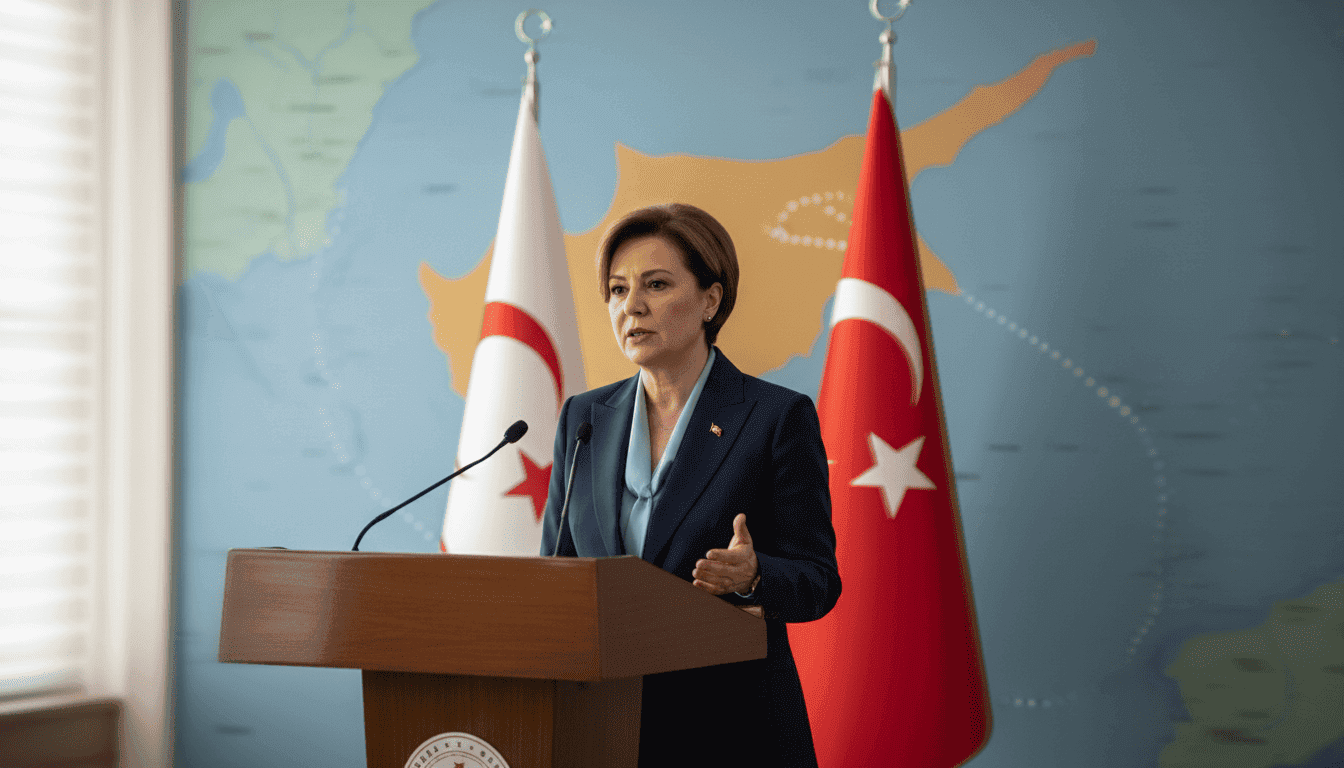
TRNC Cyprus policy coordinated with Ankara has been unequivocally declared by the Turkish Republic of Northern Cyprus (TRNC) president, signaling a profound consolidation of influence that could reshape the already delicate geopolitics of the Eastern Mediterranean. This explicit statement, made on Monday, April 20, 2026, underscores the depth of the strategic alignment between Ankara and Northern Nicosia, leaving little room for ambiguity regarding the TRNC’s operational autonomy on critical policy matters.
The declaration, reported by Yeni Safak English, comes at a pivotal time for the divided island of Cyprus. While the specific details of the policy steps were not enumerated, the blanket statement from the TRNC president indicates that all decisions pertaining to Cyprus — encompassing everything from potential future peace negotiations to resource exploration and international relations — will be made in lockstep with Turkey. This tight coordination suggests a highly integrated approach, where Ankara’s strategic imperatives are directly reflected in the TRNC’s political maneuvers.
Impact Analysis
The immediate impact of this announcement resonates across several critical fronts. For the Republic of Cyprus (RoC) and its allies, particularly Greece and the European Union, this statement will likely be viewed as further entrenching the division of the island and complicating any future reunification efforts. It solidifies the perception that the TRNC acts primarily as an extension of Turkish foreign policy, rather than an independent entity with its own distinct negotiating position. This could lead to increased diplomatic friction and potentially harden positions ahead of any renewed talks.
Economically, the implications are also significant. Decisions regarding energy exploration in the Eastern Mediterranean, particularly in areas claimed by both the RoC and the TRNC, will now be seen as directly guided by Ankara. This could heighten tensions around drilling rights and maritime boundaries, an area already fraught with geopolitical complexities. Investors and international energy companies will undoubtedly factor this explicit coordination into their risk assessments for the region, potentially impacting investment flows. Furthermore, any economic development initiatives within the TRNC will likely be framed within Ankara’s broader strategic vision, affecting sectors from tourism to infrastructure.
“This explicit alignment fundamentally alters the diplomatic calculus for Cyprus, placing Ankara’s strategic objectives at the forefront of all TRNC policy decisions and potentially narrowing pathways for independent solutions.”
Context & Background
The relationship between Turkey and the TRNC has always been robust, stemming from the 1974 Turkish intervention following a Greek-backed coup aimed at uniting the island with Greece. Since then, Turkey has been the sole country to recognize the TRNC, providing substantial economic, political, and military support. This latest statement, however, moves beyond general support to explicitly state that all Cyprus policy steps are coordinated. This reflects a shift in Turkey’s approach to the Cyprus issue, moving from advocating for a federal solution to increasingly promoting a two-state solution, a stance strongly supported by the current TRNC leadership.
Previous negotiations for a unified Cyprus, often under UN auspices, have repeatedly faltered, with deep disagreements over power-sharing, property rights, and security guarantees. The latest round of talks effectively collapsed without significant progress. Against this backdrop, Turkey and the TRNC have increasingly pursued a more assertive stance, advocating for sovereign equality and a two-state framework, directly challenging the long-standing UN resolution of a bi-communal, bi-zonal federation. This declaration of coordinated TRNC Cyprus policy is a natural progression of this more assertive strategy.
What’s Next
Looking ahead, this explicit declaration of TRNC Cyprus policy coordinated with Ankara will likely have several immediate and long-term consequences. Diplomatically, it is expected to trigger strong reactions from the international community, particularly the EU, which views the TRNC as occupied territory and supports the RoC. There could be renewed calls for sanctions or increased pressure on Turkey, though Ankara has consistently proven resilient to such measures. The UN will also face a more challenging environment for mediating any future peace talks, as the TRNC’s negotiating position will be perceived as less flexible.
On the ground, this coordinated approach could manifest in joint projects or initiatives that further integrate the TRNC into Turkey’s sphere of influence, potentially in areas like energy, defense, or infrastructure. This would deepen the division between the north and south of the island. Any future exploration for natural gas in the Eastern Mediterranean will almost certainly see joint Turkish-TRNC operations, escalating potential maritime disputes. The statement also sets the stage for a more unified and assertive front from Turkey and the TRNC in international forums, consistently presenting a single, coherent narrative on the Cyprus issue. The long-term implications for a lasting peace settlement on the island appear increasingly remote with this reinforced integration of TRNC Cyprus policy.
Key Takeaway
The TRNC president’s unambiguous declaration that all TRNC Cyprus policy steps are coordinated with Ankara represents a critical juncture in the long-standing Cyprus dispute. It solidifies Turkey’s influence over the TRNC’s strategic direction, deeply impacting future negotiations, regional geopolitics, and energy dynamics. This move reinforces the perception of a two-state reality on the island and significantly complicates the path towards any unified solution, demanding a recalibration of diplomatic strategies by all parties involved. For regional stability, the implications are profound, suggesting a future where Ankara’s strategic vision will directly shape the destiny of Northern Cyprus.