A landmark utility regulation bill, recently signed into law by Alabama Governor Kay Ivey, has sparked significant controversy and ignited protests, with many critics asserting that the legislation is a substantial victory for Alabama Power, the state’s dominant investor-owned utility. Despite its name, the “Power to the People Act,” the bill has been widely condemned by consumer advocates as a “wolf in sheep’s clothing,” transforming an initial push for lower electricity prices into a framework that appears to solidify Alabama Power’s influence.
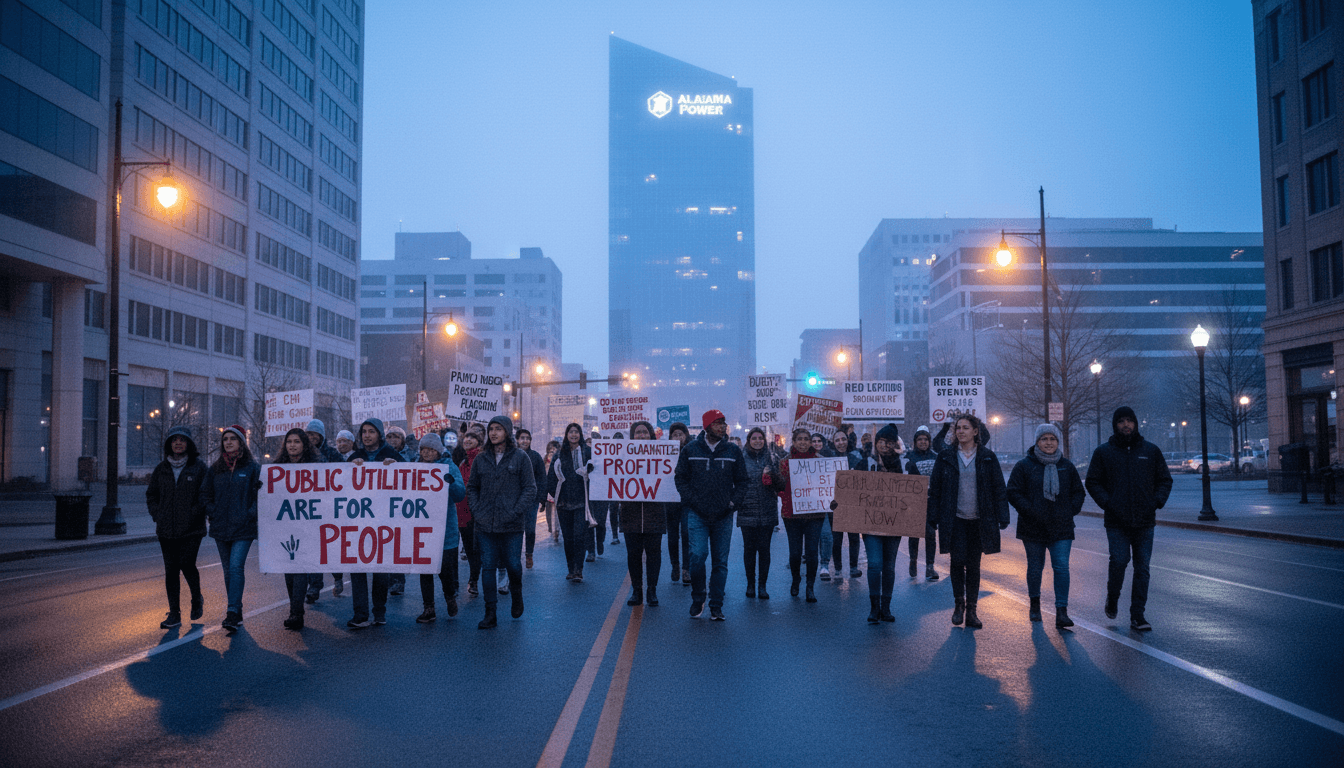
On Monday, around two dozen Alabama Power customers marched from Birmingham’s Kelly Ingram Park to the company’s nearby headquarters, expressing their clear dissatisfaction. Signs reading, “Public utilities should be for the public,” and “No more guaranteed profits,” underscored the public’s frustration. This outcry follows Governor Ivey’s signing of the legislation last week, a move that reform advocates argue largely succeeded in turning public demand into a win for the arguably most powerful political entity in Alabama.
The Core Legislative Shift
The journey of the Power to the People Act from its original intent to its final form is a tale of legislative metamorphosis. Initially, the legislation aimed to mandate regular rate cases by the state’s Public Service Commission (PSC), the body responsible for utility regulation, to scrutinize companies’ requests for electricity price hikes. This was a critical demand, given that Alabama Power, the sole provider of most residential electricity in the state, has not faced a formal rate case since 1982.
However, the enacted law notably omits any requirement for regular rate hearings. Instead, it centralizes power over the PSC’s agenda under a new secretary of energy, an appointee of the governor, and expands the PSC from three to seven members. Oversight, including rate cases, would now only be triggered if deemed necessary by this secretary of energy or by five of the seven PSC commissioners. While the new law does freeze utility rates at their current levels until 2029, an Inside Climate News investigation revealed that Alabama Power customers already bear the highest energy bills among comparable electric companies nationwide. The company had, in fact, already announced a rate freeze through 2027.
“The people of Alabama deserved better, and we will not pretend otherwise. But we want to be clear about something: This fight is not over.”
Prior to its final passage, the Legislature faced a critical juncture. The House had unanimously passed Republican Rep. Mack Butler’s bill, widely considered a strong, consumer-conscious reform measure. Concurrently, the Senate unanimously passed what largely became the Power to the People Act, sponsored by Republican Sen. Clyde Chambliss. This Senate bill, with its provisions for expanding PSC membership, was perceived by reform advocates as weak and problematic. Many saw the PSC expansion as a direct response to the November public service commission elections in Georgia, where consumer-friendly Democrats flipped two traditionally Republican seats.
Ultimately, senators approved the bill after substituting significant portions of Butler’s legislation with Chambliss’s Senate bill provisions. In a dramatic final vote in the Alabama House, Rep. Butler effectively voted against his own legislation, unable to support what he termed a “Franken-bill.” Despite his objection, the House voted to concur with the Senate’s changes, 68-31.
Broader Political Context and Reactions
Governor Ivey signed the legislation on Thursday, the same day her office confirmed her release from a Montgomery hospital after a medical procedure. In her statement, Ivey praised Alabama’s “affordability,” asserting, “Alabama is a top 10 state when it comes to cost of living, and we are the number one state for plain affordability.” This statement, however, stands in stark contrast to the experiences of many Alabamians struggling with high energy costs.
This landmark utility regulation bill was not the only attempt at systemic change this legislative session. Earlier, House Bill 392, which sought to end all PSC elections in favor of appointed posts, was declared “dead” by Senate Pro Tem Garlan Gudger due to widespread public pushback. Gudger openly admitted that the effort to halt future PSC elections was a reaction to Georgia’s election results, expressing concern that “environmental extremists funded by the most liberal Soros groups captured the Public Service Commission in Georgia.” However, political analysts largely attribute Georgia’s election outcomes to consumer frustration over rising energy prices, not external funding.
At Monday’s protest, participants vehemently denied being paid to attend. “My bank account is too low for that,” one woman stated, highlighting the genuine economic hardship driving their activism. Daniel Tait, executive director of Energy Alabama, a consumer advocacy nonprofit, expressed deep disappointment but vowed to continue the fight. “Ivey had the opportunity to send this bill back and demand the legislature pass something that actually lowers bills for Alabama Power customers,” Tait said. “She refused. The people of Alabama deserved better, and we will not pretend otherwise. But we want to be clear about something: This fight is not over.”
What’s Next for Utility Reform
The focus of consumer advocates will now shift to Governor Ivey’s temporary appointment of four new PSC commissioners, the next governor’s appointment of a secretary of energy, and the upcoming elections for two of the three existing PSC commission seats this year. Tait affirmed, “On behalf of the people ignored today, we will be in every one of these upcoming fights.”
Rep. Butler, reflecting on the arduous legislative process, described the past few weeks as his “toughest session ever.” He wrote, “Tonight was the first time I ever voted against a bill with my name on it but if any of you guys knew my dad Harry D. Butler, it is just how he raised me.” Ashtyn Kennedy, an organizer of Monday’s march, emphasized the ongoing pressure on lawmakers for meaningful utility reform, noting, “People are having to put their power bills on credit cards. That’s just not OK.” The passage of this landmark utility regulation bill, while a legislative achievement for some, has undeniably intensified the battle for affordable energy in Alabama, setting the stage for future political and policy confrontations.