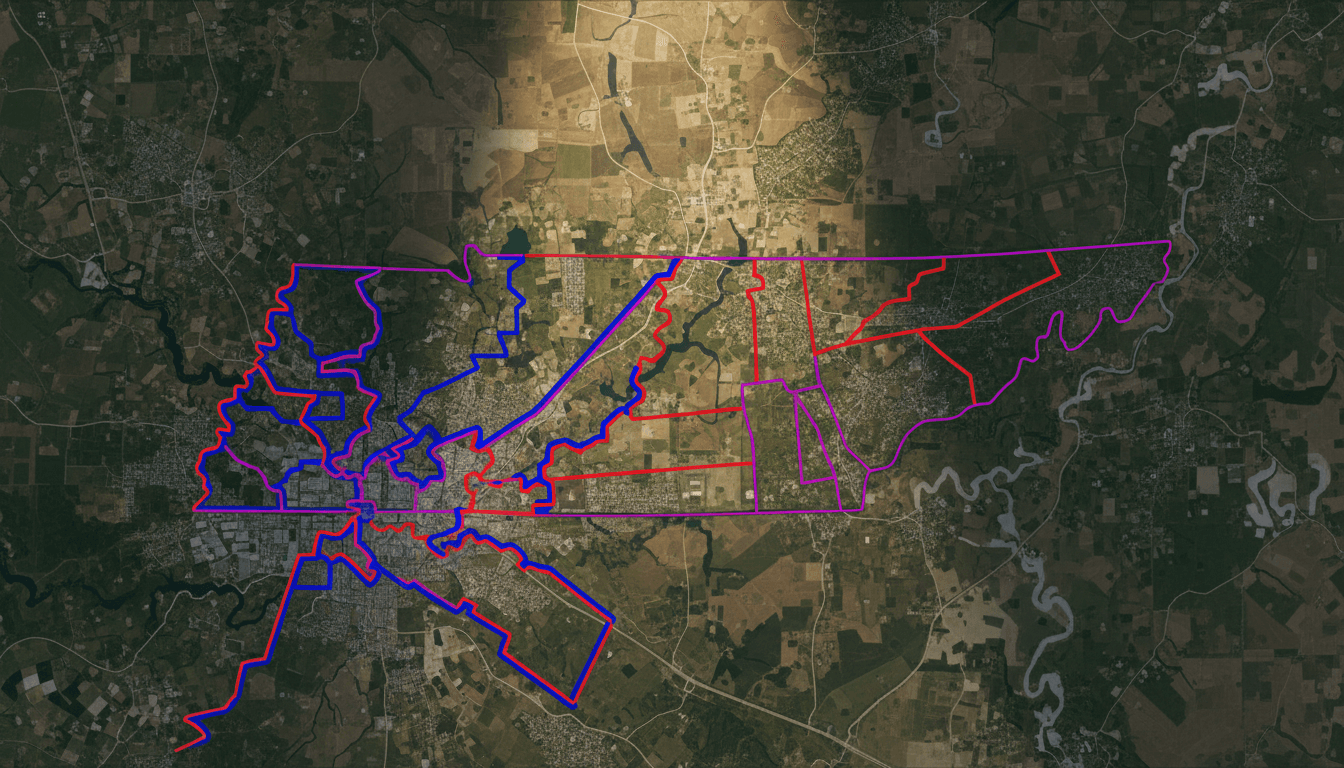
Tennessee lawmakers fracture Memphis congressional district, a move finalized on Friday, May 8, 2026, with the passage of a controversial redistricting bill. This legislative action redraws the boundaries of the state’s congressional districts, specifically targeting the 9th Congressional District, which historically encompassed the majority-Black city of Memphis. The new map effectively splits Memphis into multiple districts, scattering its voting power across predominantly Republican-leaning areas.
The Story: Reshaping Tennessee’s Political Map
The redistricting bill, passed by Tennessee lawmakers, represents a significant redrawing of the state’s electoral map. The core of this legislative effort centers on the 9th Congressional District, currently represented by a Democrat. The new boundaries dismantle the unified urban district, dividing the city of Memphis and surrounding Shelby County into at least three separate congressional districts. This strategic fragmentation is widely seen as an attempt to dilute the Democratic voting strength concentrated in Memphis, a long-standing Democratic stronghold in an otherwise deeply red state.
The legislative process leading to the bill’s passage has been contentious, marked by partisan debate and public outcry. Critics argue that the redistricting constitutes a partisan gerrymander, designed to secure additional Republican seats in the U.S. House of Representatives. Proponents, however, maintain that the new maps reflect population shifts and aim to create more geographically contiguous and compact districts, adhering to the principle of ‘one person, one vote’ while ensuring fair representation across the state.
Impact Analysis: Shifting Electoral Dynamics
The immediate impact of the decision to fracture Memphis congressional district is a significant alteration of the electoral landscape in Tennessee. By splitting Memphis, a city with a substantial Black population and a history of electing Democratic representatives, the new map makes it considerably harder for a single Democratic candidate to win in the redrawn districts. Instead, segments of Memphis will now be combined with more rural, conservative areas, likely tilting the balance towards Republican candidates.
This move could have profound implications for minority representation and voting rights within the state. Critics argue that the bill effectively disenfranchises a significant portion of the electorate by diluting their collective political voice. The redistricting effort is part of a broader national trend where states utilize their decennial redistricting powers to consolidate political power, often along partisan lines. For more on such legislative trends, see our related politics & policy articles on electoral reforms.
“This redistricting effort is not just about lines on a map; it’s about fundamentally reshaping the political voice of an entire city and its diverse population.”
Context & Background: A History of Redistricting Battles
Redistricting, the process of redrawing electoral district boundaries, occurs every ten years following the U.S. Census. In Tennessee, like many states, this process has historically been a battleground for political power. The state legislature, controlled by Republicans, has the authority to draw these maps, and their decisions often face intense scrutiny and legal challenges. The current action to fracture Memphis congressional district follows a pattern seen in other states where dominant parties leverage redistricting to their advantage.
Memphis has long been a Democratic anchor in Tennessee. The 9th District, as it was previously configured, was one of the few reliably Democratic districts in the state. The decision to dismantle this district reflects a strategic effort to maximize Republican representation in the U.S. Congress, potentially shifting a previously safe Democratic seat into a more competitive, or even Republican-leaning, configuration.
What’s Next: Legal Challenges and Future Elections
The passage of this redistricting bill is unlikely to be the final word. Legal challenges are almost certainly on the horizon. Civil rights organizations and Democratic groups are expected to file lawsuits, arguing that the new maps violate federal voting rights laws by diluting minority voting strength or constituting an illegal partisan gerrymander. These legal battles could extend for months or even years, potentially impacting the validity of the new maps for upcoming election cycles.
For the 2026 midterm elections, however, the newly drawn lines are expected to be in effect unless courts intervene with injunctions. This means candidates will be campaigning in unfamiliar territories, and voters in Memphis will find themselves in new congressional districts with different political leanings. The outcome of these elections will be a critical test of the new map’s effectiveness in achieving its intended political goals.
Key Takeaway: The Enduring Battle for Representation
The Tennessee lawmakers’ decision to fracture Memphis congressional district underscores the enduring and often contentious nature of redistricting in American politics. This legislative maneuver, while framed by its proponents as a routine adjustment to population shifts, is viewed by critics as a calculated effort to manipulate electoral outcomes and diminish the political influence of a key demographic. The battle over these lines is more than just about geography; it’s about the fundamental principles of fair representation, the balance of power, and the future of democratic participation in Tennessee and beyond. The reverberations of this decision will undoubtedly shape the state’s political landscape for the next decade, influencing everything from local policy to national electoral strategies. For further reading on the impact of such legislative changes, explore our articles on electoral integrity and governance.