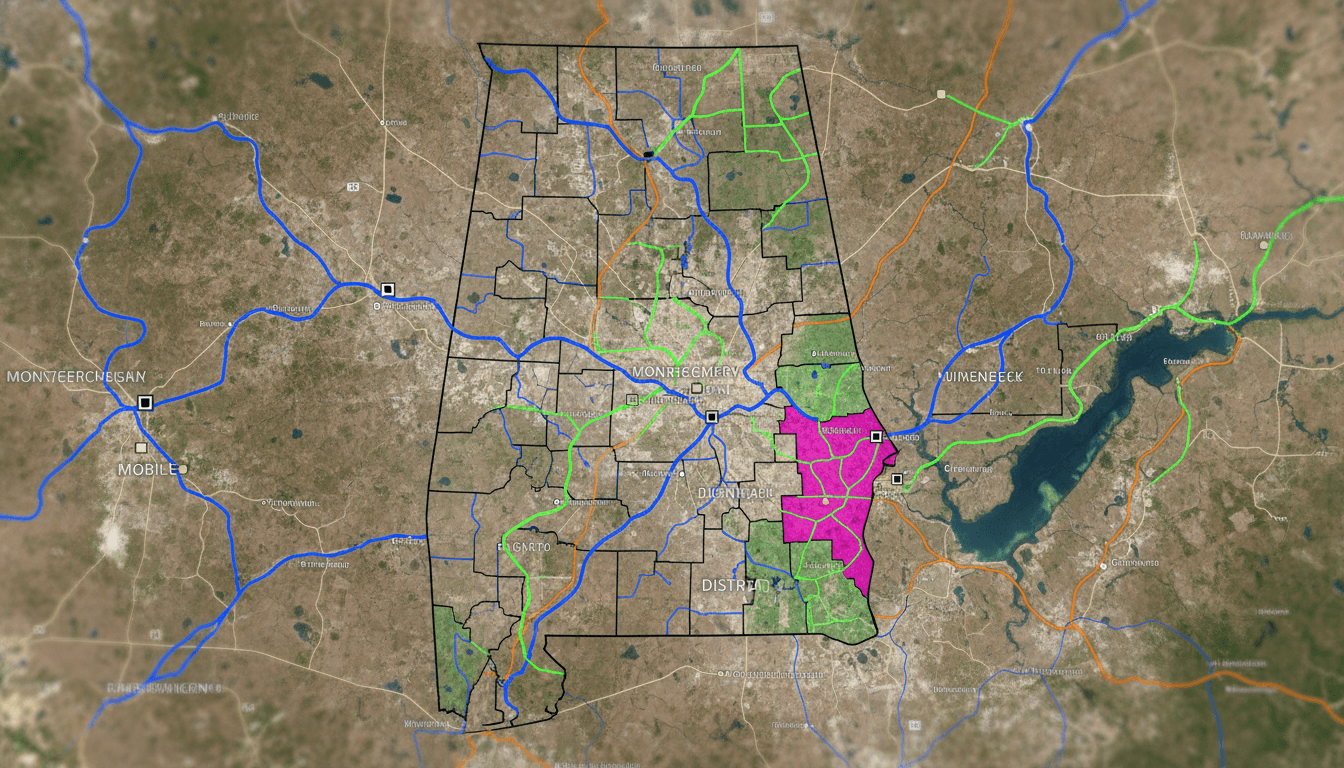
A federal judges’ ruling against Alabama congressional map has injected significant uncertainty into the state’s political landscape, specifically halting a planned August special congressional election. Three federal judges on Tuesday blocked the congressional map that Alabama Republicans had intended to use, asserting that the Supreme Court’s recent decision narrowing the Voting Rights Act does not negate their finding that the map intentionally discriminates against Black voters, violating constitutional protections. This decision immediately throws into question the electoral path for several candidates and the representation of Gulf Coast voters.
The ruling has prompted Alabama Republican leaders to announce an appeal to the U.S. Supreme Court, setting the stage for another high-stakes legal battle over redistricting and voting rights. If the current ruling stands, and the special congressional primary in August does not proceed, the Republican race in District 1 will revert to a runoff between former Congressman Jerry Carl and State Representative Rhett Marques. This scenario underscores the profound confusion now gripping candidates and voters alike.
The Immediate Fallout for Alabama Congressional Map
Former Congressman Jerry Carl, a candidate caught in the crosscurrents of this legal fight, articulated the widespread confusion. His campaign office has been forced to prepare for multiple outcomes, a logistical and strategic nightmare. For instance, if the Supreme Court were to side with Republicans and permit the use of the 2023 map, Carl would face a different slate of candidates in a special election slated for August. Compounding the complexity, his current runoff opponent, Rhett Marques, would find himself in an entirely separate district under that scenario. Carl noted that this state of flux has significantly hampered both campaigning efforts and fundraising activities.
Carl also challenged the criticism that the previous map did not fairly represent Black voters. He stated,
“The Supreme Court’s already told us those maps are not based on race, they’re based on minority. What is a minority? Minority’s not a race. So do we redraw based on American Indians? Do we redraw them based on Eskimos? There are Eskimos in Mobile County, believe it or not. So you want to redraw based on those. Good luck, but it’s not based on the race.”
His comments highlight a contentious interpretation of voting rights and representation that lies at the heart of this dispute. Despite the ongoing uncertainty, Carl urged citizens to continue participating in the electoral process. Efforts to reach Rhett Marques’s campaign for comment on the ruling were unsuccessful.
Broader Implications for Voting Rights and Representation
This judicial intervention in Alabama’s redistricting process carries significant implications beyond the immediate electoral calendar. It reignites debates about the scope of the Voting Rights Act and the judiciary’s role in ensuring fair representation, particularly for minority populations. The judges’ explicit rejection of the argument that the Supreme Court’s narrowing of the VRA impacts their finding of intentional discrimination sets a notable precedent. This ruling could embolden similar challenges to congressional maps in other states grappling with issues of racial gerrymandering, particularly as the 2026 midterm elections approach.
The case also underscores the persistent tension between legislative prerogatives in drawing electoral districts and constitutional mandates for equitable representation. For Gulf Coast voters, the uncertainty surrounding their congressional representation could lead to decreased voter engagement or feelings of disenfranchisement. The constant shifting of district lines and election dates makes it challenging for constituents to understand who represents them and how their vote will count. For more context on similar legal battles, see our recent coverage on redistricting challenges.
What Lies Ahead for Alabama
The immediate future hinges on the U.S. Supreme Court’s decision regarding Alabama’s appeal. If the highest court upholds the three-judge panel’s ruling, Alabama will likely be compelled to draw a new congressional map that addresses the identified discrimination against Black voters. This could lead to a further delay in the special election or a revised electoral schedule. Conversely, if the Supreme Court sides with Alabama Republicans, the previously blocked 2023 map could be reinstated, and the special election in August would proceed with its original set of candidates and districts. This back-and-forth illustrates the profound impact judicial decisions have on the practical mechanics of democracy and the political aspirations of candidates. The legal wrangling over the Alabama congressional map is far from over, ensuring that the state remains a focal point in the national conversation on voting rights and electoral fairness.
This ongoing legal saga emphasizes that the fight for equitable political representation remains a complex and often protracted battle, with direct consequences for millions of voters and the integrity of democratic processes. The outcome of Alabama’s appeal will undoubtedly shape future redistricting efforts across the nation and further define the boundaries of the Voting Rights Act in contemporary American politics. For additional analysis on the intersection of law and electoral policy, explore our politics & policy archives.