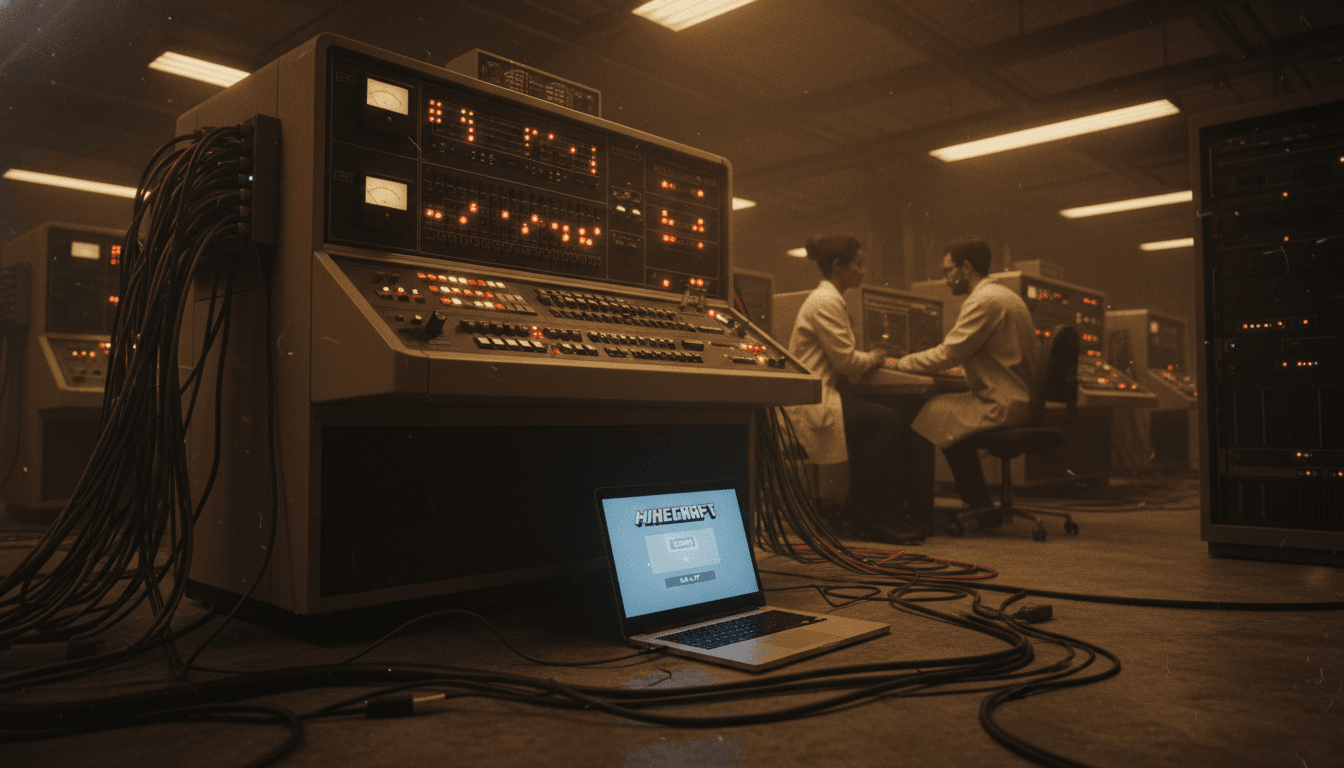
Running Minecraft on UNIVAC, a vintage 1960s mainframe, has been achieved in a groundbreaking project, demonstrating the enduring, albeit slow, capabilities of early computing hardware. Nathan Farlow, a machine learning expert, recently embarked on this ambitious endeavor, successfully hosting the login portion of a Minecraft server on a 1960s UNIVAC 1219B computer. This fascinating undertaking, meticulously documented in a blog post and a YouTube video by “TheScienceElf,” offers a unique glimpse into the past and future of computing.
The UNIVAC 1219B is no ordinary machine. Originally designed around 1965 for critical military applications like “radar in, artillery out” on U.S. Navy destroyer or cruiser ships, it represents a bygone era of computing. Only two of these colossal machines are known to survive today, with just one remaining operational. Its architecture is notably unusual by modern standards, featuring 18-bit words (not a power of two) and one’s complement arithmetic, complete with a “signed zero” concept. With a mere 40,960 18-bit words of memory, a 2-microsecond main memory cycle time, and a 500-nanosecond control memory, its specifications are a stark contrast to today’s gigabyte-scale systems. Physically, the UNIVAC is a behemoth; a single 32K memory module alone tips the scales at over 1000 lbs.
Overcoming Architectural Hurdles
Farlow’s journey to get the Minecraft server running on this vintage hardware was a testament to ingenuity and perseverance. Given the UNIVAC’s niche and complex architecture, a direct approach was impractical. Instead, Farlow leveraged existing documentation and an emulator written in BASIC to craft his own robust emulator in Rust. This crucial step allowed him to rigorously test his intricate plan without risking the rare and delicate hardware. The strategy involved writing a RISC-V emulator and then compiling to that, effectively creating a bridge between the old and new. While modern AI tools like Large Language Models (LLMs) were consulted, Claude Code notably struggled with the UNIVAC’s archaic assembly language, underscoring the unique challenges of working with such vintage systems and prompting Farlow to develop the RISC-V emulator himself.
“The project successfully established TCP/IP over a serial connection, enabling a handshake between a modern laptop and the 1960s computer, a true marvel of inter-generational tech communication.”
The Performance Reality of Vintage Hardware
The project’s success was partial but profound: while a full Minecraft server wasn’t fully operational, the critical login portion was successfully hosted. As anticipated, the performance was painstakingly slow. To put it into perspective, processing a single frame of an NES game on the UNIVAC took a staggering 40 minutes. This highlights the immense computational leap made in the past six decades. The Vintage Computer Federation (VCF) played an indispensable role in this achievement, maintaining the operational UNIVAC and providing the platform for such experimental projects. The event was promoted as a key attraction for VCF East, inviting tech enthusiasts to witness the UNIVAC functioning as a Minecraft server on April 18 and 19, from 1 PM to 3 PM, in Wall, NJ. Such initiatives are vital for preserving computing history and inspiring future innovations in related Industries news.
Running Minecraft on UNIVAC: A Glimpse into the Past and Future
This remarkable project, demonstrating the feasibility of running Minecraft on UNIVAC, serves as more than just a nostalgic exercise. It underscores the foundational principles of computing that remain relevant today and showcases the dedication required to bridge technological eras. While the practical applications of such a slow server are limited, the educational and inspirational value is immense, reminding us of the incredible progress made in computing while honoring the machines that laid the groundwork.