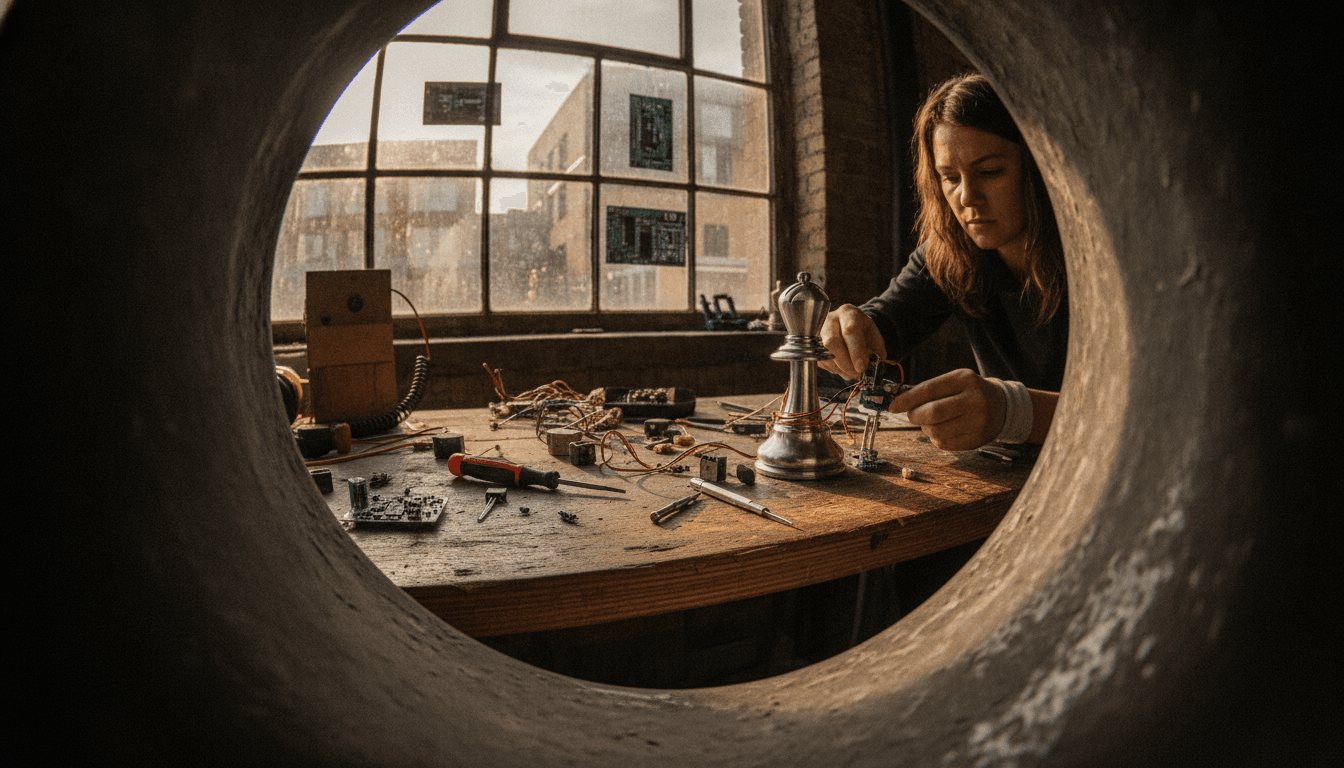
Tiny robot chess pieces are revolutionizing the traditional board game experience, moving beyond conventional self-playing boards to introduce individual, autonomous pieces. Historically, automated chess boards have relied on internal electromagnets or external robotic arms to manipulate standard pieces, a practical choice that minimizes complexity. However, a groundbreaking project by 3DprintedLife reimagines this paradigm, allowing each chess piece to move independently as a miniature robot. This open-hardware and open-source initiative, dubbed ‘MiniBot,’ offers a compelling alternative to commercial offerings like the Chessnut Move, with a design generic enough for broader applications beyond just chess.
The Engineering Behind Autonomous Chess Pieces
The MiniBots are sophisticated marvels of miniature engineering. Each individual piece is built around a custom-designed PCB featuring an ESP32-C3 module, a powerful single-core microcontroller. For locomotion, two PMO8-2 miniature stepper motors, complete with their requisite drivers, provide precise movement. A magnetometer is integrated to assist with localization, and power is supplied by a compact 170 mAh LiPo battery. Communication between the swarm of MiniBots and a central hub is facilitated via ESP-NOW, with each MiniBot operating on its own dedicated channel, ensuring efficient and reliable data exchange.
“The concept of each chess piece being its own tiny robot fundamentally changes how we interact with automated board games, offering a new level of immersion and technological sophistication.”
The central hub, the brain of this robotic chess system, also leverages an ESP32-C3 for its wireless interface. However, the heavy lifting of processing and game logic is offloaded to a Raspberry Pi Single Board Computer (SBC) via a serial link, running Python-based software. Localizing these autonomous tiny robot chess pieces on the board is achieved through an ingenious method: electromagnets embedded within the board scan for the individual magnetometers on each MiniBot, triangulating their precise positions. While an early prototype successfully demonstrated basic functionality, the ESP32-C3’s single-core nature initially presented firmware challenges. Future updates promise optimizations, including improved power saving features and streamlined recharging capabilities for these innovative pieces.
Open Source Innovation in Robotics
What truly sets the MiniBot project apart is its commitment to open hardware and open source principles. This philosophy not only democratizes access to cutting-edge robotics but also fosters a community of innovators who can build upon and adapt the design for various purposes. Unlike proprietary commercial solutions, the MiniBot’s generic design makes it a versatile platform for other applications requiring precise, autonomous miniature movement. This approach accelerates development and encourages creative problem-solving within the robotics community, potentially leading to future breakthroughs in swarm robotics and interactive gaming.
The advancement of tiny robot chess pieces represents a significant leap in the realm of automated board games and miniature robotics. By allowing each piece to function as an independent, intelligent agent, 3DprintedLife has opened new avenues for interactive play and technological exploration. This project not only enhances the chess experience but also provides a robust, open-source framework for future innovations in autonomous systems. As these technologies mature, we can anticipate even more sophisticated and engaging applications that blur the lines between traditional games and advanced robotics.