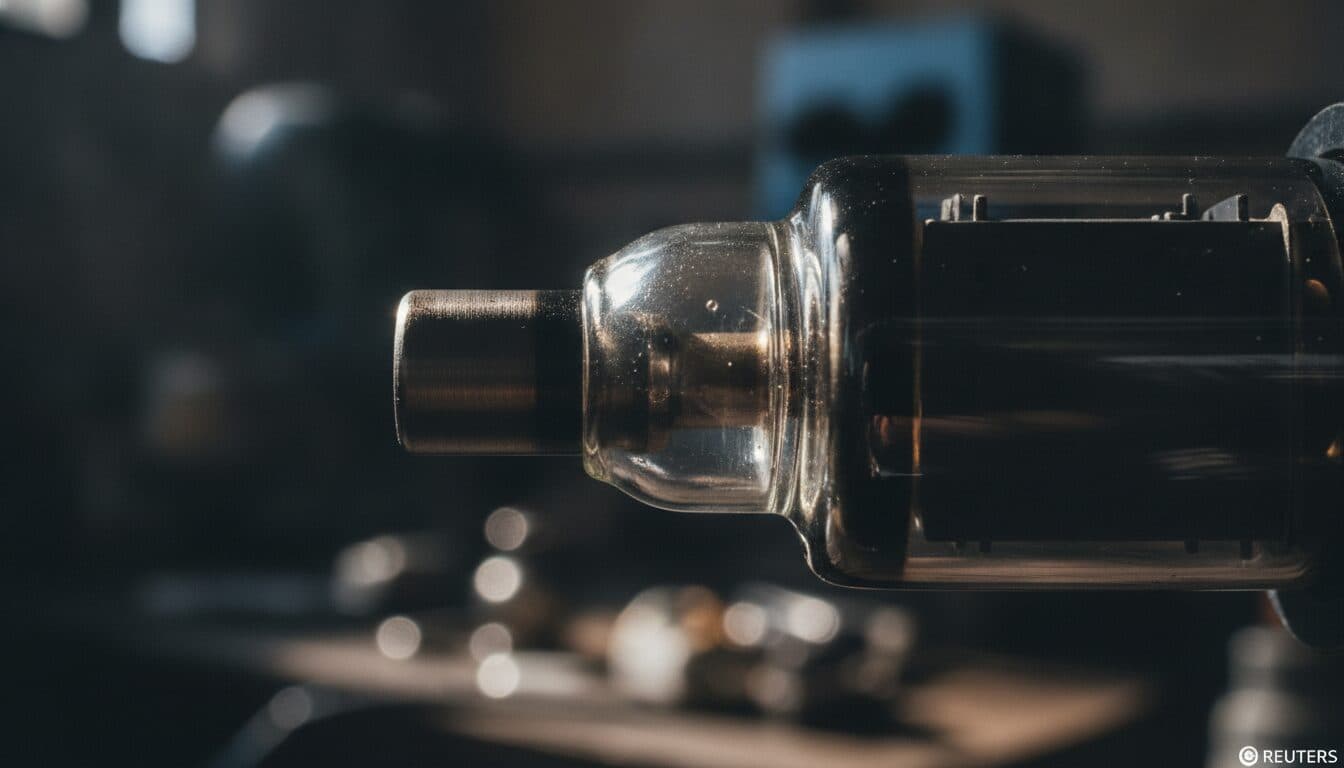
Orbital drug manufacturing is taking a significant leap forward as Varda Space Industries, a pioneering startup, announces a landmark partnership with pharmaceutical giant United Therapeutics. This collaboration marks a pivotal moment, transitioning the ambitious concept of in-orbit production from government-backed experiments on the International Space Station to a tangible commercial pathway for novel drug development.
Pioneering Commercial Orbital Drug Manufacturing
For years, the scientific community has theorized about the unique properties chemical mixtures exhibit in microgravity. Without the constraints of Earth’s gravitational pull, phenomena like water’s spherical adhesion due to surface tension hint at the potential for entirely new atomic arrangements in crystallized compounds. Varda Space Industries, based in El Segundo, California, is now leveraging this principle, offering drug companies a repeatable method to produce novel molecules in space.
Michael Reilly, Varda’s chief strategy officer, emphasizes the significance, stating,
“This is the first commercial path to products made in space.”
The immediate goal of this partnership is to launch versions of United Therapeutics’ drugs into orbit, allowing them to form solid crystals under weightless conditions. The hope is that these space-grown crystals will exhibit atomic structures not achievable on Earth, potentially leading to drugs with enhanced stability, efficacy, or other valuable properties.
United Therapeutics, led by CEO Martine Rothblatt, a visionary known for her work in telecommunications satellites and a multibillion-dollar health franchise, sees space as the next frontier for pharmaceutical innovation. Rothblatt, whose company has developed successful treatments for pulmonary arterial hypertension and is exploring xenotransplantation, believes orbital conditions could yield “even more amazing” versions of existing drugs.
The Economics and Logistics of Space-Based Pharma
Pharmaceutical companies routinely extend the life of blockbuster drugs by developing improved versions or reformulating them, securing additional patent protection. This often involves collaborating with specialist companies like Halozyme and MannKind. Varda aims to disrupt this model by offering space excursions as an alternative to traditional reformulation methods like nebulizers or nanoparticles. Founded in 2021 by Delian Asparouhov and former SpaceX engineer Will Bruey, Varda’s business model hinges on the decreasing cost and increasing frequency of rocket launches.
The company procures rides from SpaceX, which now launches reusable Falcon 9 rockets every few days. These rockets transport Varda’s small satellites, each equipped with a boulder-sized capsule designed for experiments. After processing in orbit, these capsules detach and return to Earth, landing in the Australian outback. This capability has also attracted interest from the US military, which pays Varda to conduct research relevant to hypersonic missile technology, showcasing the dual-use nature of their space technology. Varda’s unique blend of hypersonic engineers and pharmaceutical chemists under one roof underscores its innovative approach to space manufacturing.
Unlocking New Drug Polymorphs in Microgravity
The primary objective of the Varda-United Therapeutics collaboration is to identify new crystal forms, or polymorphs, of United’s drugs. While the specific drugs and financial terms remain undisclosed, Rothblatt confirmed that United is funding Varda to explore how microgravity influences crystallization.
“One has to do the experiment to find out if that is so. The first part of the experiment is to see what polymorphs of these molecules can be made without the influence of gravity,”
she explained, emphasizing the empirical nature of the endeavor.
There is compelling evidence that crystals form differently in space. A 2017 experiment by Merck on the International Space Station showed its cancer immunotherapy drug Keytruda forming uniform crystals in space, unlike the two distinct sizes observed on Earth. While that specific discovery didn’t directly lead to Merck’s injectable Keytruda, it demonstrated the potential for space-based insights to inform drug formulation. Reilly acknowledges the historical gap between orbital discoveries and commercial products, stating, “We’ve been learning from space for years, but I can’t name anything manufactured in space, brought down to Earth, and sold. So that is a first—or it will be a first.” Varda anticipates launching United Therapeutics’ drugs into orbit early next year, potentially ushering in a new era of related Industries news and pharmaceutical innovation.
The economic viability of space manufacturing has long been debated, with the high cost of launching payloads into orbit being a significant barrier. However, drugs present a unique exception due to their high value-to-weight ratio. A single kilogram of a drug like Ozempic, for instance, can command over $100 million at retail. This economic reality makes pharmaceuticals one of the few industries where the astronomical costs of space access could be justified, paving the way for a future where medicines are routinely developed and perhaps even manufactured beyond Earth’s atmosphere.